

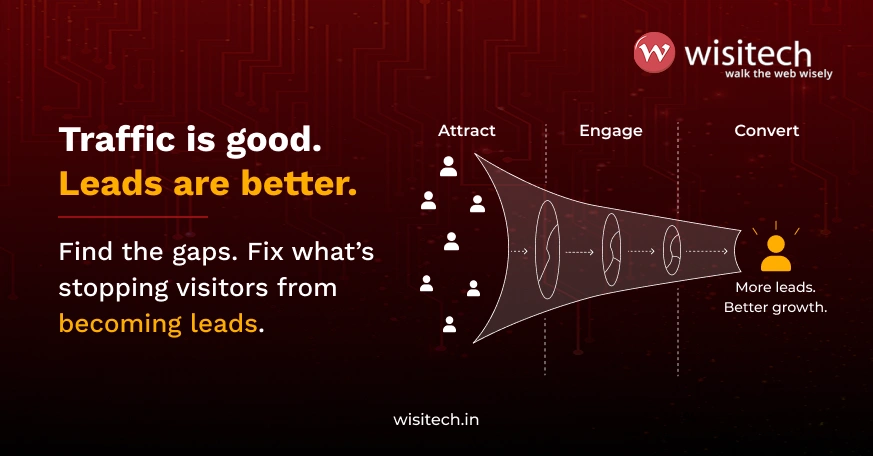
You open Google Analytics and the numbers look decent. Sessions are up. Organic traffic is growing. You ran ads last month and clicks came in. But the inquiries are not matching the traffic. The phone is not ringing the way it should. The contact form submissions are a trickle. If you’re wondering why your website gets traffic but no leads, the problem is almost never the volume of visitors. It is what happens after they arrive on your website. This post walks through the ten most common reasons Indian business websites fail to convert traffic into leads, with specific fixes for each, so you can diagnose exactly where your site is leaking before you spend another rupee on ads or SEO.
Prefer watching instead?
Watch this breakdown before diving into the complete diagnostic.
The 10-point diagnostic: Why your website gets traffic but no leads
Understanding why your website gets traffic but no leads starts with identifying where visitors drop off before they become enquiries.
Before diving into each point, a quick benchmark. Website conversion rates in India vary by industry: B2B websites typically convert at 1.5 to 3%, D2C ecommerce at 1 to 2%, and service businesses at 2 to 4%. SaaS sign-ups can reach 3 to 7% with optimized flows. If you are below 1% with meaningful traffic, you have a leak worth fixing urgently. If you are between 1 and 2% but know your product or service has strong demand, incremental fixes can double your lead volume without spending more on traffic.
Run through this list in order. Most Indian business websites have at least three of these problems simultaneously.
1. You are attracting the wrong traffic
One of the biggest reasons why your website gets traffic but no leads is poor traffic quality. This is the most common cause and the one most owners miss because traffic volume feels like progress. High traffic with no leads often means your content or ads are pulling in visitors who were never going to enquire. A manufacturer ranking for informational blog content about their industry will see thousands of sessions from researchers, students, and competitors, none of whom will convert. A D2C brand driving paid traffic to a generic homepage instead of a product-specific landing page is paying for bounces.
The fix: Audit your traffic sources in GA4. Check which pages get the most sessions and what keywords or campaigns are driving them. If your top-traffic pages have no commercial intent, they are an SEO vanity metric, not a business asset. Custom SEO services built around commercial-intent keyword targeting, not just traffic volume, is what separates rankings that convert from rankings that do not.
2. Your page speed is driving visitors away before they read anything
In India, where a significant portion of mobile users are on 4G connections with real-world speeds of 10 to 20 Mbps, a page that takes more than 3 seconds to load loses a large share of visitors before they see your offer. Google’s data shows that as page load time goes from 1 second to 3 seconds, the probability of bounce increases by 32%. From 1 second to 5 seconds, it jumps to 90%. This is not a technical detail. It is a direct tax on every rupee you spend driving traffic.
The fix: Run your site through Google PageSpeed Insights and check your Core Web Vitals scores, specifically LCP (Largest Contentful Paint), INP (Interaction to Next Paint), and CLS (Cumulative Layout Shift). If your LCP is above 2.5 seconds on mobile, this is likely one of your top conversion killers. Technical SEO services that address Core Web Vitals directly, rather than treating them as a secondary concern, are often the fastest path to conversion improvement for sites with decent traffic.
3. Your value proposition is not clear in the first 5 seconds
A visitor lands on your homepage or landing page. What do they understand about what you do, who you do it for, and why they should choose you, within the first scroll? Most Indian business websites fail this test completely. Homepages that open with a hero banner saying ‘Welcome to [Company Name]’ or ‘Your Trusted Partner for Growth’ communicate nothing. The visitor has to work to understand the offer, and most will not bother.
The fix: Your above-the-fold content must answer three questions immediately: what you do, who it is for, and what the visitor should do next. Test this by showing your homepage to someone who has never heard of your business and asking them to describe what you do after 5 seconds. Their answer will tell you everything you need to know.
4. Your calls to action are buried, vague, or missing
A website not converting visitors into leads almost always has a CTA problem. Either the primary action is below the fold and most visitors never reach it, or it says something generic like ‘Contact Us’ or ‘Learn More’ that communicates no urgency and no benefit. Research consistently shows that specific CTAs outperform generic ones significantly. ‘Get a free website audit’ converts better than ‘Contact Us’. ‘Talk to a developer’ converts better than ‘Get in touch’.
The fix: Every key page needs a primary CTA visible without scrolling. The CTA copy should state what happens next and why it is worth clicking. Secondary CTAs lower on the page can offer a softer commitment (a download, a case study, a pricing guide). Call to action best practices in the Indian market also include making phone numbers and WhatsApp links equally prominent, especially on mobile, where many users prefer not to fill forms.
5. Your forms are too long or too complicated
Lead forms with more than four fields lose roughly 50% more leads than three-field forms, according to HubSpot and Marketo data. Indian buyers filling forms on mobile are particularly sensitive to friction. Asking for company name, designation, industry, budget range, project timeline, and GST number in the first contact form is asking for too much from someone who is still evaluating whether they trust you.
The fix: Reduce your primary contact form to three fields maximum: name, phone or email, and a brief message or dropdown for enquiry type. You can collect additional information after the first contact is established. If you need a longer form for a specific reason such as a project brief, offer it as a secondary option and make the short form the default.
6. You have no WhatsApp option and your mobile experience is poor
India is a mobile-first market. Over 75% of Indian website traffic comes from mobile devices, but mobile conversion rates are typically 30 to 50% lower than desktop without deliberate optimization. The most India-specific fix on this list: add a WhatsApp CTA. Research and practitioner data consistently show that WhatsApp CTAs on mobile convert 3 to 5 times better than traditional lead forms for Indian buyers. The reason is simple. Typing into a form on a phone feels like work. Opening a WhatsApp chat feels like talking to a person.
The fix: Add a floating WhatsApp button to your mobile site that pre-fills a message like ‘Hi, I want to know more about [your service]’. Ensure your mobile pages load under 3 seconds, your CTA buttons are thumb-sized and well-spaced, and your forms do not require pinch-zoom to fill. Test your site on a mid-range Android phone, not a laptop or an iPhone, because that is what most of your visitors are using.
7. You are missing trust signals that Indian buyers specifically look for
Trust is a bigger conversion barrier for Indian buyers than for many other markets, particularly for first-time visitors from organic search or paid ads who have no prior relationship with your brand. Generic trust signals like ’10 years of experience’ do not move the needle as much as specific, verifiable ones.
Trust signals that work particularly well on Indian business websites: client logos with recognizable Indian brands, case studies with named clients and specific outcomes, GST registration displayed visibly (it signals a legitimate business), founder or team photos with names (not stock photography), Clutch or GoodFirms review scores, and Google Business Profile rating displayed on-site. If you run Google Ads, showing a lead generation website with a high review count in the ad extension significantly improves click-through rates and post-click trust.
8. Your landing pages are not matched to your traffic source
A landing page not converting is often a message-match problem, not a design problem. If your Google Ad says ‘Custom WordPress websites from 50,000’ and the landing page it links to is your generic homepage with no mention of WordPress or pricing, the visitor arrives and immediately wonders if they clicked the right thing. Every paid traffic source, every campaign, and every key organic keyword should ideally land on a page where the headline mirrors the intent of the click.
The fix: Audit your top traffic sources and check whether the landing page copy matches the promise or intent of the source. For Google Ads, each ad group should have a dedicated landing page. For organic traffic, the page that ranks for a keyword should answer that specific keyword’s intent directly and have a relevant CTA, not a generic ‘contact us for anything’ form.
9. Your site is technically broken in ways you are not aware of
Broken contact forms are more common than most business owners realize. A form that looks fine in Chrome on a MacBook may fail silently on a Samsung Galaxy mid-range phone. Form submission emails that go to spam, broken phone number links on mobile, JavaScript errors that prevent buttons from working, checkout flows that time out on slower connections. These are not hypothetical edge cases. They are real issues that silently kill conversions on Indian business websites every day.
The fix: Test every conversion path on your website on at least three different devices, specifically a mid-range Android phone, an iPhone, and a desktop browser. Submit a test enquiry through every form and verify the submission arrives correctly. Check your spam folder. If you have had a developer make changes to the site recently without proper QA, treat a technical audit as urgent. A website development company with proper QA processes will catch these issues before launch. A freelancer who tests only on their own machine often does not.
10. You are not following up with leads fast enough
This is not a website problem, but it shows up as a conversion problem in your analytics. A visitor fills a form, gets no response for 24 to 48 hours, and goes to a competitor. The enquiry registered as a lead, but it never converted to a sale because the follow-up was too slow. Research by the Harvard Business Review found that companies that respond to leads within an hour are seven times more likely to qualify the lead than those that wait longer.
The fix: Set up automated acknowledgement emails or WhatsApp messages the moment a form is submitted. Ensure someone is notified immediately on submission, not just when they check their email. If you are using a CRM, set up a follow-up sequence that kicks off automatically on form submission. The website can only get you the lead. What you do in the first hour determines whether it converts.
Indian website conversion rate benchmarks (2026)
Use this to gauge where your site stands. If you are below the typical range for your industry, you have a website conversion rate optimization problem worth prioritizing above additional traffic spend.
| Industry / site type | Typical conversion rate | Top performers | Primary fix if below range |
|---|---|---|---|
| B2B services and consulting | 1.5% – 3% | 4% – 6% | Value proposition clarity, trust signals |
| D2C ecommerce | 1% – 2% | 3% – 4% | Mobile UX, checkout friction, WhatsApp |
| SaaS sign-ups | 3% – 7% | 8% – 12% | Onboarding friction, CTA specificity |
| Real estate and property | 2% – 4% | 5% – 7% | WhatsApp CTA, fast follow-up |
| Education and edtech | 2% – 5% | 6% – 8% | Social proof, fee transparency |
| Manufacturing and export | 0.5% – 1.5% | 2% – 3% | Product specificity, inquiry form simplification |
| Professional services | 2% – 5% | 6% – 8% | Trust signals, CTA above fold |
Figures are indicative benchmarks based on industry data and practitioner observations as of 2026. Actual conversion rates vary by traffic quality, offer, pricing, and audience. Use as directional reference, not guaranteed targets.
Fix priority matrix: where to start
Not every fix deserves equal urgency. Run through this priority framework before you decide where to spend time and budget.
| Fix | Effort | Typical conversion lift | Priority |
|---|---|---|---|
| Add WhatsApp CTA on mobile | Low (1-2 hours) | 30% – 80% on mobile | Do this week |
| Shorten contact form to 3 fields | Low (1-2 hours) | 15% – 30% | Do this week |
| Add specific CTA above fold | Low (2-4 hours) | 10% – 20% | Do this week |
| Fix broken forms and mobile errors | Medium (1-3 days) | Variable, potentially very high | This month |
| Improve page speed / Core Web Vitals | Medium (3-7 days) | 10% – 40% | This month |
| Add trust signals (reviews, logos, GST) | Low (half day) | 10% – 25% | This month |
| Rewrite value proposition copy | Medium (2-5 days) | 15% – 35% | Next sprint |
| Build dedicated landing pages per campaign | High (1-3 weeks) | 20% – 50% | Next sprint |
| Fix traffic quality with targeted SEO | High (ongoing) | Compound over 3-12 months | Strategic |
If you’re still trying to understand why your website gets traffic but no leads, start with the high-priority fixes before investing more in SEO or paid advertising.
WhatsApp vs lead form: what actually converts in India
This comparison is unique to the Indian market and worth its own section because most global CRO advice ignores it entirely.
| Factor | Lead form | WhatsApp CTA |
|---|---|---|
| Mobile friction | High (typing, field navigation) | Low (one tap, familiar interface) |
| Response expectation | Hours to days | Minutes (buyer expects immediate reply) |
| Lead quality | Filtered by form effort | Mixed, requires qualification |
| Best for | Desktop, high-consideration B2B | Mobile, D2C, local services, real estate |
| Conversion rate vs form | Baseline | 3 to 5x higher on mobile |
The verdict: use both. Keep the lead form for desktop and for buyers who prefer email communication. Add a prominent WhatsApp button for mobile visitors. Pre-fill the WhatsApp message with your service name so the conversation starts with context. If you add only one thing to your site this week, make it a WhatsApp CTA on mobile.
The 60-minute website lead audit
Run this yourself before hiring anyone. It takes an hour and will show you the top three fixes your site needs. This audit is designed to help you pinpoint why your website gets traffic but no leads in less than an hour.
- Check your top 10 traffic pages in GA4. Are these pages with commercial intent, or informational content? If most traffic goes to blog posts that answer general questions, your SEO is driving awareness, not conversions.
- Run Google PageSpeed Insights on your homepage and top landing page. Check mobile LCP. If it is above 3 seconds, page speed is a conversion killer.
- Submit a test enquiry through every form on your site. Time how long it takes to receive the confirmation email. Check your spam folder.
- Open your site on a mid-range Android phone. Can you find the CTA without scrolling? Can you tap the phone number directly? Is there a WhatsApp option?
- Check your bounce rate by traffic source in GA4. High bounce rate from paid traffic specifically means a landing page mismatch problem.
- Ask someone outside your business to describe your offer from your homepage in 5 seconds. Their answer reveals your value proposition clarity problem.
- Check your Google Business Profile for reviews and response rate. For local businesses, GBP is often the first trust signal a visitor checks before submitting a form.
Is it a traffic problem or a conversion problem?
Before applying any of the fixes above, confirm which problem you actually have. The symptoms overlap and the wrong diagnosis leads to wasted spend.
| Signal | Traffic problem | Conversion problem |
|---|---|---|
| Overall sessions | Low or declining | Reasonable or growing |
| Bounce rate | Variable | High on pages with CTAs |
| Time on site | Very low (under 30 seconds) | Moderate but no enquiry |
| Top keywords driving traffic | Branded or irrelevant | Mix of commercial and informational |
| Paid traffic behaviour | Very high bounce, immediate exit | Engages but does not convert |
| Fix direction | SEO strategy and content targeting | On-page UX, CTA, form, trust signals |
Many Indian business websites have both problems simultaneously. The traffic is partly wrong-intent, and the pages that do get commercial traffic are poorly optimized for conversion. In this case, fix the conversion layer first. Getting more wrong traffic faster is not the answer. If you’re wondering why your website gets traffic but no leads, the reason is often not a single issue. In many cases, it is a combination of poor traffic quality and ineffective on-page conversion. Once conversion improves, invest in growing the right traffic through custom SEO services targeted at commercial-intent queries.
Ready to stop guessing why your website is not converting?
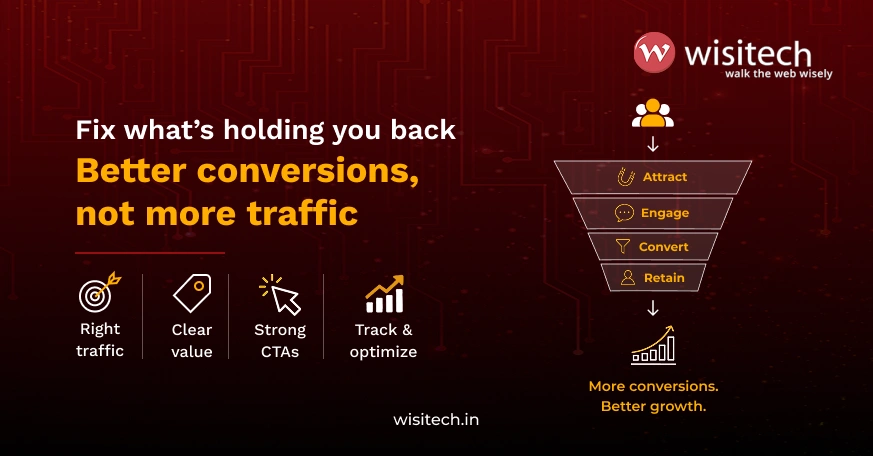
If you have gone through this diagnostic and the root cause points to a website that is slow, technically broken, or structurally incapable of converting, no amount of CTA tweaking will solve it. Sometimes the fix is not optimization. It is a rebuild done right. Wisitech is a website development company with 27 years of experience and 2,500+ projects delivered across ecommerce, B2B, and enterprise verticals. Our custom website development is built around performance from the ground up: Core Web Vitals compliance, mobile-first architecture, structured lead capture flows, and clean code that does not break every time you update a plugin.
For businesses where the traffic quality itself is the problem, our professional SEO services are built around commercial-intent keyword targeting, technical SEO, and content that converts, not just content that ranks. We use AI to accelerate research and content structuring, with human strategy and editorial judgment driving everything we produce.
strategy and editorial judgment driving everything we produce.
If you’re still wondering why your website gets traffic but no leads, talk to us. We will look at your site honestly and tell you whether the fix is a development problem, an SEO problem, or both.
27 years. 2,500+ projects. Fortune 500 experience. Creativity leads, AI amplifies.