

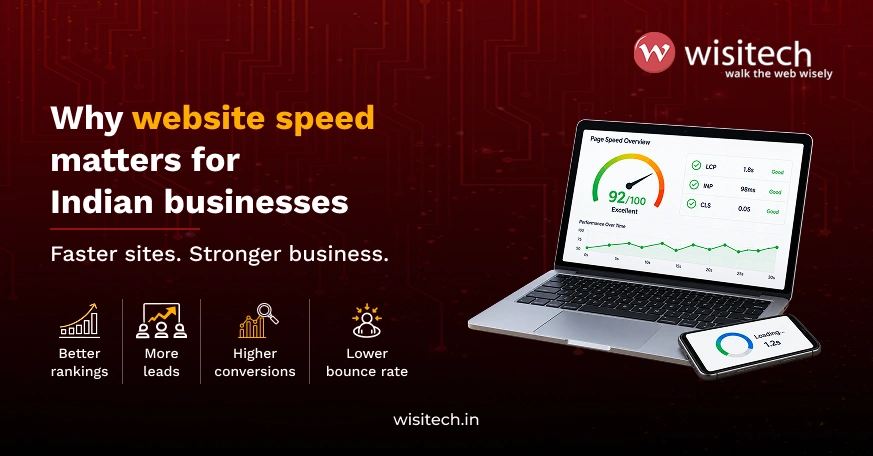
A slow website rarely fails all at once. Most of the time, the damage happens quietly.
A visitor clicks your ad but leaves before the homepage loads. A product page takes too long to appear on mobile data. A potential lead opens your website in a Tier-2 city and exits before the contact form becomes usable. Over time, these small moments turn into lost rankings, fewer inquiries, weaker conversions, and declining trust.
This is why website speed optimization has become a business priority rather than just a technical improvement.
For Indian businesses, website performance carries even more weight because users browse across varying network conditions, device quality, and regional internet infrastructure. A website that performs well in Mumbai may feel frustratingly slow in smaller cities where users rely heavily on mobile networks. Businesses that ignore performance optimization often discover that marketing campaigns, SEO efforts, and paid advertising generate weaker results simply because the website experience cannot keep up.
What is website speed optimization?
Website speed optimization is the process of improving how quickly a website loads, responds, and performs across devices and internet conditions. It includes optimizing images, reducing unnecessary scripts, improving hosting infrastructure, refining code quality, and enhancing overall page experience.
For Indian businesses, optimization also involves improving mobile responsiveness, handling payment gateway scripts efficiently, and ensuring websites remain accessible even under inconsistent network conditions.
A fast website does not just improve user experience. It improves discoverability, engagement, and business outcomes.
Why speed matters more in India than many businesses realize
Indian internet usage is heavily mobile-driven. Users browse websites while commuting, shopping, comparing products, or researching services on smartphones. That creates a very different performance environment compared to desktop-first markets.
Many Indian business websites still rely on overloaded WordPress themes, low-cost hosting, excessive plugins, and unoptimized media files. These technical shortcuts may reduce upfront costs, but they often create long-term performance issues.
The consequences become visible quickly:
- Higher bounce rates
- Lower search visibility
- Reduced lead generation
- Poor ecommerce conversions
- Lower customer trust
For ecommerce brands, even a slight delay during checkout can reduce completed purchases. For service-based businesses, a slow contact page can directly affect inquiries and consultations.
Website speed is no longer a backend issue handled quietly by developers. It now shapes how users judge the credibility and professionalism of a business.
How Google uses speed as a ranking signal
Google has repeatedly emphasized page experience and performance as ranking considerations, especially for mobile search results. Faster websites are easier to crawl, easier to navigate, and more likely to keep users engaged.
This is where core web vitals optimization services have become increasingly important.
Core Web Vitals measure real-world user experience across three major areas:
| Metric | What It Measures | Recommended Target |
| LCP (Largest Contentful Paint) | Main content loading speed | Under 2.5 seconds |
| INP (Interaction to Next Paint) | Responsiveness after interaction | Under 200ms |
| CLS (Cumulative Layout Shift) | Visual stability during loading | Under 0.1 |
These metrics are not just technical benchmarks. They directly influence how users experience a website.
If a page shifts unexpectedly while loading, users become frustrated. If buttons respond slowly, engagement drops. If content takes too long to appear, visitors leave before interacting.
That user behavior eventually affects rankings.
Slow websites quietly reduce leads and conversions
Many businesses assume poor conversions are caused by weak marketing or ineffective messaging. In reality, website speed often plays a major hidden role.
Imagine a user clicking a Google search result for a service provider. If the page takes several seconds to load, the visitor may abandon the website before even reading the offer. The business loses a lead without ever realizing why.
The same pattern affects ecommerce stores. Product pages that load slowly reduce browsing time and increase cart abandonment. This becomes especially problematic during festive sales periods when traffic spikes.
For SaaS businesses, poor performance can affect demo bookings, free trial signups, and onboarding engagement.
This is why many businesses are now investing in professional website speed optimization services instead of treating speed issues as occasional technical maintenance.
The most common reasons Indian business websites become slow
Most performance problems are not caused by one major issue. They usually come from multiple smaller inefficiencies accumulating over time.
Heavy images and videos
Large media files remain one of the biggest reasons websites load slowly on mobile networks.
Low-quality hosting
Cheap shared hosting often struggles during traffic spikes, causing delayed response times.
Too many third-party scripts
WhatsApp widgets, chat tools, analytics scripts, payment gateways, and marketing plugins can significantly affect performance.
Poor frontend optimization
Unoptimized CSS, JavaScript, and bloated themes increase rendering time.
Weak caching systems
Without proper caching, browsers repeatedly reload the same resources unnecessarily.
Unoptimized mobile experiences
Many websites still prioritize desktop layouts while Indian audiences primarily browse on mobile devices.
India-specific performance challenges businesses often overlook
Global optimization guides rarely address the realities of Indian browsing behavior.
For example, payment gateways such as Razorpay and PayU often introduce additional scripts that affect loading performance. Multilingual websites using Hindi, Tamil, or Telugu fonts may also face rendering delays if optimization is handled poorly.
Even WhatsApp integrations, which are extremely common for Indian businesses, can increase loading time if implemented inefficiently.
Businesses targeting Tier-2 and Tier-3 cities must think beyond metro-city internet speeds. A visually heavy website that works well on high-speed broadband may perform poorly for users on standard mobile data connections.
That is why optimization strategies must align with Indian user behavior instead of relying entirely on global performance templates.
How businesses can improve website performance
Improving speed requires a combination of technical optimization and strategic planning.
Businesses should focus on:
- Compressing and resizing images properly
- Reducing unnecessary plugins and scripts
- Using scalable hosting infrastructure
- Implementing browser caching
- Optimizing mobile-first layouts
- Using CDN services for faster delivery
- Improving backend efficiency and database queries
This is where experienced providers offering website speed optimization services create long-term value. Performance optimization is not just about making pages load faster today. It is about building infrastructure that supports future traffic growth, better SEO performance, and smoother customer experiences.
Why fast websites create stronger business outcomes

Businesses often think about speed only after performance problems become severe. The smarter approach is to treat performance as part of growth strategy from the beginning.
Fast websites generally experience:
- Better user engagement
- Lower bounce rates
- Stronger SEO visibility
- Higher lead conversion rates
- Better ecommerce performance
- Improved customer trust
In highly competitive industries, those improvements create measurable business advantages over slower competitors.
For Indian businesses investing in digital growth, performance is no longer optional. It influences how customers discover, experience, and evaluate a brand online.
Conclusion
A slow website does not simply frustrate visitors. It weakens marketing performance, reduces lead generation, affects search rankings, and damages customer confidence.
That is why website speed optimization has become one of the most important investments for Indian businesses building long-term digital growth.
Whether you operate an ecommerce store, SaaS platform, enterprise portal, or service-based website, improving performance directly improves user experience and business outcomes.
Professional services help businesses identify technical bottlenecks, improve Core Web Vitals, and build faster digital experiences aligned with modern user expectations.
At Wisitech, we help Indian businesses improve website performance with tailored website speed optimization services. Book a free consultation today to learn how faster websites can improve rankings, leads, and conversions.”