

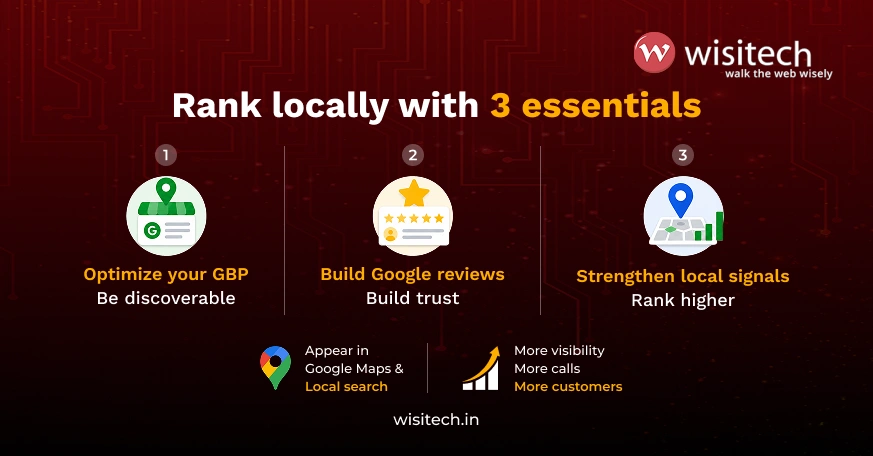
Open Google right now and type the name of what your business does, followed by your city. The businesses that appear in the top three results are not necessarily the best. They are the best optimized. That difference is the entire subject of this guide.
Local SEO for Indian businesses is not a technical niche for digital marketing agencies. It is the single most direct path between a potential customer in your area and your phone ringing. 46% of all Google searches have local intent. 76% of people who search for a local business on mobile visit that business within 24 hours. Every day your business does not appear in those results is a day your competitor does.
Local SEO for Indian businesses is no longer optional for brands that depend on nearby customers. It is one of the fastest ways to improve visibility, enquiries, and in-store visits without increasing advertising spend.
What is local SEO and why does it matter more in India?
Local SEO for Indian businesses is the practice of making your business visible when nearby customers search for what you offer. Not just on Google Search, but in Google Maps, the local three-pack that appears before organic results, and Google’s AI Overviews for local queries. It covers your Google Business Profile, your presence on Indian directories like Justdial and Sulekha, your website’s local content, and the reviews and citations that tell Google your business is real, active, and relevant.
The difference between local SEO and regular SEO is intent. When someone searches ‘dentist near me’ at 7pm, they are not researching dentistry. They need an appointment. The businesses that appear at that moment get the call. The ones that do not, do not. That is exactly what local SEO services are built to solve: making sure your business is the one that appears.
In India, where mobile accounts for over 80% of internet usage and voice searches in Hindi, Tamil, Telugu, and Bengali are accelerating, local search is not a niche digital marketing tactic. It is where the majority of commercial transactions begin.
How Local SEO for Indian businesses works
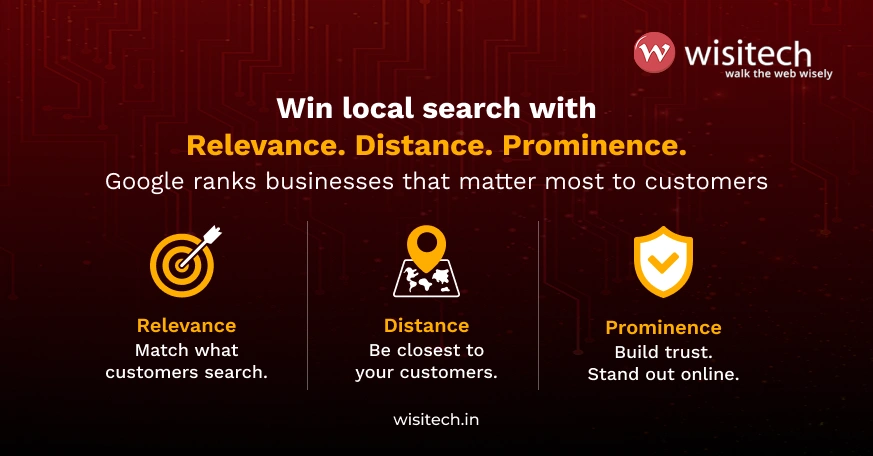
Understanding local search ranking factors in India is the foundation of everything else. Google uses three primary signals to decide which businesses appear in the local pack and Google Maps results:
Relevance
How well does your business match what the person is searching for? Google looks at your Google Business Profile categories, your business description, the keywords on your website, and the services you have listed. A plumber listed under ‘Home Services’ with no specific services listed will lose to a plumber who has listed ‘Pipe Repair’, ‘Bathroom Fitting’, and ‘Water Tank Cleaning’ as individual services.
Distance
How close is your business to the searcher or to the location they specified? Distance is partly outside your control, but your GBP service area settings, your website’s local content, and hyperlocal keyword targeting (colony, sector, ward, pin code) all influence which searches Google considers you relevant for.
Prominence
How well-known and trusted is your business online? Prominence is the factor most Indian businesses underinvest in, and the one most susceptible to deliberate effort. A clinic with 200 Google reviews, listings on Practo, Justdial, and the local hospital association directory will consistently outrank a clinic with 12 reviews and a Google Business Profile that was set up three years ago and never updated. The second clinic might be the better practice. Google does not know that. Google Maps ranking in India rewards the business that has built the most verifiable online evidence of being a real, active, and trusted local presence. Building prominence systematically is what professional local SEO services do that most business owners cannot replicate alone, because it requires consistent work across reviews, citations, and link acquisition over months, not a one-time setup.
Step 1: Set up and optimize your Google Business Profile
Your Google Business Profile India (formerly Google My Business, still often called GMB) is the most important single asset in local search. It is what appears in the three-pack, on Google Maps, and in the knowledge panel. Most Indian businesses have one. Almost none have it fully optimized. The difference between a basic listing and a properly built one can mean the difference between appearing third in your local pack and not appearing at all.
The 10 elements of a fully optimized GBP
- Business name. Use your exact legal or trading name. Do not stuff keywords into the name field. Google penalizes this and can suspend your listing.
- Primary and secondary categories. Your primary category is the most critical GBP ranking signal after proximity. Choose the most specific category available. Add secondary categories for additional services. A multi-specialty clinic should not list only ‘Medical Clinic’, it should add ‘Dermatologist’, ‘Orthopedic Surgeon’, and any other relevant specialties.
- Business description. Write 750 characters that describe what you do, who you serve, and what makes your business worth choosing. Include your primary service and city name naturally.
- Services and products. Add every service you offer with a name and description. This is where your keyword coverage expands. A lawyer who lists ‘Property Dispute’, ‘Divorce Proceedings’, ‘Consumer Forum Cases’, and ‘Cheque Bounce’ as individual services will appear for all of them.
- Photos. Businesses with more than 100 photos on GBP get 520% more calls and 2,717% more direction requests than those with fewer, according to Google’s own data. Add interior, exterior, team, product, and service photos. Update regularly.
- Hours. Keep your hours accurate, including holiday hours. Incorrect hours are one of the fastest ways to lose customer trust and hurt your ranking.
- Phone number and website link. Use your local phone number, not a toll-free number. Link to a specific location page on your website, not just the homepage.
- GBP posts. Post updates, offers, events, and news directly on your GBP at least once a week. Posts signal active management and appear directly in local search results.
- Q&A section. Seed your own questions and answers on your GBP. Common questions about your services, pricing, and location help potential customers and signal content depth to Google.
- Messaging. Enable the messaging feature. Indian customers increasingly prefer WhatsApp and direct message over phone calls for initial inquiries. A business that responds to GBP messages promptly signals engagement to Google.
Step 2: NAP consistency across Indian directories
NAP consistency is one of the strongest ranking signals in Local SEO for Indian businesses because it helps Google verify that your business information is accurate across the web.Not approximately identical. Exactly identical. ‘Pvt Ltd’ vs ‘Private Limited’. ‘011-‘ vs ‘+91-11-‘. Flat 4 vs Flat No. 4. Google cross-references your listings across directories to verify your business is real. Every inconsistency weakens that signal. Enough inconsistencies and Google starts to doubt whether your address information is trustworthy at all.
The most common NAP inconsistency in Indian businesses: the address on the GBP does not exactly match the address on the website footer. Usually because the GBP was set up by one person and the website was updated by someone else, six months later. Check both right now before reading further.
High-priority Indian directories for local citations
| Directory | Category strength | Free/Paid | Priority |
|---|---|---|---|
| Justdial | All categories, very strong for local | Free basic, paid for leads | Critical |
| Sulekha | Services, home, professional | Free basic | Critical |
| IndiaMart | B2B, manufacturing, wholesale | Free basic | High for B2B |
| Practo | Healthcare, doctors, clinics | Free basic | Critical for health |
| Zomato / Swiggy | Restaurants, food, cafes | Free listing | Critical for F&B |
| MagicBricks / 99acres | Real estate | Free basic | Critical for real estate |
| Yellow Pages India | General, all categories | Free | Medium |
| Facebook Business | All categories | Free | High |
| Bing Places | All categories | Free | Medium |
| Apple Maps Connect | All categories, iOS users | Free | Medium |
For industry-specific businesses, add vertical directories. Lawyers should be on LawRato and Vakilsearch. Doctors on Practo and Lybrate. Chartered accountants on CAclubindia. Hotels on MakeMyTrip and OYO. These vertical citations signal category relevance as well as NAP consistency. If you are managing this across more than two or three platforms, a local SEO company that handles citation building and NAP audits systematically will save significant time and avoid the inconsistencies that typically appear when citations are built manually.
Step 3: Build Google reviews strategically
Reviews are one of the strongest local search ranking factors in India, and the one most business owners handle wrong. A business with 150 reviews averaging 4.4 will almost always outrank a business with 15 reviews averaging 4.8. This surprises people. More reviews, even with a slightly lower average, beats a perfect score with low volume. Google is measuring trust at scale, not perfection. Volume signals that real customers are actively choosing you. Recency signals that you are still operating. Two reviews from last month matter more than twenty from two years ago.
A strong review strategy is essential for Local SEO for Indian businesses because reviews influence both rankings and customer trust.
How to generate a consistent flow of Google reviews in India
The most effective method in the Indian market is the WhatsApp follow-up. After a service is delivered, send a WhatsApp message to the customer with a direct link to your Google Business Profile India review page. The message takes 10 seconds to send and converts significantly better than email or a verbal request. A simple template: ‘Hi [Name], thank you for visiting [Business Name]. If you are happy with the service, we would be grateful if you could share your experience here: [GBP review link]. It takes less than a minute and helps us a lot.’
What not to do: never offer incentives for reviews, never ask only satisfied customers to review (selective solicitation violates Google policy), and never use review generation services that create fake reviews. Google’s systems detect these patterns and will suppress or suspend your listing. The risk is not worth it when organic review generation works.
How to respond to negative reviews
Every negative review on your Google Business Profile is visible to every future potential customer. Responding publicly, professionally, and promptly matters more than the review content itself. Acknowledge the feedback, apologize for the experience, and offer to resolve it offline. A business that responds thoughtfully to a one-star review often converts more prospects than a business with all five-star reviews and no responses, because it demonstrates that the business is engaged and cares about customers.
Step 4: On-page local SEO for your website
Your GBP and your website work together. Google looks at your website to verify the information on your GBP and to understand what you do and where you do it. Ranking locally in India requires both to be aligned. These are the on-page changes that move the needle.
Effective Local SEO for Indian businesses also depends on aligning your website with your Google Business Profile through location-specific content and structured data.
Location pages
If your business serves multiple areas, create a dedicated page for each. Not a templated page with just the city name swapped in, but a page with genuinely local content: the address and phone number for that location, photos of that specific branch, local customer testimonials, a Google Map embed, and content about the neighborhood or area you serve. A dental chain with 12 clinics needs 12 location pages, each with unique content.
Local keyword targeting on existing pages
Your homepage, service pages, and about page should naturally mention your city, area, and neighborhood. Not forced keyword insertion, but genuine geographical context: where you are located, which areas you serve, and how customers can find you. Include your full address in the footer of every page and implement LocalBusiness schema markup, which tells Google exactly who you are, where you are, and what category you belong to. Local keyword research in India should inform your content with hyperlocal terms: sector names, colony names, landmark references, and pin codes that your actual customers use when searching.
GST registration as a trust signal
This is an India-specific angle no competitor covers. Displaying your GSTIN visibly on your website, typically in the footer or contact page, signals to both Google and potential customers that your business is registered, legitimate, and accountable. For B2B buyers especially, GST invoice capability is a prerequisite. A visible GSTIN also reinforces your NAP data because it ties your business to a specific registered address.
Step 5: Vernacular and voice search optimization for Indian users
Pick up your phone. Open Google. Say ‘mere paas accha dentist kaun sa hai’. Someone near you just did exactly that. Most Indian businesses have zero presence for that query. Not because it is difficult to target, but because no one has bothered. Voice search in India is growing fastest in Hindi, Tamil, Telugu, and Bengali, and the competitive landscape for vernacular local queries is almost entirely empty. The businesses that move on this now will own those results for years.
Voice search is becoming an increasingly important part of Local SEO for Indian businesses, especially in multilingual markets across India.
How to optimize for Hindi and regional language searches
- Add a Hindi or regional language FAQ section to your website if your target customers speak those languages. Voice search pulls directly from FAQ content.
- Use Hinglish (Hindi written in English script) in your GBP description and posts where relevant. ‘Hum [city] mein best [service] provide karte hain’ in your GBP description adds vernacular relevance.
- Include the transliterated versions of your services in your GBP. A caterer who lists ‘Wedding Catering’ should also list the service in a way that matches how Hindi-speaking customers describe it in voice search.
- Add conversational FAQ schema to your website that directly answers the questions voice assistants field. ‘Who is the best doctor in [area]?’ structured as a FAQ answer is exactly the format Google pulls for voice responses.
Step 6: Mobile-first local SEO for India’s smartphone majority
Here is a test. Open your website on a Redmi Note or a Realme device, not your own phone, but the mid-range Android that most of your customers are using. Count the seconds until the page is usable. If you reached five, you lost that customer. Google tracks exactly this behavior. A visitor who clicks your GBP link and immediately hits the back button is a signal that your listing should rank lower. Over 80% of local searches in India happen on mobile. A slow site is not just a user experience problem. It is a rankings problem.
Mobile performance is another critical factor in Local SEO for Indian businesses because most nearby searches now happen on smartphones.
Mobile local search in India requires four things beyond general mobile optimization: a visible click-to-call button above the fold, a WhatsApp contact option alongside the phone number, a page load time under 3 seconds on a 4G connection, and no pop-ups or interstitials that block the content immediately on mobile. Test your site on a Redmi or Realme device, the actual phones your customers use, not on a high-end handset or desktop emulator.
Local SEO for specific Indian industries
Local SEO for Indian businesses differs by industry because the directories, ranking signals, and customer behaviour vary across sectors. Here’s what matters most for each vertical.
Local SEO for restaurants in India
Local SEO for restaurants in India is dominated by Zomato and Swiggy listings alongside Google. Your Zomato profile, photos, menu accuracy, and review rating are as important as your GBP for restaurant discovery. Ensure your menu is updated on all platforms simultaneously. Add food category GBP attributes: outdoor seating, parking, wifi, serves alcohol. Post GBP photos of your best dishes weekly, food photography drives engagement on local listings more than any other category.
Local SEO for doctors and clinics in India
Doctors and clinics have a different local search landscape from most other categories. Patients searching in India check Practo and Lybrate reviews as carefully as Google reviews, so both platforms need to be optimized with specialization, consultation fees, and available appointment slots. Add Medical schema markup to your website. Include your registration number and specialization in your GBP description. Respond to every review publicly because healthcare decisions are high-trust and patients read every response before booking.
Local SEO for real estate in India
Local SEO for real estate in India requires locality-specific landing pages for every area you operate in. A broker active in Whitefield, Indiranagar, and Koramangala should have separate pages for each, with area-specific property listings, local market insights, and customer testimonials. MagicBricks and 99acres profiles should mirror the GBP information exactly. Schema markup for Real Estate Agent and for individual property listings significantly improves visibility in local property searches.
Local SEO checklist for Indian businesses
Most Indian businesses are missing at least five items on this list. The ones they are missing are usually the ones causing the most ranking damage. Go through it category by category.
Google Business Profile
- GBP claimed and verified
- Primary category is the most specific option available
- Secondary categories added for all relevant services
- All services listed with names and descriptions
- Business description at 750 characters with primary keyword and city
- At least 20 photos uploaded, including interior, exterior, and team
- Hours accurate and holiday hours added
- GBP posts published at least once per week
- Q&A section seeded with 5 to 10 common questions
- Messaging enabled and response time under 4 hours
Citations and directories
- NAP is identical on website, GBP, and all directory listings
- Listed on Justdial, Sulekha, IndiaMart, and Facebook Business
- Listed on vertical directories relevant to your industry
- Bing Places and Apple Maps listing created
- GSTIN displayed on website footer and contact page
Website
- Location page exists with full address, phone, and Google Map embed
- LocalBusiness schema markup implemented
- City and area mentioned naturally in homepage and service page content
- Page loads in under 3 seconds on mobile
- Click-to-call and WhatsApp contact visible above fold on mobile
- FAQ schema added for common local search questions
Reviews
- WhatsApp review request template ready and in use
- Responding to all reviews within 48 hours
- Review count growing month on month
Wisitech’s local SEO services: built for map pack rankings, not citation submissions
Wisitech delivers local SEO services for Indian businesses across restaurants, clinics, retail chains, professional services, real estate agencies, and multi-location enterprise brands. Our Google Business Profile optimization services cover GBP architecture, category optimization, posts management, Q&A management, and review management with a 24-hour response SLA.
Our custom local SEO services go well beyond directory submissions. We handle citation building across Indian and global directories, NAP consistency audits, LocalBusiness and FAQ schema implementation, location page builds for multi-branch businesses, and link acquisition from local and industry-relevant publications. For multi-location brands and franchise networks, we manage per-location GBP setup, dedicated landing pages with unique local content, and centralized reporting by location.
If your business is not appearing when nearby customers search for what you offer, get in touch with us. We will audit your current local presence and tell you exactly what is holding your rankings back.
27 years. 2,500+ projects. Fortune 500 experience. Creativity leads, AI amplifies.