

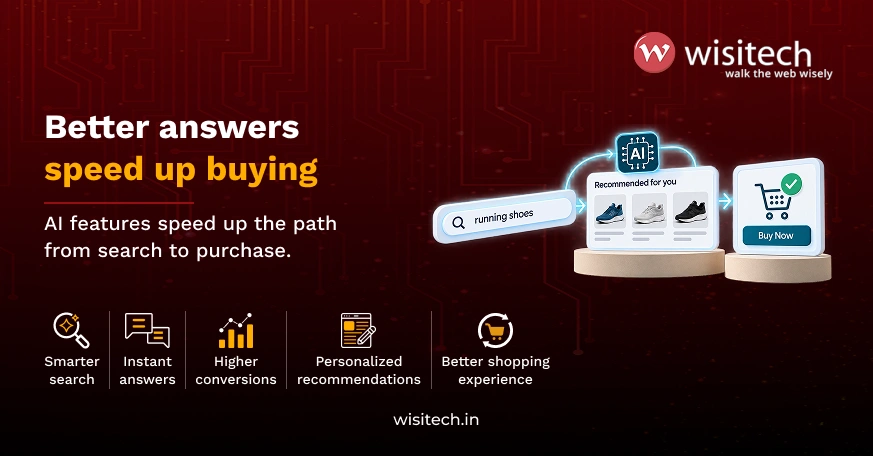
Indian ecommerce businesses have reached a stage where adding an AI label to a store is easy. The harder question is whether a feature changes shopper behavior enough to justify implementation and maintenance. For a D2C brand, the answer usually lies in fixing points of friction.
That makes AI features for ecommerce website a business decision rather than a technology shopping list. Each feature should have a clear job and measurable outcome.
Start with the conversion problem, not the AI feature
Before considering AI features for ecommerce website, identify where shoppers are getting stuck. If visitors cannot find the right product, better search may matter. If they browse without deciding, recommendations may help. If support questions delay purchase, conversational assistance may have a role.
This matters for Indian stores serving different languages, price expectations, delivery zones, and product categories. A fashion brand may need size guidance, while an electronics retailer may need comparison tools.
An experienced ecommerce website development company can map these friction points against the storefront, analytics, product data, and backend integrations before recommending features.
AI-powered search is one of the strongest bets
Site search has a direct relationship with buying intent. A visitor searching for “black kurta under ₹2,000 for wedding” gives the store considerably more information than someone who lands on the homepage.
Modern AI search can interpret natural-language queries, correct spelling, and connect phrases with product attributes. This is useful where Indian shoppers mix English with local expressions, sizes, colors, and price expectations.
AI search still needs clean product data, so AI features for ecommerce website cannot compensate for a weak catalogue. If attributes, inventory, variants, and categories are incomplete, a sophisticated search layer may return poor results.
Recommendations can increase the value of existing traffic
Product recommendations are practical because they work with traffic a store already has. “You may also like,” complementary products, recently viewed items, and personalized collections can help shoppers discover relevant products without starting another search.
A beauty D2C brand might recommend a cleanser alongside a moisturizer, while a home furnishings store could suggest matching cushion covers. Measure whether recommendations increase revenue, basket size, or purchase completion.
Conversational shopping needs a narrow purpose
AI chat assistants are among the most visible AI features for ecommerce website, but they are easy to overbuild. A chatbot that answers basic questions while forcing shoppers into another interface may add little value.
A better assistant can handle questions about size, product differences, compatibility, shipping, returns, or availability. For B2B, it can guide buyers toward the correct specification.
The assistant needs reliable store information and clear boundaries. Invented availability or delivery dates can quickly become a trust problem.
Personalization works when it reflects genuine intent
Personalization can change products, offers, categories, or content based on browsing behavior, purchase history, location, or engagement. Showing a different banner to every visitor does not automatically make an experience better.
For an Indian D2C business, personalization could surface monsoon products in relevant regions, show replenishment reminders, or highlight products based on category interest.
An ecommerce web development company should connect personalization rules to measurable objectives and ensure the implementation does not slow the storefront.
What about AI-generated product descriptions?
AI can speed catalogue production, but this is usually an efficiency gain rather than a direct conversion feature. Generic descriptions will not fix weak product pages, and human review remains important for specifications, claims, sizing, ingredients, and warranties. An ecommerce software development company can help integrate AI with complex catalogues and ERP workflows.
Features that often sound better than they convert
Several AI ideas deserve scrutiny before receiving development budget. Autonomous pricing, AI-generated discounts, synthetic reviews, generic chatbots, and automated homepage personalization can look impressive while producing uncertain commercial value.
Ask three questions: what shopper problem does it solve, what behavior should change, and how will that change be measured? For a growth-stage store, ₹5 lakh spent improving search, product discovery, speed, checkout, and analytics may have a clearer path to return than an elaborate AI layer.
Build AI into the ecommerce system, not beside it
The strongest AI features for ecommerce website depend on existing systems working together. Search needs product data. Recommendations need behavioral signals. Assistance needs accurate store information. Personalization needs analytics and customer data.
Implementation should therefore span the storefront, catalogue, CRM, ERP, analytics, and logistics stack. A disconnected AI tool can create another dashboard without solving the original problem.
For Shopify and WooCommerce businesses, this may mean selected integrations, custom development, or both. Complex B2B operations may require a custom architecture.

How to measure whether AI is actually working
Every AI features for ecommerce website project should begin with a baseline. Measure conversion rate, search-to-purchase behavior, average order value, checkout completion, and relevant support outcomes before launch.
Then test the feature against a comparison group where practical. A recommendation engine that increases clicks but lowers average order value deserves investigation. The goal is useful improvement, rather than collecting AI features.
Choose AI where the customer feels the difference
The best AI features for ecommerce website help an Indian shopper find the right product, understand a choice, overcome hesitation, or complete a purchase with less effort.
For growth-stage businesses, start with conversion bottlenecks, validate the data, and choose technology that fits the wider ecommerce system. AI should strengthen the customer journey and operating model.
If you are deciding which AI capabilities deserve development budget, talk to us and bring us the conversion problem you want to solve; we can help you identify the technology that earns its place in your store.