

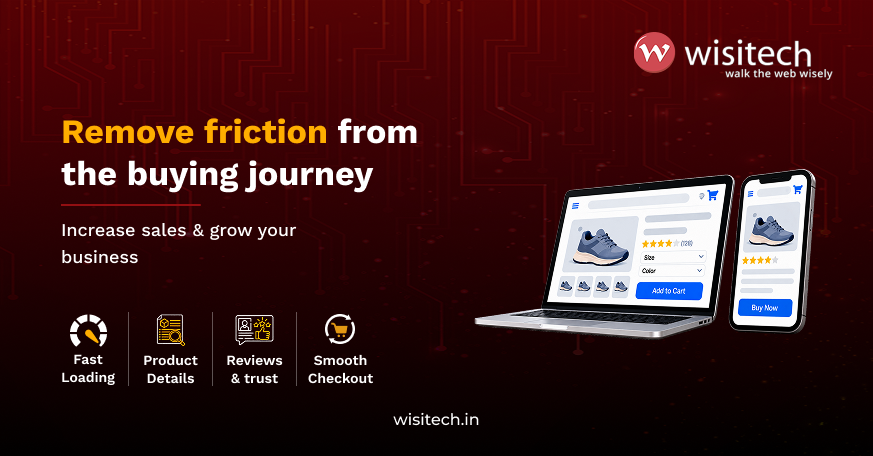
When a customer in Delhi, Gurgaon, or Noida lands on a store after a Google search or social ad, the buying decision starts immediately. The page must load quickly, explain the product, answer practical questions, and make payment easy. If it feels slow or confusing, the customer can leave.
This is why modern ecommerce websites convert better in growth-stage businesses. The difference is not simply a newer design. It comes from building the storefront around customer behavior and business systems.
Modern ecommerce starts with the buying journey
Older stores are often organized around individual pages. Modern stores are planned around the complete path from discovery to purchase. A customer may land on a product page, compare variants, check delivery, read reviews, add an item to the cart, and pay from a mobile phone. Each step needs to connect without unnecessary friction.
For a D2C brand in Gurgaon, delivery information, COD availability, returns, reviews, and payment choices can matter as much as the product image. When customers hunt for these details, buying becomes harder. The real reason modern ecommerce websites convert better is that useful information appears when the customer needs it.
Speed and mobile experience protect buying intent
A visitor who clicks a paid ad and waits for a slow product page can simply return to Google. Older stores often become slower because of heavy themes, large images, unnecessary plugins, tracking scripts, and outdated code.
A modern rebuild should review image delivery, caching, hosting, scripts, APIs, and mobile rendering. A strong ecommerce website development company should treat performance as conversion work, not a task after design.
Mobile deserves the same attention. For many Indian stores, customers discover products and place orders on phones. A desktop-first site that simply shrinks can create problems with menus, filters, forms, buttons, and checkout. Product details should remain readable and key actions easy to tap. This is another reason modern ecommerce websites convert better: the experience matches the device customers use.
Product pages should reduce uncertainty
A product page has a commercial job. It needs to help a customer feel confident enough to buy.
An Indian shopper may want to know whether the product is genuine, which size to choose, when it will reach Noida, whether COD is available, and what happens if it arrives damaged. Older stores often hide these details across pages. Modern product pages bring useful information closer to the decision, including specifications, reviews, delivery estimates, returns, stock status, and better images.
The same principle applies to category pages. Clear filters, useful sorting, logical product groups, and strong internal links help customers reach the right product faster. This is why modern ecommerce websites convert better: better discovery reduces the distance between intent and purchase.
Checkout should remove hesitation
A customer who reaches checkout has already shown strong buying intent. The website should help that intent move forward rather than introduce new obstacles.
Forced account creation, unclear shipping charges, limited payment options, repeated forms, broken coupon fields, and unexpected costs can cause abandonment. These problems are more expensive when the business pays for traffic through Google Ads or social campaigns.
Modern checkout flows reduce unnecessary steps, validate forms clearly, work well on mobile, and show the final cost before payment. The goal is to make completing the order straightforward.
Integrations turn a website into a business system
An ecommerce store rarely works alone. It may connect with a CRM, ERP, inventory system, payment gateway, shipping provider, or marketing platform.
Older stores often accumulate these connections as patches, creating errors or manual work. A modern ecommerce system plans integrations as part of the architecture, so orders, inventory, payments, and fulfilment data move reliably between systems.
A capable ecommerce web development company should discuss these requirements before development starts. For a B2B distributor in Faridabad, dealer pricing, bulk ordering, stock visibility, and ERP integration may matter more than another visual feature.
When an older store needs optimization or a rebuild
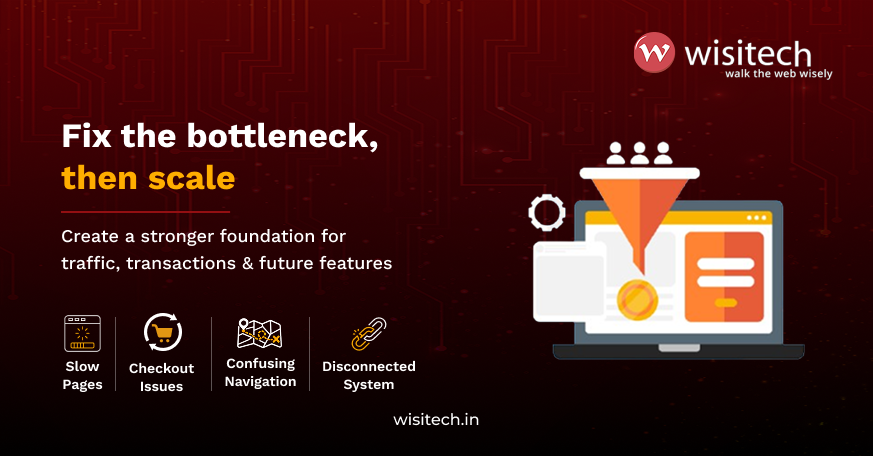
Not every old ecommerce website needs to be replaced, and understanding why modern ecommerce websites convert better starts with finding the actual bottleneck. If the platform is sound, performance improvements, UX changes, better product pages, checkout work, and cleaner integrations may solve the main problems.
A rebuild becomes more relevant when the existing system repeatedly blocks growth. Warning signs include performance issues, unreliable integrations, poor mobile UX, difficult catalogue management, limited checkout flexibility, and too much manual backend work.
Before approving a rebuild, measure where customers drop off and which technical issues affect revenue. This helps explain why modern ecommerce websites convert better when the technology removes friction instead of adding more features.
This is where ecommerce development agency support becomes useful. The right partner should identify the business problem first and then recommend the technology and development work needed to solve it.
Why modern ecommerce websites convert better as a business system
Why modern ecommerce websites convert better comes down to fewer obstacles between customer intent and completed purchase. A modern store loads quickly, works well on mobile, presents useful information, makes products easy to find, simplifies checkout, and connects properly with the systems behind the business.
For a growth-stage Indian brand, this matters more than having the newest visual style. If traffic is coming in but sales have plateaued, increasing ad spend may not address the real problem. The website itself may need attention.
A stronger ecommerce system also gives the internal team a cleaner foundation for adding products, campaigns, integrations, and new sales channels as the business grows. That is why modern ecommerce websites convert better when development decisions are tied to revenue, operations, and customer experience rather than appearance alone.
For a Delhi NCR business, that can mean fewer abandoned carts, less manual order handling, cleaner data, and a better experience for customers coming from paid and organic channels. The aim is not to replace technology simply because it looks old. The aim is to remove the limitations holding the business back.
Conclusion
The practical lesson is clear: why modern ecommerce websites convert better is ultimately a business question, not a design trend. When speed, mobile UX, product information, navigation, checkout, integrations, and trust work together, the website becomes a stronger part of the sales system. That is why modern ecommerce websites convert better as businesses and customer expectations grow.
If your store has grown faster than its technology, Wisitech can help identify what is holding conversion back and what should be fixed first. Bring us the bottleneck, not just the redesign brief, and let’s build an ecommerce system that is ready for the next stage of your growth.