

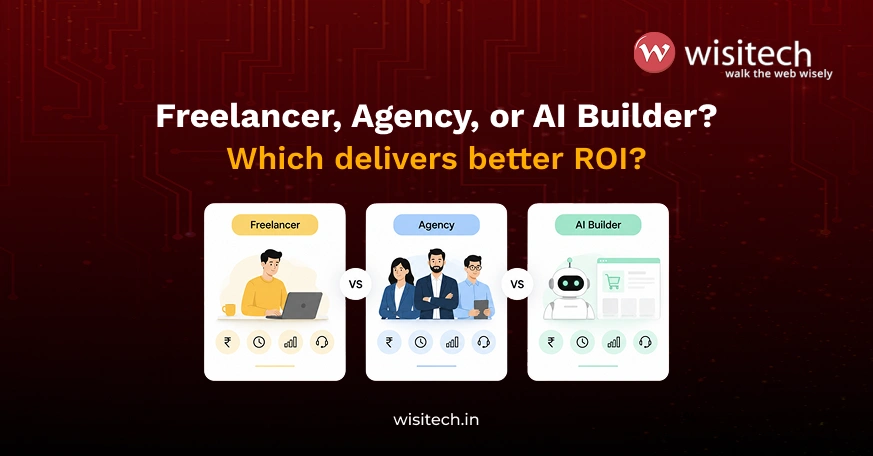
Picture this: a Delhi-based D2C skincare brand is ready to go online. The founder has three quotes on her desk. A freelancer from Upwork has offered to build the store in three weeks for Rs. 40,000. A mid-size web development company has proposed a structured six-month engagement for Rs. 4.5L. A Shopify AI builder subscription costs Rs. 1,200 a month and can go live tomorrow. All three are legitimate options. All three will give her an ecommerce website. But only one will give her an ecommerce website development outcome that holds up when orders start coming in at 3 a.m. on Diwali night.
That is the decision this guide is built for. Not which option is cheapest, but which one delivers real return on investment for Indian businesses building or scaling online stores in 2026.
Key Takeaways
- There is no single best answer. The right option depends on your business stage, order volume, and growth plans.
- AI builders are fastest but have real limits for brands that need custom integrations, GST compliance, or scalable catalogues.
- Freelancers can deliver strong MVPs but carry post-launch reliability risks that hurt revenue-generating stores.
- A professional ecommerce website development company costs more upfront but typically delivers the strongest ROI at scale.
- India-specific factors like Razorpay integrations, ONDC readiness, GST invoicing, and regional languages often tip the decision away from AI builders.
The three ecommerce website development options, explained
Before comparing costs and ROI, it helps to define what each option actually involves.
Freelancer
A freelancer is a self-employed developer, or occasionally a small team, hired on a project basis. They typically work across platforms like Upwork, Freelancer.com, or through direct referrals. Setup costs in India range from Rs. 15,000 for a basic template store to Rs. 80,000 for a moderately customised build. Timelines vary widely. The risk is not the quality of the initial build, as many freelancers are technically capable. It is what happens after launch. If the developer moves on, gets busy, or stops responding, you are left managing a production store with no support.
Agency
A web development company brings a structured team: project managers, front-end and back-end developers, QA testers, and a defined delivery process. You are not hiring a person; you are hiring a system. Costs typically start at Rs. 1.5L and can reach Rs. 10L for enterprise-grade custom web development. Timelines are longer, ranging from eight to twenty weeks, but the output is a tested, documented, scalable store with post-launch support built into the contract. For businesses that plan to do serious volume, this structure is worth the premium.
AI Builder
AI-powered ecommerce builders, including tools like Shopify’s AI features, Wix AI, and India-built platforms like Dukaan, can generate a functioning online store in hours. Subscription costs range from free tiers to Rs. 25,000 per year. They are excellent for founders validating an idea or testing a product line. The limitations appear when you need custom payment gateway logic, B2B pricing tiers, complex catalogue management, or integrations with Indian platforms like Razorpay, PayU, or CCAvenue that require back-end configuration beyond what a drag-and-drop tool supports.
Cost comparison for ecommerce website development in India
The table below compares all three options on the factors that matter most to Indian business owners:
| Criteria | Freelancer | Agency | AI Builder |
| Setup cost (INR) | Rs. 15,000–Rs. 80,000 | Rs. 1.5L–Rs. 10L | Rs. 0–Rs. 25,000/yr |
| Timeline | 4–12 weeks | 8–20 weeks | 1–3 days |
| Customisation | Medium | High | Low to Medium |
| Scalability | Limited | High | Platform-limited |
| Ongoing support | Variable | Structured | Self-managed |
| Best for | Budget MVPs | Growth-stage brands | Quick launches |
Agency costs reflect a full-service web development company engagement. Costs for custom web development services that include unique features such as B2B portal development, custom PHP development, or Laravel development services will sit at the higher end of the range.
ROI analysis: Which option actually makes you more money?
Cost is only one side of the ROI equation. What matters is revenue generated relative to investment made, and that calculation looks very different depending on your business model.
Freelancer ROI: Good for low-volume, bad for scale
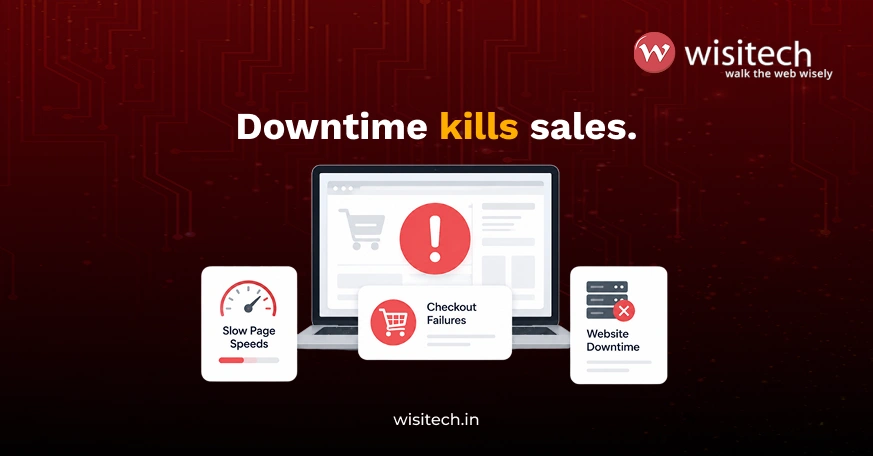
A bootstrapped brand doing Rs. 50,000 in monthly orders can run comfortably on a freelancer-built store for 12 to 18 months. At that scale, the low upfront investment and reasonable performance are a fair trade. The ROI breaks down when order volumes grow, bugs compound, and the developer is no longer available to fix them. Every hour of downtime during a sale event is lost revenue that the original savings cannot cover.
Agency ROI: Best for revenue-serious brands
A professionally built store from a reputable web development company typically includes performance optimisation, mobile responsiveness, and structured testing, all of which have a direct impact on conversion rate. Industry data consistently shows that a one-second improvement in page load time can improve ecommerce conversion rates meaningfully. For a brand doing Rs. 5L a month in sales, even a 1% lift in conversion rate represents Rs. 60,000 in additional annual revenue. That math makes a Rs. 3L to Rs. 5L agency investment look very different.
Brands that have moved from freelancer-built stores to properly engineered ecommerce builds commonly report fewer site issues, better checkout completion, and reduced dependence on developer patches. That is not a coincidence. It is the output of structured custom web development.
AI builder ROI: Fastest launch, lowest ceiling
AI builders have an excellent ROI for idea validation and early-stage businesses. If you are spending Rs. 1,200 a month and making Rs. 30,000 in sales, the unit economics work. The ROI weakens when you hit the platform’s ceiling: limited SKUs, no custom discount logic, no integration with your ERP or inventory system, and then you have to migrate anyway. At that point, you have paid two setup costs: one to launch, and one to rebuild.
Pros and cons: A deep dive for Indian business owners
Freelancer
Pros
- Lower upfront cost, viable for bootstrapped founders
- Flexible scope, easy to adjust mid-project
- Direct communication with the person doing the work
Cons
- Single point of failure: if they leave, you are stuck
- No structured QA or testing process
- Limited capacity to handle complex features like B2B portal development or custom PHP development
- No accountability framework for delays or scope creep
Agency
Pros
- Team-based delivery with project management, QA, and post-launch support
- Can handle complex requirements including custom web development and ecommerce consulting services, Laravel development services, and web application development
- Accountable to contracts, timelines, and SLAs
- Experience across industries means faster problem-solving
Cons
- Higher upfront investment
- Longer timelines due to process and approvals
- Quality varies: choosing the wrong agency carries the same risks as a bad freelancer, at a higher cost
AI builder
Pros
- Fastest time to launch: days, not weeks
- Low or no upfront cost
- No technical knowledge required
Cons
- Limited customisation: you work within the platform’s constraints
- Platform lock-in: migrating away is complex and often requires rebuilding from scratch
- Not suited for brands that need GST-compliant invoicing, custom payment gateway integration, or ONDC compatibility
How to choose: A decision framework for indian entrepreneurs
Answer these four questions before you decide:
- Are you validating or scaling? If you are still testing whether there is demand for your product, an AI builder gives you a fast, low-cost way to find out. If you are already generating sales and need to grow reliably, stop patching and invest in a proper build.
- What is your expected monthly order volume? Below Rs. 2L per month, a freelancer-built or AI store is workable. Above that, the risk of downtime and poor performance begins to cost more than the savings justify.
- Do you need Indian-specific integrations? Razorpay, PayU, CCAvenue, and Shiprocket integrations are standard for Indian ecommerce but not all builders support them cleanly. GST invoicing and ONDC registration add further complexity that typically requires custom web development services.
- Have you been through a bad development experience before? If yes, a structured web development company with a clear process and post-launch SLA is not an indulgence. It is risk management.
Best ecommerce platforms and tools for Indian sellers in 2026
Regardless of whether you go freelancer, agency, or AI builder, the underlying platform matters. The most commonly used options for Indian businesses are:
- Shopify: Widely supported, large developer ecosystem, strong for D2C brands. Shopify development companies in India are easy to find and vet.
- WooCommerce: Open-source, highly customisable, lower licensing cost. Works well with custom PHP development.
- Magento / Adobe Commerce: Enterprise-grade; used by brands with large catalogues and complex pricing rules.
- Dukaan and Shopaccino: India-built platforms with built-in GST support and Indian payment gateway integrations. Good for early-stage brands.
- StoreHippo: Strong for B2B ecommerce, multi-vendor setups, and businesses needing multilingual storefronts.
For brands with complex requirements such as multiple warehouses, B2B pricing tiers, or franchise models, a web development company offering custom web development services on an open-source stack typically delivers more flexibility than any SaaS platform.
Choose for the business you want to build, not the budget you have today
The right answer is not the cheapest one. For a brand still finding its market, an AI builder or a well-scoped freelancer project is perfectly sensible. For a business that depends on its online store for revenue and cannot afford downtime, lost checkouts, or a developer who has gone quiet, the economics of ecommerce website development point clearly toward a professional ecommerce development company with a structured delivery process and real post-launch accountability.
The worst outcome is not spending more upfront. It is spending twice: once to build quickly, and once to rebuild properly after the first version cannot keep up.
Tell us your current setup and monthly order volume, and we will tell you exactly which ecommerce build path makes commercial sense for your business. Our recommendations are based on your growth goals, technical requirements, and expected ROI, not on selling the most expensive solution.
Disclaimer: The costs, timelines, and ROI figures presented in this article are illustrative estimates based on industry averages and may not reflect every project. Actual ecommerce website development costs and outcomes vary based on business requirements, platform choice, custom features, integrations, and vendor pricing. Please consult qualified professionals and obtain project-specific quotations before making investment decisions.