

Every month, Indian businesses spend serious budgets on Google Ads and end up with clicks and impressions that never turned into customers. The dashboard looks busy, the budget starts getting exhausted but the leads do not come or the ones that do are not qualified. The platform works. The campaigns fail.
Google Ads for Indian businesses works when it is set up around outcomes: qualified leads, profitable sales, measurable ROAS (Return on Ad Spend). It fails when it is set up around activity: setting up campaigns, adding keywords, monitoring budget and so on, what you call the regular drill. Understanding the difference requires looking past the dashboard and into the structure of the account itself.
This guide covers Google Ads cost in India across industries, how realistic ROI benchmarks can be applied depending on the business type, and the specific structural differences between campaigns that compound returns over time and ones that drain budgets while producing reports nobody acts on.
How Google Ads works in India
Google Ads is an auction-based platform. You bid on keywords, and Google decides which ads to show based on a combination of your bid and your Quality Score. Quality Score is Google’s rating of how relevant your ad and landing page are to the keyword being searched. A higher Quality Score means your ad can win auctions at a lower cost than a competitor bidding more but offering a worse user experience.
In India, Google commands over 97% of search market share. Google Ads CPC in India is substantially lower than in Western markets, making it accessible at lower budgets. But low CPC is not the same as good ROI. A campaign paying ₹8 per click that brings people searching for jobs or tutorials will always lose to a campaign paying ₹80 per click that brings decision-ready buyers.
Search ads vs display ads vs shopping ads: which should Indian businesses use?
| Campaign type | How it works | Best for | India suitability |
|---|---|---|---|
| Search ads | Text ads on search results for target keywords | Lead generation, B2B, high-intent buyers | Strong across most categories |
| Shopping ads | Product images with price in search results | Ecommerce, product retailers | Strong for Shopify and WooCommerce stores |
| Display ads | Banner ads across Google’s website network | Brand awareness, remarketing | Low CPC, good for retargeting |
| Performance Max | AI-driven campaigns across all Google surfaces | Ecommerce and lead gen with clean conversion data | Powerful but needs structured management |
| YouTube ads | Video ads before and during YouTube content | Brand building, D2C, product demos | Very high reach, low CPV in India |
The right campaign type depends on your business goal, product type, and where your buyers are in the decision process. Most accounts that perform well run a combination of campaign types rather than a single format, because different buyers find you through different surfaces. Custom Google Ads management across multiple campaign types requires a clear strategy for how each type complements the others, not just running all of them simultaneously and hoping the budget distributes itself sensibly.
How much do Google Ads cost in India?
Google Ads cost in India is determined by four factors: the industry, the keyword competitiveness, your Quality Score, and your campaign structure. Search Ads CPC in India averages ₹8 to ₹25 for most general categories. Display Ads run at ₹1 to ₹5. The categories that push CPC significantly higher are real estate, legal services, insurance, education, and B2B software, where one good lead can justify months of ad spend. Across all categories, PPC management services that actively manage Quality Score and match types consistently reduce CPC by 15 to 40% over the first six months.
Average CPC by industry in India (2026)
| Industry | Avg. CPC (INR) | Min. monthly ad spend | Notes |
|---|---|---|---|
| D2C ecommerce | 10 – 40 | 30,000 – 60,000 | Shopping + search combination |
| B2B services | 80 – 300 | 60,000 – 1,00,000 | High CPC, high lead value |
| Real estate | 150 – 500 | 1,00,000 – 3,00,000 | Most competitive category |
| Education and edtech | 40 – 150 | 50,000 – 1,50,000 | Seasonal spikes March to May |
| Healthcare and clinics | 60 – 200 | 40,000 – 80,000 | Regulated categories, careful setup |
| Legal and financial services | 100 – 400 | 80,000 – 2,00,000 | High-value leads justify cost |
| Local services | 20 – 80 | 15,000 – 40,000 | Call extensions essential |
| SaaS and B2B software | 100 – 350 | 60,000 – 1,50,000 | Low volume, high intent |
CPC figures are indicative averages as of May 2026. Actual CPC varies by keyword match type, Quality Score, location, and competition. All budget figures exclude 18% GST.
What is the minimum budget for Google Ads in India?
There is no technical minimum. Google Ads budget in India can be as low as ₹500 per day. The practical minimum for generating enough data to optimize meaningfully is 30,000 to 50,000 per month in ad spend. Below this, campaigns rarely accumulate the conversion data that automated bid strategies need to function.
For accounts under ₹50,000 per month, manual CPC on exact and phrase match with a tightly focused keyword set gives more control than handing the account to Smart Bidding with insufficient signal.
The success of Google Ads for Indian businesses depends on more than CPC alone. Campaign structure, landing page quality, conversion tracking, and ongoing optimization all influence the return you achieve from your advertising budget.
What ROI can businesses expect from Google Ads?
Google Ads ROI in India varies on the basis of campaign quality, landing page performance, offer strength, and sales process. That said, there are directional benchmarks that separate realistic expectations from wishful thinking.
What is a good ROAS for campaigns?
ROAS (Return on Ad Spend) measures revenue per rupee spent on ads. A 3x ROAS means ₹3 earned for every ₹1 spent. For Indian ecommerce, a well-managed mature campaign typically achieves 3x to 5x ROAS. For B2B and lead generation, the equivalent measure is cost per qualified lead, which should be benchmarked against deal value and close rate rather than a generic industry figure.
Average conversion rate for Indian ecommerce Google Ads: 1.5% to 3.5%. Average CTR for Search Ads in India: 2% to 5%. A campaign that is structured well for your specific product and audience will often outperform these figures.
Google Ads ROI by business type
| Business type | Primary metric | Realistic target | Timeframe |
|---|---|---|---|
| Ecommerce | ROAS | 3x to 6x at maturity | 3 to 6 months |
| B2B lead generation | Cost per qualified lead | Below average deal margin | 2 to 4 months |
| Local services | Cost per call or form | Below average job value | 1 to 3 months |
| SaaS and B2B software | Cost per demo or trial | Below CAC threshold | 3 to 6 months |
| Education | Cost per enrollment inquiry | Below student lifetime value | 2 to 4 months |
Landing Page: The single biggest lever for ROI improvement is not bid strategy or keyword selection. It is the landing page. A well-structured campaign pointing at a weak, generic landing page will always underperform a simpler campaign with a page specifically built for the ad intent. Google Ads optimization services that address both campaign structure and landing page alignment together produce measurably better results than those that treat the two as separate scopes.
What separates a good Google Ads campaign from a wasteful one?
This is what most readers of a Google Ads for Indian businesses guide are actually trying to answer. The difference is not visible from the outside. A good campaign and a wasteful one can spend the same budget and produce reports that look equally busy. Here is how to tell them apart.
5 signs your Google Ads campaign is wasting money
- Broad match keywords with no negative keyword list. A campaign running ‘web development’ on broad match will trigger ‘web development jobs’, ‘web development tutorials’, and ‘free web development course’ clicks. Zero purchase intent, but the budget depletes just the same.
- Smart Campaigns or unstructured Performance Max. Smart Campaigns hand full control to Google’s AI with minimal input. Performance Max without proper asset group structure and audience signals runs as a black box. Both perform poorly without clean conversion data feeding them signals.
- No conversion tracking, or tracking the wrong events. If your account tracks page views as conversions, automated bidding optimizes for page views. Smart Bidding is only as intelligent as the signal it receives. Broken or misconfigured conversion tracking is the most common reason campaigns spend without producing results.
- All paid traffic sent to the homepage. The homepage is designed for orientation, not conversion. Dedicated landing pages aligned with specific ad intent consistently outperform homepages by 30% to 80% on conversion rate. Sending every campaign to the same page treats your budget as interchangeable, which it is not.
- Monthly reports that show clicks and impressions but never qualified leads or revenue. If your agency cannot tell you how many qualified inquiries your campaigns generated last month, or what revenue Google Ads contributed, they are measuring the wrong things.
7 signals of a high-performing Indian Google Ads campaign
Conversion tracking set up correctly with GA4, Google Tag Manager, and Enhanced Conversions so Smart Bidding has real signal to work with.
- Tightly themed ad groups where every keyword in a group matches the ad copy and the landing page, not loose clusters of loosely related terms.
- A live negative keyword list reviewed and expanded weekly from actual search term reports, not built once at launch and forgotten.
- Quality Score above 7 on core keywords, meaning Google considers the ads and landing pages relevant, which directly lowers CPC.
- Performance Max structured with distinct asset groups per product or service theme, not one mega-group. For ecommerce stores, Google Shopping ads management includes Merchant Center feed optimization alongside Shopping and PMax, not just campaign setup.
- Weekly optimization cycles covering bid adjustments, search term reviews, audience signal refinements, and budget pacing.
- Reporting that connects ad spend to qualified leads, pipeline value, or revenue, with the ability to answer ‘what did we get for that budget last month?’
Setting up Google Ads for Indian businesses requires more than creating campaigns and choosing keywords. A structured approach from the beginning makes future optimization far more effective.
How to start Google Ads for your business
Google Ads for small businesses follows the same structural principles as enterprise campaigns. The difference is scale and complexity, not the underlying logic.
Step 1: Define your goal and budget
Be specific. ‘Get more leads’ is not a campaign goal. ’20 qualified inquiry form submissions per month at a cost below ₹1,500 each’ is. Everything downstream, campaign structure, keyword selection, bidding strategy, follows from this definition. Your budget needs to be at a level where the campaign can accumulate at least 30 to 50 conversions per month. Below this, automated bidding strategies cannot optimize effectively and you are better served by manual CPC.
Step 2: Choose the right campaign type
Start with Search campaigns on exact and phrase match. This gives maximum control over what triggers your ads while you build conversion data. Add Shopping campaigns if you are running an ecommerce store with a product feed. Avoid Performance Max until your account has at least 30 conversions per month. Avoid Smart Campaigns entirely unless you have no capacity to manage campaigns manually and accept the performance trade-off.
Step 3: Keyword targeting and negative keywords
- Research keywords in Google Keyword Planner.
- Organize by intent: commercial intent keywords (ready to buy) go in separate ad groups from informational keywords.
- Build a negative keyword list before launch.
- Standard negatives for most Indian campaigns: free, course, tutorial, jobs, salary, training, how to, career, certification, DIY.
Step 4: Ads that convert for Indian audiences
- Responsive Search Ads with at least 8 headlines and 4 descriptions.
- Include a price point or INR range where relevant, price-qualified clicks convert better.
- Mirror the search term in at least one headline.
- Use ad extensions: sitelinks, callouts, structured snippets, and call extensions for mobile. WhatsApp CTAs in ad copy and on landing pages consistently outperform standard form CTAs for Indian mobile audiences.
Step 5: Conversion tracking
This is the step most advertisers skip and the one that costs the most. Without correct conversion tracking, you cannot know which keywords, ads, or landing pages produce results. Google Ads conversion tracking setup at minimum: GA4 configured, linked to Google Ads, conversion events imported (form submission, purchase, call). Preferred setup: Google Tag Manager, Enhanced Conversions for Leads, and offline conversion imports for CRM-closed deals. Without this foundation, Smart Bidding is optimizing for noise.
Google Ads vs Facebook Ads: which channel fits your business?
Google Ads vs Facebook Ads in India is the most common channel comparison question. They serve different purposes.
| Factor | Google Ads | Facebook / Meta Ads |
|---|---|---|
| User intent | Active search intent, buyer is looking now | Passive, buyer is browsing, not searching |
| Best for | Lead generation, high-intent purchases, B2B | Brand awareness, D2C, impulse purchases |
| Average CPC India | ₹10 to ₹300 (Search) | ₹5 to ₹50 (Feed ads) |
| Conversion timeline | Faster for high-intent queries | Longer, needs nurturing |
| India suitability | Strong for B2B, services, ecommerce intent | Strong for D2C, fashion, food, lifestyle |
For most Indian lead-generation businesses, Google Ads delivers faster and more qualified leads. For D2C brands building awareness in new markets, Meta Ads work better as a discovery channel. The most effective setups run both and attribute correctly.
Should you run Google Ads yourself or hire a specialist?
Managing Google Ads for Indian businesses in-house can work for smaller budgets, but as spend increases, specialist expertise becomes increasingly valuable. For businesses spending under ₹30,000 per month, a capable founder or in-house marketer can run a focused Search campaign. For businesses spending ₹1 lakh or more per month, the cost of poor campaign management, wasted spend, missed conversions, and misattributed data, consistently exceeds the cost of professional Google Ads management. The math is not close.
What an experienced team delivers that most in-house setups cannot: campaign architecture built around margin and LTV rather than just keywords; weekly search-term audits that prevent budget leakage before it compounds; conversion tracking that feeds real signal into automated bidding; Performance Max structured with proper asset groups; and optimization that runs on weekly cycles, not monthly check-ins.
For businesses that have been running campaigns and are unhappy with results, a proper Google Ads audit is usually the right first step before any new budget is committed. It brings forth exactly what is wasting the budget and what is worth scaling. Trying to fix a poorly structured account by increasing the budget is one of the most common and expensive mistakes in paid search.
Wisitech’s Google Ads management: built around outcomes, not activity
Wisitech has been managing Google Ads for Indian businesses across ecommerce, B2B, SaaS, healthcare, real estate, and local services for over a decade. We are a certified Google Partner.
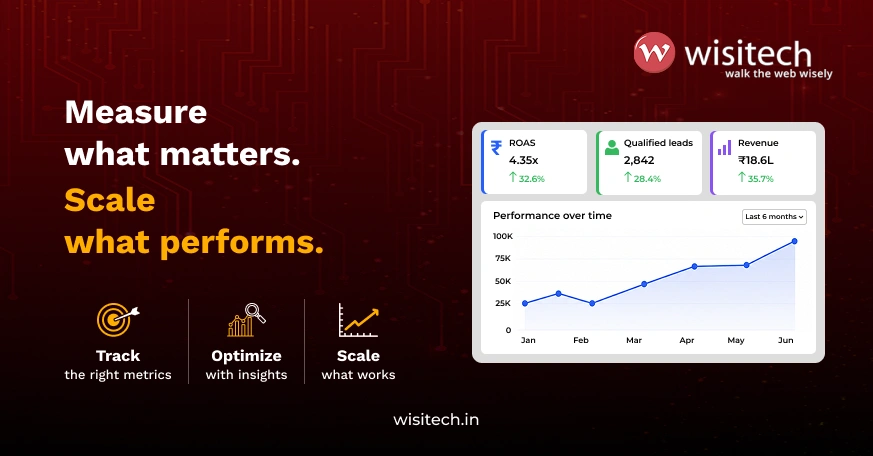
Our campaigns are managed around ROAS and pipeline. Not impressions, not click-through rates, not keyword rankings.
Our custom Google Ads management starts with a full account audit and conversion tracking setup using GA4 and GTM. We build campaign architecture based on your margin, CAC, and revenue targets. Search campaigns are structured with tightly themed ad groups. Shopping feed optimization covers Shopify, WooCommerce, Magento, and CS-Cart. Campaign scope spans Search, Shopping, Performance Max, YouTube, Display, and Demand Gen.
Weekly optimization cycles cover search-term review, negative keyword expansion, bid adjustments, audience signal refinements, and budget pacing. Monthly reporting maps ad spend to qualified leads, pipeline value, and revenue. Our google ads services in India are best suited for businesses spending ₹50,000 per month or more who want a team managing to business outcomes, not a retainer shop running templated monthly audits.
If your campaigns are spending but not converting, request a Google Ads audit. We will diagnose exactly what is working, what is wasting budget, and what needs to change.
27 years. 2,500+ projects. Fortune 500 experience. Creativity leads, AI amplifies.