

Your Google Ads campaigns are generating clicks. Traffic is landing on your site. Spend is going out every day. Yet the leads are underwhelming, acquisition costs keep climbing, and the return does not justify the budget. For performance-driven founders, CMOs, growth heads, and ecommerce operators, this is not a minor annoyance. It is a revenue leak.
The instinct is usually to blame targeting, bidding, keywords, or creative. Sometimes that is justified. But if qualified users are clicking and failing to convert, the problem often starts after the click. This is where landing page design for Google Ads becomes the real performance lever.
The average Google Ads conversion rate across industries is roughly 7.52%, but averages hide inefficient execution. Businesses sending paid traffic to generic pages consistently underperform, while optimized landing pages can drive significantly stronger results. Some studies suggest businesses using focused landing experiences see conversion improvements of up to 55% compared to generic website journeys. That difference is not design aesthetics. That is conversion engineering.
If your business is already spending on Google Ads, the question is no longer whether you need a better ad strategy. It is whether your post-click experience is sabotaging the traffic you are paying for.
Key takeaways
- Landing page design for Google Ads directly affects conversion rate, Quality Score, and overall acquisition efficiency
- Message mismatch is one of the most common reasons Google Ads traffic fails to convert
- Sending paid traffic to a homepage remains one of the biggest performance mistakes
- Faster landing pages convert significantly better, especially for India’s mobile-first audience
- Removing unnecessary navigation, friction, and distractions improves conversion performance
- Custom landing page design consistently outperforms template-driven landing experiences for paid campaigns
- Better landing page optimization helps improve Google Ads conversion rate without increasing ad spend
What is landing page design for Google Ads and why it matters
A landing page is a standalone page built around one campaign objective. Unlike a homepage, which serves multiple purposes, a landing page is designed to move one specific audience toward one specific action. That action could be booking a consultation, requesting a demo, getting a quote, downloading a lead magnet, or completing a purchase.
This distinction matters because paid users behave differently from organic visitors. Organic users may browse, compare options, and explore multiple pages before taking action. Paid users arrive with intent. They clicked because your ad promised a specific solution, and they expect the next step to feel relevant, immediate, and friction-free.
If someone searches for “Google Ads agency for SaaS startups,” clicks your ad, and lands on a homepage with multiple service categories, blog promotions, generic brand messaging, and several navigation exits, momentum is lost almost instantly.
That is why landing page design for Google Ads is not a branding exercise. It is a performance asset. Businesses investing in paid acquisition understand that effective landing page design is built around conversion flow, message match, speed, and clear calls to action, not generic website layouts that dilute intent.
The #1 reason Google ads clicks don’t convert
The single most common reason paid traffic fails to convert is message mismatch.
Your ad creates an expectation. Your landing page must fulfill it.
If your ad says:
“Book a Free PPC Audit for Ecommerce Brands”
But your landing page headline says:
“Welcome to Our Full-Service Digital Marketing Agency”
You have broken continuity.
The visitor now has to stop, think, re-evaluate, and decide whether they are in the right place. That hesitation kills momentum.
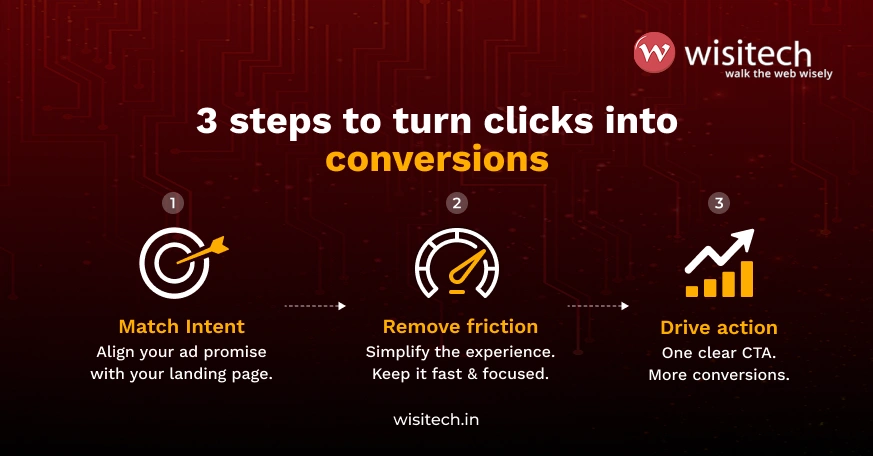
This is exactly why message match Google Ads landing page strategy is such an important conversion factor.
High-performing Google Ads landing page optimization ensures:
- ad promise matches landing page headline
- offer consistency remains intact
- CTA language aligns with campaign intent
- the visitor never feels redirected into a different conversation
Successful landing page design for Google Ads maintains continuity between the ad, the landing page, and the conversion goal so visitors never question whether they are in the right place.
10 landing Page mistakes killing your Google ads ROI
1. Sending traffic to your homepage
This is still one of the most common mistakes in paid acquisition.
A homepage is built for exploration. A paid landing page is built for conversion.
A homepage contains distractions. Navigation menus, unrelated services, blog content, brand storytelling, and multiple exit paths all dilute action.
A focused high converting landing page design removes friction and keeps attention where it belongs.
2. Weak above-the-fold messaging
The first screen must immediately answer:
- What is this?
- Is this relevant to me?
- Why should I care?
- What should I do next?
If your visitor has to scroll just to understand the offer, performance suffers.
The above the fold CTA landing page structure remains one of the strongest conversion fundamentals.
3. Slow Load Times
Speed is not optional in 2026.
Pages loading in one second can convert significantly better than pages loading in five seconds. In India, where much of paid traffic comes through mobile networks and mid-range devices, speed is even more critical.
A slow page creates:
- bounce
- frustration
- wasted spend
- lower Quality Score
Serious landing page development must prioritize performance architecture, not visual weight.
4. Generic CTAs
Buttons like “Submit” or “Learn More” underperform because they create ambiguity.
Better examples:
- Book Your Free Audit
- Request a Custom Growth Plan
- Get Your PPC Review
- Speak to a Specialist
Strong landing page design services focus heavily on CTA clarity.
5. Too much form friction
Long forms kill momentum.
For most paid landing pages, the form should ask only for the essentials:
- full name
- work email
- phone number
- company name
If qualification matters, use a single dropdown such as service required instead of stacking multiple business questions upfront.
The goal is to start the conversation, not make users complete an application form before trust is built.
6. Poor mobile UX
India’s paid traffic ecosystem is overwhelmingly mobile-first.
Buttons must be tappable. Forms must be usable. Content must load cleanly.
Desktop-first execution is conversion negligence.
7. Weak trust signals
Paid traffic users are skeptical.
You need visible proof.
Examples:
- client logos
- testimonials
- measurable outcomes
- certifications
- recognisable partnerships
A conversion-focused landing page design company treats trust as infrastructure.
8. Template thinking
Templates create sameness.
They may look polished, but rarely align with campaign intent, audience psychology, or funnel goals.
Businesses serious about performance need custom landing page design, not decorative shortcuts.
9. Broken tracking
If conversion tracking is inaccurate, optimization becomes guesswork.
Modern attribution complexity makes this worse.
Bad tracking leads to bad budget decisions.
10. No testing culture
A landing page should never be treated as finished.
Without testing, performance stalls.
This is where landing page CRO for paid ads becomes essential.
Landing Page vs homepage: The performance difference
This deserves direct comparison because many businesses still treat them interchangeably.
| Homepage | Landing Page |
|---|---|
| Designed to introduce the business | Designed to convert a specific audience |
| Says, “Here is everything we do.” | Says, “Here is the exact solution you clicked for.” |
| Encourages exploration | Encourages action |
For businesses running paid acquisition, that difference directly impacts ROI.
If your goal is lead generation, product trials, demos, or offer redemption, sending Google Ads traffic to a homepage usually creates unnecessary leakage.
This is why landing page design for Google Ads consistently outperforms sending paid traffic to generic website pages.
How landing pages affect Google ads quality score
Many advertisers think Quality Score is mostly about keywords and ad relevance.
That is incomplete.
Landing page experience plays a direct role.
Google evaluates:
- relevance
- usability
- content clarity
- speed
- mobile experience
- transparency
A poor Google Ads quality score landing page experience can raise acquisition costs, reduce Ad Rank competitiveness, and weaken efficiency.
Better landing page design for Google Ads improves more than conversion rate. It improves media economics.
For performance-focused businesses, that matters.
How to design a high-converting landing page for Google ads
Strong landing page design for Google Ads follows performance principles, not generic web design trends.
Start with intent alignment
Every campaign should begin with user intent clarity.
Ask:
What did the user search for?
What promise did the ad make?
What action should happen next?
Keep one conversion goa
A paid landing page should drive one primary action.
Multiple competing CTAs reduce clarity.
Use conversion-focused copy
Good copy addresses:
- pain points
- objections
- urgency
- business outcomes
A SaaS landing page design page should focus on demos, signups, and feature clarity.
An ecommerce landing page design page should emphasize urgency, offers, trust, and frictionless buying.
Build fast
Speed is conversion infrastructure.
Performance-first execution matters more than visual excess.
Design for mobile
Thumb-friendly interaction, clean layouts, and short forms are non-negotiable.
Add proof aggressively
Trust reduces hesitation.
Use:
- quantified outcomes
- testimonials
- recognisable clients
- certifications
- guarantees
A/B testing: The fastest route to better conversion performance
Even strong landing pages can improve.
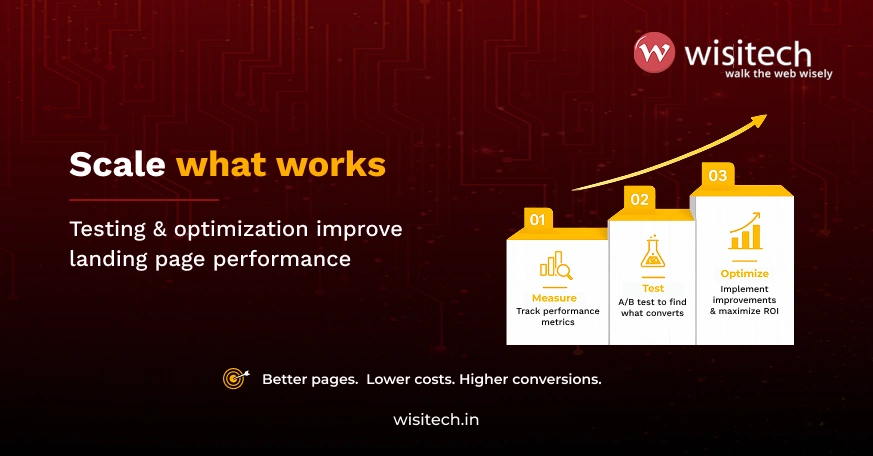
A/B testing remains one of the most reliable ways to increase performance.
Testing commonly includes:
- headline variations
- CTA copy
- button placement
- form length
- trust signal positioning
- hero imagery
- offer framing
Continuous testing is an essential part of landing page design for Google Ads because even small improvements in messaging or layout can produce meaningful gains in conversion rate.
Even modest testing improvements can create meaningful acquisition gains.
This matters because improving conversion efficiency reduces dependence on higher ad spend.
If your goal is to improve Google Ads conversion rate, testing is essential.
2026 changes that make better landing pages even more important
Google Ads in 2026 is far more automated than it was even two years ago. Performance Max campaigns, AI-assisted bidding, predictive audience expansion, and automated creative optimization have made traffic acquisition faster and more scalable. That sounds like a win, and in many ways, it is. But there is a catch. Automation improves traffic delivery. It does not improve what happens after the click.
In fact, weak landing pages now become expensive much faster because Google can push larger volumes of traffic into broken post-click experiences at scale.
Performance Max scales waste faster if your landing page is weak
Performance Max campaigns are designed to maximize reach across Google’s ecosystem, including Search, Display, YouTube, Discover, Gmail, and Maps. For businesses with aggressive acquisition goals, that means faster traffic volume and broader reach. But if your landing page is not conversion-ready, scaling traffic simply scales inefficiency.
A campaign generating ₹2,000 in wasted spend per day can quickly become ₹10,000 in wasted spend once automation expands reach. This is why landing page design for Google Ads matters more than ever. Better automation does not compensate for poor post-click conversion architecture.
AI-generated landing pages are fast, but fast is not the same as effective
AI has made landing page creation dramatically faster. Tools can generate layouts, headlines, copy, and even visual structures in minutes. That speed is useful, but businesses confusing speed with strategy are already seeing the downside.
Generic AI-built pages often lack:
- audience-specific messaging
- conversion psychology
- clear funnel logic
- differentiated offers
- trust-building structure
- proper CTA hierarchy
A SaaS founder, an ecommerce brand, and a B2B lead generation company do not convert the same way. Yet most AI-generated templates treat them similarly. Effective landing page design requires understanding intent, objections, decision-making friction, and campaign economics, not just filling sections with autogenerated content.
Core web vitals and real-world mobile performance still matter
Google continues to reward fast, usable web experiences, and Core Web Vitals remain critical to both SEO and paid performance. Metrics like INP (Interaction to Next Paint), LCP (Largest Contentful Paint), and CLS (Cumulative Layout Shift) directly affect usability.
For Indian advertisers, this matters even more. Your landing page may feel fast on office Wi-Fi and a flagship device, but your actual audience may be browsing on mid-range Android phones over unstable 4G networks. A visually heavy page with bloated scripts, delayed interactivity, or unstable layout shifts creates friction immediately.
This is why serious landing page design services India must be performance-first, not just design-first.
Rising CPCs mean conversion efficiency matters more
Google Ads costs are not getting cheaper in competitive sectors. SaaS, legal, healthcare, education, real estate, and ecommerce continue to face rising CPC pressure. When clicks cost more, post-click inefficiency becomes more painful.
If your landing page converts poorly, every increase in CPC compounds acquisition inefficiency. Improving targeting helps, but improving conversion infrastructure often creates faster ROI gains.
That is why businesses focused on growth in 2026 are not just optimizing ads. They are optimizing what happens after the click.
India-specific considerations most global guides ignore
Most landing page advice is written for US or European markets, where user behaviour, device usage, and conversion expectations differ significantly from India. If you are running paid campaigns here, copying global best practices without adapting them to local behaviour can hurt performance.
Landing page design for Google Ads should always reflect how Indian users browse, interact, and make purchasing decisions rather than relying on global templates.
Mobile reality
India’s paid traffic ecosystem is overwhelmingly mobile-first, but not everyone is browsing on high-end devices with stable internet. A landing page that feels fast on a MacBook or flagship smartphone may perform poorly on mid-range Android devices using inconsistent 4G networks. That gap matters because even a few seconds of delay can increase bounce rates and kill high-intent traffic before they engage with your offer.
WhatsApp conversion behaviour
In many Indian industries, especially education, healthcare, consulting, real estate, and local services, users often prefer instant conversational contact over filling out traditional lead forms. A visitor may hesitate to complete a long form but will readily click a WhatsApp button to ask a question. Ignoring this behaviour means forcing users into a conversion path they may not prefer.
Festive campaign behaviour
Consumer intent shifts dramatically during high-spend periods like Diwali, Navratri, Dhanteras, end-of-season sales, and major ecommerce events. During these periods, ad competition increases, CPCs rise, and users become more offer-sensitive. Generic evergreen landing pages often underperform here. Campaign-specific messaging, urgency, and seasonal relevance become far more important.
Local trust signals matter more
Trust hesitation is real, especially for service-based and higher-ticket purchases. Indian users often look for signals that the business is credible and accessible before converting. Visible GST credentials, recognisable Indian client logos, region-specific testimonials, local contact details, and familiar trust markers help reduce hesitation and improve conversion confidence.
Wisitech’s landing page design services: built for conversions, not just visual appeal
Wisitech delivers landing page design services for businesses that are actively investing in paid acquisition and need measurable performance, not just polished layouts. We build conversion-focused landing pages for SaaS companies, ecommerce brands, lead generation businesses, professional service firms, and growth-focused enterprises running Google Ads and other paid campaigns.
Our landing page design services go beyond visual execution. We handle conversion-focused UX architecture, campaign-specific messaging, mobile-first design, speed optimization, CTA strategy, form experience design, message match alignment, and performance-led landing page development built around actual acquisition goals. Whether you need landing pages for lead generation, product signups, service enquiries, or paid campaign funnels, every page is engineered to reduce friction and improve conversion efficiency.
For businesses running Google Ads, our work aligns landing page strategy with paid campaign intent, helping improve post-click performance instead of sending expensive traffic into generic website journeys. If your campaigns are generating clicks but not enough conversions, get in touch with us. We will assess your current landing experience and identify exactly where conversion leakage is happening.
27 years. 2,500+ successful projects. Fortune 500 experience. Creativity leads, AI amplifies.