

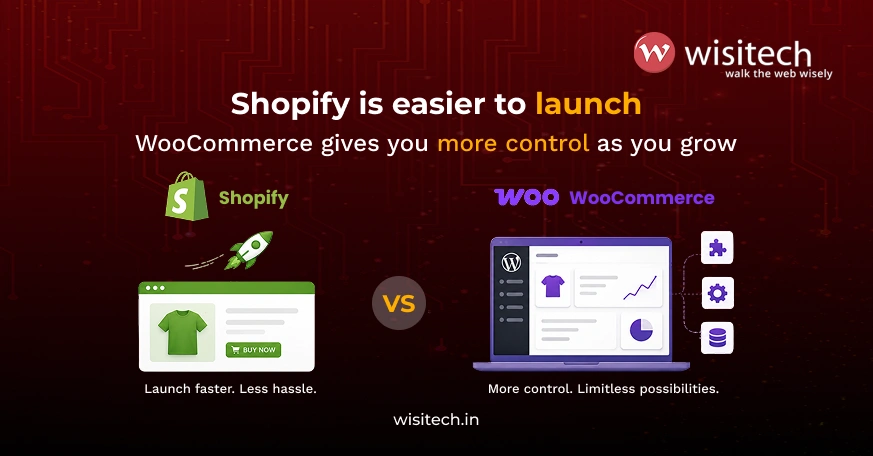
For any Indian entrepreneur choosing an ecommerce platform in 2026, the Shopify vs WooCommerce in India debate is still the starting point, and it is not a simple one. Both platforms have evolved significantly.
Shopify has embedded AI into its core product, changing how stores are managed day to day. WooCommerce has matured into a serious custom WooCommerce development stack with deep support for Indian compliance requirements, from GST invoicing to Razorpay payment flows. Pricing works differently on each. Hosting responsibilities are completely different. And the right answer depends heavily on where your business is right now. This post gives you a direct, India-specific breakdown so you can make the call without wading through global comparisons that miss what actually matters here.
The 60-second verdict: Shopify vs WooCommerce in India
If you are launching a D2C brand or a product-first store in India with a small team and a firm launch date, Shopify is the faster, lower-risk choice. The platform handles hosting, security, software updates, and payment setup. You focus on the store and the product.
If you need deep content and commerce integration, full control over your database and checkout, a complex B2B pricing structure, or you are building on top of an existing WordPress site, WooCommerce development gives you control that no hosted platform can match. It takes more work to set up correctly and more ongoing attention to maintain, but for businesses that need that flexibility, the trade-off is worth it.
Both platforms support Razorpay and UPI. Both can be made GST-compliant. Both can scale. The real differences in Shopify vs WooCommerce in India come down to cost structure, time-to-launch, who manages infrastructure, and how much AI tooling comes built in.
What each platform actually is
Shopify
Shopify is a hosted ecommerce platform. You pay a monthly subscription and the platform manages servers, security patches, software updates, and uptime. You get a storefront, a checkout, a payment integration layer, and an app store with thousands of extensions. The appeal for Indian brands is that you can go from zero to a live, Razorpay-enabled store in a matter of days without managing any infrastructure.
WooCommerce
WooCommerce is a free, open-source ecommerce plugin built on WordPress. The WooCommerce development stack gives you full ownership of hosting, security, performance tuning, and updates. That ownership is the source of both its flexibility and its complexity. A well-built WooCommerce store development on managed cloud hosting can outperform a mid-tier Shopify store on page speed and custom functionality. A poorly maintained one will cause problems at the worst possible time, usually during a high-traffic sale.
Real cost comparison for Indian businesses
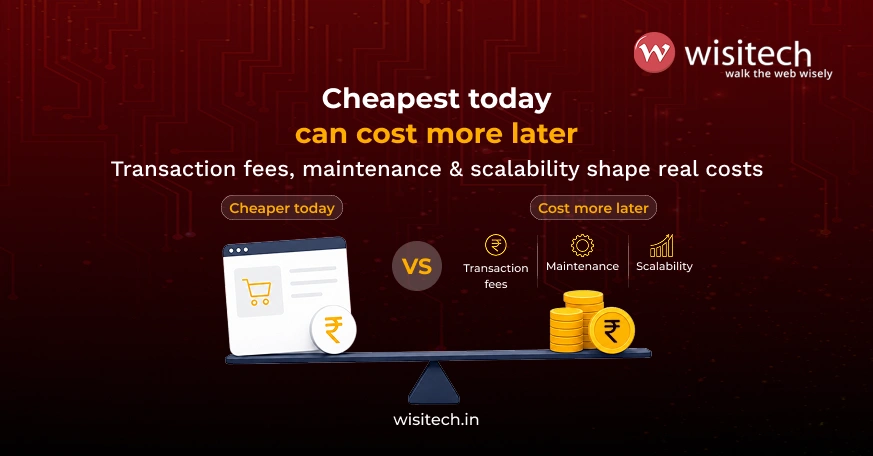
Shopify’s costs are visible upfront. WooCommerce’s costs are modular and accumulate. Neither is automatically cheaper. The right answer depends on your order volume, your team’s technical capacity, and how much revenue you are processing.
Shopify plans in India (2026)
Shopify bills Indian merchants directly in INR. Always verify current rates on Shopify’s India pricing page, as INR amounts are updated periodically. The current plan structure on monthly billing is:
| Plan | Monthly (INR) | Annual approx. (INR) | Best for |
|---|---|---|---|
| Basic | 1,994 | 1,795 | New D2C stores, first store builds |
| Grow (Standard) | 7,447 | 6,703 | Stores doing 3 lakh+ monthly revenue |
| Advanced | 30,164 | 27,148 | High-volume stores, advanced reporting |
| Plus | 1,75,000+ (3-yr term) | 1,75,000 | Enterprise, large catalog, B2B |
Annual billing saves approximately 25%. Indian businesses registered for GST also pay 18% GST on the subscription, so the Basic plan at 1,994 per month becomes approximately 2,353 per month all-in. If your business is GST-registered, you can claim this as input tax credit.
One cost that catches new Indian merchants by surprise: Shopify Payments is not available in India. Every order processed through Razorpay, PayU, or Cashfree carries a platform transaction fee on top of the gateway’s own charge. On the Basic plan, this is 2% per transaction. On Grow, 1%. On Advanced, 0.6%. At 10 lakh in monthly revenue, moving from Basic to Grow saves roughly 10,000 per month in transaction fees alone, which more than covers the plan upgrade cost.
WooCommerce running costs in India (2026)
The core WooCommerce plugin is free. Running a live WooCommerce store development project is not. A realistic monthly cost breakdown:
| Cost item | Monthly estimate (INR) | Notes |
|---|---|---|
| Hosting (Hostinger Business) | 169 – 599 | Introductory vs renewal rate; works for under 500 orders/month |
| Hosting (Cloudways DigitalOcean) | 1,200+ | Better for consistent traffic; Redis caching included |
| Domain (.in or .com) | 100 – 150 | Annual fee amortized monthly |
| GST invoicing plugin | 300 – 800 | SUMO GST, WPPalm, or similar |
| Premium theme (amortized over 12 months) | 300 – 800 | Free themes are a viable starting point |
| Security plugin | 300 – 600 | Wordfence or equivalent; not optional for a live store |
| WooCommerce support and maintenance | 2,500 – 8,000 | If outsourced; optional for teams managing WordPress in-house |
Note- Prices are as of May 12, 2026 and are subject to change. Verify current rates with the respective providers before making a decision.
WooCommerce has no platform transaction fee. You pay Razorpay’s standard gateway rate, currently around 2% for most Indian merchants, and nothing more to WooCommerce. For stores processing 20 lakh or more per month, this difference adds up to a material annual saving compared to a high-volume Shopify Basic or Grow account.
GST compliance: how each platform handles it
Shopify
Shopify does not generate GST invoices natively, but the App Store has reliable options. Shopify GST invoice apps like GST Invoice India, Sufio, and Vyapari let Indian merchants configure CGST, SGST, and IGST splits, capture buyer GSTINs at checkout, and auto-generate downloadable tax invoices per order. For B2B businesses with annual turnover above 5 crore, where e-invoicing is mandatory under the CGST Act, integrating Shopify with ClearTax or IRIS IRP covers that requirement. Good GST apps typically cost 400 to 1,500 per month.
WooCommerce
The WooCommerce GST plugin India ecosystem is mature and has more depth than Shopify’s app options. SUMO WooCommerce GST, WooCommerce GST India by WPPalm, and YITH WooCommerce PDF Invoices support HSN and SAC codes, multi-rate product taxation, CGST/SGST/IGST calculation, and PDF invoice generation.
Since WooCommerce runs on your own server, you can also build a fully custom invoicing workflow or connect directly to Tally for accounting. This is where WooCommerce’s open architecture genuinely earns its advantage, particularly for B2B merchants with complex pricing structures or high invoice volumes.
Razorpay on Shopify and WooCommerce
Shopify
Razorpay has an official Razorpay Shopify integration available from the App Store. Setup takes under an hour. It supports UPI, debit and credit cards, net banking, wallets, EMI, and Pay Later. Refunds and order updates are handled via webhooks. On the Basic plan, the effective per-transaction cost is roughly 4%: Shopify’s 2% platform fee plus Razorpay’s gateway fee. Moving to Grow halves the platform portion to 1%.
WooCommerce
The Razorpay WooCommerce plugin is a free, official plugin available from the WordPress plugin directory. It supports the same payment methods as the Shopify version, and also supports Razorpay Subscriptions for brands offering subscription-based products. There is no platform transaction fee on WooCommerce. Your cost is Razorpay’s gateway rate only, which for stores doing high volumes is a meaningful difference.
Both integrations support UPI Autopay for subscription billing, which is increasingly relevant as more Indian D2C brands move toward prepaid subscription models.
AI in 2026: where Shopify has moved ahead
This is one of the biggest differentiators in Shopify vs WooCommerce in India, and it grows with every Shopify product update.
Shopify Magic and Sidekick
Shopify’s Winter 2026 Edition embedded AI across the platform at the product level. Shopify Magic generates product descriptions, email copy, and storefront text from a few keywords, maintaining brand voice at scale. Sidekick is a conversational AI assistant built into the Shopify admin. It launched in January 2025 and is now a core part of how merchants manage their stores daily. Both are free on all Shopify plans.
In practice, Sidekick lets you ask which products are underperforming, instruct it to set up a discount campaign, create a customer segment, or modify shipping rules through a plain-English chat interface.
The Winter 2026 update introduced Sidekick Pulse, which proactively surfaces issues such as a drop in mobile conversion or a high-margin item running low on stock, and suggests action without you having to ask. Shopify reports that orders from AI-assisted searches increased 15 times between January 2025 and January 2026.
WooCommerce
WooCommerce has no native AI layer. AI capabilities come through WooCommerce plugin development or third-party integrations. Common approaches include connecting OpenAI APIs for product copy generation, using Jetpack AI for content, or building automation workflows with tools like n8n. These work well for technical teams but require additional setup and ongoing maintenance. If AI-assisted store management matters and you want it working out of the box, Shopify currently has a clear lead.
Scalability: how each platform handles growth
Shopify
Shopify manages its own infrastructure. During Diwali flash sales or festive season spikes, the platform scales automatically. Shopify processed 5.1 million transactions per minute at its Black Friday 2025 peak. For Indian D2C brands running high-traffic campaigns, that reliability removes a real operational risk. Shopify Plus is designed for high-volume and enterprise merchants, adding custom checkout scripting, dedicated support, B2B wholesale tools, and advanced automation via Shopify Flow. It is worth evaluating for brands scaling past 1 crore in monthly GMV.
WooCommerce
WooCommerce can handle enterprise-level traffic, but it requires deliberate infrastructure choices. Managed WordPress hosting on Cloudways combined with Redis object caching, a CDN, and WooCommerce speed optimization work at the server and plugin level can support 10,000+ daily orders reliably. The difference from Shopify is that this performance is earned through active engineering work, not delivered by default. For brands with a capable technical team or an experienced WooCommerce developer in India managing the stack, this provides greater control and often a lower operating cost at scale. For businesses without that resource, Shopify is the more predictable path.
India-specific considerations
Shipping and logistics integrations
Both platforms integrate with major Indian shipping aggregators such as Shiprocket, Delhivery, and NimbusPost. Shopify offers these through App Store apps. WooCommerce integration services support official plugins for order sync, label generation, and tracking updates. Neither platform has a meaningful edge here.
Cash on delivery (COD)
COD remains a significant share of orders in India, particularly in Tier-2 and Tier-3 markets. Both platforms support COD natively. WooCommerce has more native flexibility for conditional COD logic, such as restricting it to orders below a certain cart value or within specific pin codes, which helps control return-to-origin costs. On Shopify, conditional COD requires an app or custom Liquid code.
Decision matrix
Use this to map your situation to the right platform when choosing between Shopify vs WooCommerce in India:
| Your situation | Platform | Reason |
|---|---|---|
| New D2C brand, launching in under 6 weeks | Shopify Basic | Fastest path to live with Razorpay and GST setup included |
| Startup with an existing WordPress site driving organic traffic | WooCommerce | Keeps content and commerce on one platform without migration overhead |
| Scaling D2C, 3-15 lakh monthly revenue, running paid ads | Shopify Grow | Lower transaction fees cover the upgrade cost; better analytics for ad spend |
| B2B with custom pricing, tiered discounts, wholesale | WooCommerce or Shopify Plus | WooCommerce for custom plugin builds; Shopify Plus for managed B2B wholesale |
| Large catalog, complex variants, custom filtering | WooCommerce | More control over product data structure and filtering logic |
| Enterprise brand, 50 lakh+ monthly GMV, custom checkout | Shopify Plus or headless WooCommerce | Evaluate based on checkout requirements and dev team capacity |
| Budget-conscious MSME, in-house technical team, under 500 orders/month | WooCommerce on Hostinger | Lowest total cost, no platform transaction fee, full ownership |
Migrating between platforms
The migration we see most often in India is WooCommerce stores moving to Shopify, typically when a brand crosses 5,000 monthly orders and wants a managed platform to reduce operational load. WooCommerce migration services for the reverse direction, from Shopify to WooCommerce, are less common and are usually driven by platform cost at high GMV or a need for custom technical architecture that a hosted platform cannot support.
Either migration requires careful data mapping for products, variants, customers, orders, and URLs. Maintaining 301 redirect parity is essential to protect organic rankings. This is not a project to attempt without dedicated support on a live store.
Choosing between Shopify and WooCommerce? Talk to Wisitech before you build.
Wisitech is a full-service web development and digital marketing agency with 27 years of experience and 2,500+ projects delivered across the US, India, and the Middle East. We have helped dozens of Indian SMEs, D2C brands, and funded startups navigate Shopify vs WooCommerce in India, and we build on both platforms.
Our WooCommerce development services cover custom theme builds, plugin development, Razorpay and payment gateway integration, GST-compliant invoicing, Shiprocket and Delhivery setup, and ongoing WooCommerce support and maintenance.
Our Shopify development services cover everything from first store builds to Shopify Plus migrations. We scope what fits your stage, not what generates the largest engagement.
If you want a direct recommendation based on your catalog, order volume, and growth plans, get in touch with us directly.
27 years. 2,500+ projects. Fortune 500 experience. Creativity leads, AI amplifies.