

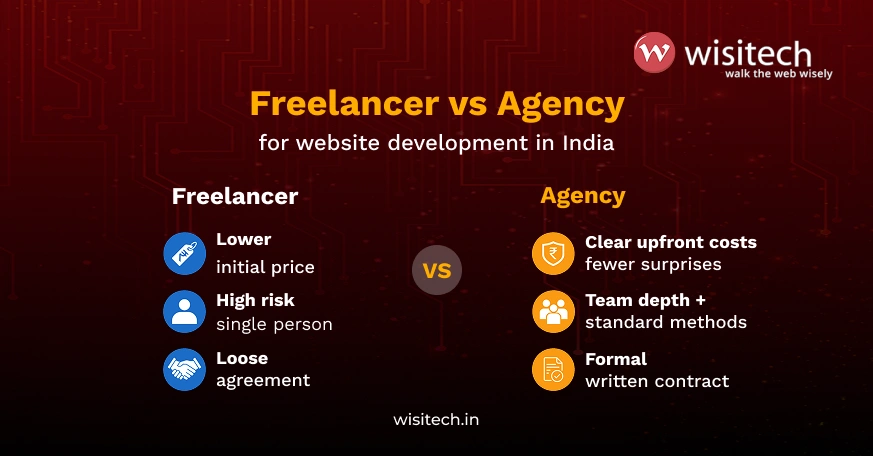
You have a website project. You have quotes from a freelancer and from a website development company. The freelancer is quoting 60,000. The agency is quoting 3,50,000. The gap looks enormous, and neither party is giving you a straight answer about whether it is actually justified. This guide gives you a practical framework for hiring a freelancer vs agency for website development in India, covering cost, risk, and accountability with real INR benchmarks and real failure scenarios.
The 60-second verdict
Hire a freelance web developer when the project is simple, well-scoped, the budget is under 1.5 lakh, and you have the time and capacity to actively manage delivery yourself.
Hire a website development company when the project involves ecommerce, custom functionality, a tight launch deadline, post-launch support requirements, or any scenario where a single person going dark would derail your business.
The price gap between the two models is real, but freelancer vs agency for website development in India is ultimately a decision about balancing cost, risk, and accountability. The question is which gap matters more for your specific project.
Freelancer vs agency: The 3-axis comparison
| Axis | Freelancer | Website development company |
|---|---|---|
| Cost | Lower upfront cost; higher hidden risk cost | Higher upfront cost; predictable total cost of ownership |
| Risk | Single point of failure; availability risk; quality variance | Team redundancy; structured QA; process-driven delivery |
| Accountability | Personal, informal, hard to enforce contractually | Business entity, formal contract, SLA, escalation path |
Understanding freelancer vs agency for website development in India becomes much easier when you compare the two across cost, risk, and accountability instead of focusing on price alone.
Cost: What you actually pay with a freelancer vs an agency
The visible cost difference between hiring a freelance web developer in India and a website development company is significant. But the visible cost is only part of the equation. The total cost of ownership includes your own time spent managing the project, the cost of delays, and the cost of rework if things go wrong.
Freelancer cost benchmarks in India (2026)
Based on current market data across platforms and direct project engagements, freelance web development costs in India in 2026 fall broadly into the following ranges:
| Project type | Freelancer INR range | Typical timeline | Notes |
|---|---|---|---|
| Basic 5-7 page business site | 25,000 – 80,000 | 2 – 5 weeks | WordPress or template-based |
| Custom WordPress site | 60,000 – 2,00,000 | 4 – 10 weeks | Custom theme, plugins |
| Ecommerce store (Shopify/WooCommerce) | 80,000 – 3,50,000 | 6 – 14 weeks | Quality varies widely |
| Custom web application | 2,00,000 – 8,00,000 | 12 – 24 weeks | High availability risk |
Figures are approximate market benchmarks based on current India freelance market data as of May 2026. Actual costs vary significantly by skill level, city, and project scope. All figures exclude 18% GST where applicable. These are indicative ranges, not guaranteed quotes.
Agency cost benchmarks in India (2026)
A registered website development company in India prices projects to cover a full team: project manager, designer, developer, QA, and post-launch support. This is why web design and development services from a registered agency cover the full scope, from visual design to deployment, while a freelancer typically specialises in one layer. The cost reflects that structure:
| Project type | Agency INR range | Typical timeline | Notes |
|---|---|---|---|
| Basic 5-7 page business site | 80,000 – 2,50,000 | 4 – 8 weeks | Includes PM, QA, support |
| Custom WordPress site | 2,00,000 – 6,00,000 | 6 – 12 weeks | Custom design, full stack |
| Ecommerce store (Shopify/WooCommerce) | 2,50,000 – 10,00,000 | 8 – 16 weeks | Payment, GST, logistics |
| Custom web application | 6,00,000 – 25,00,000+ | 14 – 30 weeks | Architecture, QA, SLA |
Figures are approximate market benchmarks as of May 2026. Actual agency quotes vary by company size, city, tech stack, and project complexity. All figures exclude 18% GST. Post-launch support and maintenance are typically priced separately.
The hidden cost of choosing wrong
The cost comparison above shows the upfront difference. What it does not show is the rework cost. When a freelance web developer delivers substandard code or goes dark mid-project, Indian businesses typically spend 1.5 to 3 times the original project budget to have the work audited, fixed, or rebuilt by a different developer or agency. A 60,000 freelance project that requires 1,50,000 in rework has a true cost of 2,10,000, which is often higher than a mid-tier agency would have charged for the same scope.
This is not a reason to avoid freelancers entirely. It is a reason to price in the risk honestly before making the decision. For projects where the cost of failure is low, a freelancer can be excellent value. For projects where a bad outcome would directly impact revenue, leads, or brand credibility, the agency premium is often justified by the risk reduction alone.
This is why freelancer vs agency for website development in India should always be evaluated based on the total cost of ownership rather than the initial quote.
Risk: What can go wrong with each model
When hiring a freelancer vs agency for website development in India, risk is the most underweighted factor. Most buyers compare quotes without pricing in the probability and cost of things going wrong. Here is an honest breakdown of the risks on each side.
Risks of hiring a freelance web developer in India
- Single point of failure. If your freelancer gets sick, takes on a bigger client, or simply stops responding, your project has no fallback. There is no team to pick up where they left off.
- Availability drift. Freelancers manage multiple projects simultaneously. Yours will share attention with three to five others. Timelines that looked firm at the start of the project often drift when a more urgent client demands more hours.
- Inconsistent code quality. Without peer review or internal QA, the quality of a freelancer’s output depends entirely on their individual discipline. Code that works on launch can be difficult or expensive to maintain, extend, or hand over to another developer.
- No structured post-launch support. If something breaks two weeks after launch, you are dependent on the same freelancer’s availability and willingness to fix it. There is no SLA, no ticketing, and no escalation path.
- Scope creep with no process. Without a formal change management process, scope changes in a freelance engagement often lead to disputes about what is in scope, additional charges with no prior agreement, or work stopping entirely.
- IP and code ownership gaps. In India, copyright defaults to the developer unless the contract explicitly transfers it. Many freelance engagements operate on informal agreements that leave the client with no legal ownership of their own website’s code.
- Demanding money for small updates. A pattern common in informal freelance engagements: post-launch updates that should reasonably fall within scope are renegotiated as new paid work, sometimes at rates that do not match the original agreement.
Risks of hiring a website development agency in India
- Juniorization after the pitch. The agency presents senior developers during the sales process and assigns junior team members to the actual build. Ask specifically who will be doing the work, by name, before you sign.
- Process overhead on small projects. Agency project management structures that work well for 10 lakh projects add unnecessary complexity and cost to 1.5 lakh brochure sites. Match the model to the project size.
- Communication layers. In large agencies, the person you speak to is rarely the person building the product. Miscommunication between account managers and developers is a common source of scope disputes.
- Lock-in through proprietary systems. Some agencies build on proprietary page builders or internal frameworks that make it difficult to move to another vendor later. Always confirm you will receive all source code, credentials, and repository access on final payment.
Accountability: Who is actually responsible when things go wrong
Accountability is what separates the experience of hiring a freelancer vs agency for website development in India most sharply. When evaluating freelancer vs agency for website development in India, this is where the difference becomes most obvious. With a registered website development company, you have a business entity, a formal contract, a GSTIN you can verify, and an escalation path if deliverables are not met. With a freelancer, you have a personal relationship and whatever was written in a WhatsApp chat or email exchange.
What accountability looks like with an agency
- A written contract with named deliverables, milestone-based payments, and a defined timeline.
- A GSTIN you can verify on the official GST portal and a company registration you can check on the MCA portal.
- A post-launch SLA defining response times, what is covered, and for how long.
- Source code and IP transfer to the client on final payment, explicitly stated in the contract.
- A named project manager as a single point of contact with a backup if they are unavailable.
What accountability looks like with a freelancer
Accountability with a freelance web developer is entirely dependent on the individual and the strength of your written agreement. A senior, experienced freelancer with a professional contract can be as accountable as a boutique agency. A junior freelancer working on verbal terms is a significant risk regardless of their technical skill. The difference is that with a freelancer, you are dependent on one person’s character and capacity. With a website development company, accountability is structural.
If you choose a freelancer, these are the minimum contractual protections you must have in place: a written agreement with defined deliverables and timeline, milestone-based payments tied to verified delivery, an IP transfer clause assigning all code and credentials to you on final payment, a defined process for scope changes, and a post-launch support commitment with a specified response window.
Ecommerce website development: freelancer or agency for D2C brands
For ecommerce website development services, the freelancer vs agency question has a clearer answer than for brochure sites. A live ecommerce store handling orders, payments, and customer data has zero tolerance for downtime, buggy checkout flows, or a developer who is unavailable when something breaks on the day of a sale campaign.
Ecommerce builds require platform-specific knowledge (Shopify, WooCommerce, or custom), payment gateway integration (Razorpay, PayU, Cashfree), GST-compliant invoicing setup, shipping aggregator integration, and Core Web Vitals performance that directly affects both conversion rate and organic rankings.
Freelancers with genuine expertise in all of these areas do exist, but they are rare and typically charge rates that close the gap with boutique agencies. For most Indian D2C brands, a specialist website development company with ecommerce experience is the lower-risk path for this type of project.
Enterprise web development services: why agencies win at scale
For enterprise web development services, B2B portals, SaaS products, multi-tenant platforms, or complex web applications built on Laravel or custom PHP, hiring a freelancer is not a viable model. Enterprise projects require architecture reviews, code reviews, API development, QA at every sprint, deployment pipelines, security testing, and documentation. These are team-based disciplines that a single individual cannot sustain.
If your project budget is above 8 to 10 lakh, the project involves custom backend logic or database architecture, or the website will be a core piece of business infrastructure, custom website development through a registered agency with a verifiable track record is not just the better option. It is the only option that gives you meaningful protection if the project goes sideways.
Custom website development: When you outgrow what a freelancer can deliver
There is a natural project boundary where the question of hiring a freelancer vs agency for website development in India becomes straightforward. A freelancer can build a great brochure site, a clean WordPress blog, or a standard Shopify store. Custom website development that involves bespoke database architecture, complex third-party API integrations, role-based access systems, or multi-layered checkout flows is categorically different work. It requires a team with specialists in different disciplines, not a generalist working alone.
Signs you have outgrown what a single freelance web developer can reliably deliver: the project requires both front-end design and complex back-end logic; you need a staging environment, version control, and deployment pipelines from day one; the site will handle sensitive customer data or payments at scale; or you need post-launch SLA support as a business-critical requirement rather than a nice-to-have.
When to switch from freelancer to agency or vice versa
Switch from freelancer to agency when:
- Your freelancer has missed two or more agreed milestones without a clear explanation.
- Communication has become irregular and you are consistently chasing for updates.
- The project scope has grown to include ecommerce, web application features, or enterprise requirements.
- You have launched but the site has recurring bugs that are not being fixed promptly.
- You need ongoing web development support and maintenance and your freelancer is not consistently available or has no formal retainer structure.
- The business stakes of the website have increased since you started: you are now running paid ads, a festive campaign, or a product launch that depends on the site performing reliably.
Stick with your freelancer when:
- They have delivered on time and to spec consistently.
- The project scope remains simple and well-defined.
- You have a written contract with clear IP transfer and support terms.
- The cost saving is meaningful and the risk profile of the project is low.
- They have demonstrated the ability to handle post-launch issues promptly.
Contract essentials: Protecting yourself regardless of which model you choose
Whether you hire a freelance web developer or a company, these contract clauses are non-negotiable:
- Deliverables listed explicitly. Not ‘a website’ but specific pages, features, integrations, and technical specifications.
- Milestone-based payments tied to verified delivery. Never pay in full upfront. A standard structure: 30% on kickoff, 40% on staging delivery and review, 20% on pre-launch approval, 10% on go-live.
- Source code and IP transfer clause. All code, repositories, design files, database schemas, and credentials transfer to you on final payment. This clause is often missing from freelance agreements and must be added explicitly.
- Timeline with defined review windows. A project schedule with milestone dates and a clear process for requesting changes or flagging delays.
- Scope change process. How additional requirements are scoped, priced, and approved. Without this, every change becomes a dispute.
- Post-launch support terms. What is covered, for how long, at what response time, and at what cost after the included warranty period.
- Exit clause. If the engagement ends early, what data and files are handed over, in what format, and within what timeframe?
Decision matrix: matching your project to the right model
| Your situation | Recommended model | INR budget range | Key condition |
|---|---|---|---|
| Simple brochure site, first website | Experienced freelancer | 30,000 – 1,00,000 | Written contract, IP clause, milestone payments |
| WordPress site with custom design | Freelancer or boutique agency | 80,000 – 3,00,000 | Portfolio verified, past clients contacted |
| D2C ecommerce store | Specialist agency | 2,50,000 – 10,00,000 | Ecommerce case studies, Razorpay experience |
| B2B portal or custom web application | Full-stack web development company | 6,00,000 – 25,00,000 | Architecture review before sign-off |
| Enterprise platform or SaaS product | Agency with dedicated team model | 15,00,000 – 1 crore+ | Escrow, SLA with penalty clause, named PM |
| MVP for funded startup, 8-12 week deadline | Product-focused agency | 3,00,000 – 10,00,000 | Iterative delivery model, sprint reviews |
| Ongoing maintenance of an existing site | Agency on monthly retainer | 8,000 – 40,000 per month | Defined scope, response SLA |
Still deciding? Talk to Wisitech before you commit.
If you have been through a bad freelance experience, you know the pattern. Chasing updates. Getting billed for things that should be included. Wondering if your website will actually hold up when it matters. Wisitech is built for exactly that situation.
We are a website development company with 27 years of experience and 2,500+ projects delivered for clients across India, the US, and the Middle East. We build on WordPress, Laravel, and custom PHP, hand-coded, no drag-drop builders, no template shortcuts. Our custom website development services come with written contracts, milestone-based payments, source code transfer on final payment, and a structured post-launch AMC. You know exactly what you are getting, and you own it completely when it is done.
Our web development services cover the full stack: front-end, back-end, database, and deployment as a single integrated team. We also offer dedicated web developers in India on a monthly retainer for businesses that need ongoing development without the cost of a full in-house hire.
If you are still weighing up hiring a freelancer vs agency for website development in India and want a direct, no-pitch conversation about what your project actually needs, get in touch with us. We will tell you honestly if a freelancer is the better fit for your scope, and if it is us, we will tell you exactly why.
27 years. 2,500+ projects. Fortune 500 experience. Creativity leads, AI amplifies.