

Indian businesses today have more options than ever when building a digital presence. From low-cost website builders and ready-made templates to fully customized enterprise platforms, the choices can feel overwhelming. This is where understanding custom website development becomes important. Custom website development refers to building a website specifically around a business’s goals, workflows, branding, integrations, and user experience instead of relying on pre-designed templates.
For startups, ecommerce brands, SaaS companies, and enterprises in India, the real question is not whether template websites work. The real question is whether they can support long-term growth, performance, scalability, and customer expectations in an increasingly competitive digital market.a
This guide explains the practical differences between template websites and custom websites, and how a professional web development company can help Indian businesses prioritize before making a decision.
What is the difference between a custom and a template website?
A template website is built using pre-designed layoutsa and fixed structures. Businesses customize colors, text, and images, but the underlying framework remains largely unchanged.
A custom website, on the other hand, is designed and developed specifically for a business’s operational needs, customer journey, and growth goals.
Here is a simplified comparison:
| Feature | Template Website | Custom Website |
| Design Flexibility | Limited | Fully customizable |
| Scalability | Moderate | High |
| Performance Optimization | Generic | Business-specific |
| SEO Control | Basic | Advanced |
| Integrations | Limited | Flexible |
| Security | Standard | Customizable |
| Branding | Similar to other sites | Unique identity |
| Long-Term Growth | Restricted | Scalable |
For many Indian businesses, the choice depends on growth plans, technical requirements, and customer expectations rather than just the budget alone.
Custom website development vs template: side-by-side business reality
Template websites are popular because they are fast and affordable. They are often used by early-stage startups, freelancers, local businesses, and businesses testing a new market.
However, templates come with limitations that become more visible as businesses scale.
Where template websites work well
Template websites are suitable for:
- Small brochure websites
- Portfolio websites
- Early-stage startup landing pages
- Temporary campaign websites
- Businesses with limited feature requirements
For businesses looking for speed and low upfront investment, templates can provide a practical starting point.
Where custom website development services become necessary
As operations grow, businesses usually require:
- Advanced SEO architecture
- Faster website performance
- Custom dashboards and portals
- CRM or ERP integrations
- Ecommerce scalability
- Advanced security controls
- API-based automation
- Better mobile optimization
This is where custom web development becomes a strategic investment instead of just a design decision.
Businesses operating in competitive industries often realize that template websites struggle to support complex operational workflows and customer expectations.
How much does custom website development cost in India?
Website costs in India vary significantly depending on complexity, integrations, and scalability requirements.
| Website Type | Estimated Cost Range | Suitable For |
| Template Website | ₹50,000 – ₹2,00,000 | Small businesses & freelancers |
| Semi-Custom Website | ₹2,00,000 – ₹5,00,000 | Growing startups |
| Fully Custom Website | ₹5,00,000+ | SaaS, ecommerce, enterprises |
The lower entry cost of templates makes them attractive initially. However, businesses often spend more later when trying to fix scalability, SEO, or performance limitations.
Custom development may require a larger initial investment, but it often reduces long-term operational limitations and redesign costs.
Which option is better for your business type?
The right solution depends heavily on your business model and future plans.
For startups
Indian startups with limited budgets may initially benefit from template websites if their immediate goal is launching quickly.
However, startups expecting rapid user growth, investor visibility, or advanced product functionality should consider custom development earlier.
Template websites may slow down scaling later due to structural limitations.
For SaaS companies
SaaS companies usually require:
- User dashboards
- Subscription systems
- Product onboarding workflows
- API integrations
- Data security layers
- Advanced UI/UX systems
These requirements often make template websites impractical.
A web application development company can help SaaS businesses create scalable digital platforms aligned with product growth.
For ecommerce businesses
Indian ecommerce businesses face additional challenges such as:
- GST configuration
- UPI integrations
- COD workflows
- Logistics APIs
- Multi-vendor systems
- Inventory synchronization
Template ecommerce stores may work initially, but growing ecommerce brands usually need more flexibility and operational control.
This is especially true for businesses managing large product catalogs or custom checkout experiences.
For enterprises
Enterprises typically require:
- High security standards
- Internal workflow automation
- Multiple user roles
- ERP integration
- Custom portals
- Multi-location functionality
These requirements usually demand complex website development with scalable architecture and dedicated backend systems.
Custom website development process in India
A structured development process improves project quality and scalability.
1. Discovery and requirement analysis
The development team studies:
- Business objectives
- User behavior
- Competitor positioning
- Technical requirements
- Operational workflows
2. UI/UX planning
Wireframes and user journeys are designed to improve navigation, engagement, and conversions.
3. Frontend and backend development
Developers build the actual platform using technologies suited to project requirements.
Many businesses prefer working with a PHP development company or Laravel-focused teams for scalable backend systems.
4. Integrations and automation
The website is integrated with:
- CRM systems
- Payment gateways
- Analytics tools
- Marketing automation platforms
- ERP software
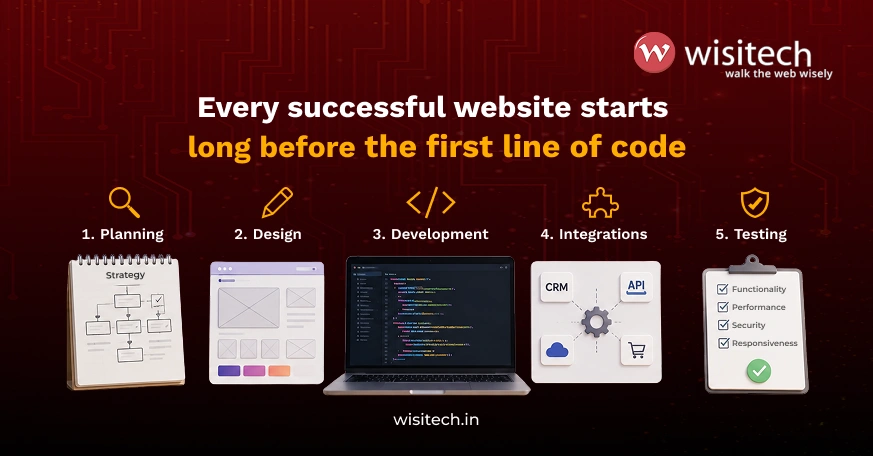
5. Testing and optimization
Performance, security, responsiveness, and browser compatibility are thoroughly tested before launch.
6. Deployment and maintenance
After deployment, ongoing optimization and maintenance help maintain performance and security standards.
India-specific website development considerations
Indian businesses operate in a unique digital environment that affects website decisions significantly.
Mobile-first user behavior
Most Indian users access websites through smartphones. Custom websites allow businesses to optimize mobile performance more effectively than many templates.
GST and payment gateway integrations
Businesses often require:
- GST invoicing
- UPI support
- Razorpay integration
- PayU or CCAvenue support
Custom development offers greater flexibility for these integrations.
Regional language support
Businesses targeting Tier-2 and Tier-3 cities increasingly need multilingual interfaces.
Custom websites provide better control over localization and regional language experiences.
Data privacy and compliance
India’s evolving digital compliance landscape requires businesses to think carefully about security, customer data handling, and backend infrastructure flexibility.
Should Indian businesses choose templates or custom websites?
There is no universal answer. A template website may be enough for businesses with simple informational needs and limited scalability requirements. However, businesses planning to grow digitally, automate operations, improve SEO performance, or build differentiated customer experiences usually benefit more from custom website development.
The decision should not be based only on upfront cost. It should be based on long-term operational flexibility, scalability, and business goals.
At Wisitech, we help startups, ecommerce brands, SaaS companies, and enterprises choose the right website development approach based on their operational needs, performance expectations, and future expansion plans. Consult us to learn how our custom web development solutions can support your business growth with scalable, SEO-focused, and performance-driven digital platforms.
Disclaimer: Website pricing, scalability comparisons, and development insights mentioned in this blog are indicative estimates based on publicly available data from Indian web development companies, freelancer marketplaces, SaaS platforms, and industry benchmarks as of 2026. Actual website development costs and technical requirements may vary depending on business goals, feature complexity, integrations, technology stack, security requirements, and the expertise of the development partner selected.