

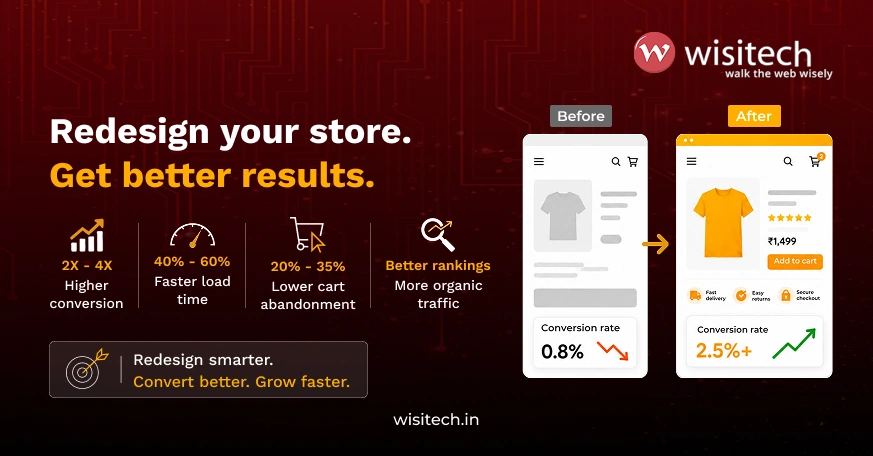
You are spending on Meta and Google Ads. Traffic is coming in. But the conversion rate is stuck below 1%, cart abandonment is high, and mobile users drop before checkout. The store works but it does not perform. For most growing D2C brands and ecommerce businesses in India, this is the exact moment that triggers the redesign conversation. Ecommerce website redesign in India is not a cosmetic exercise. Done correctly, it is a structural intervention that connects UX, performance, and SEO into a system that converts better than the one it replaces.
This guide covers the signals that tell you a redesign is overdue, the results a well-executed ecommerce website redesign actually delivers, what the process looks like, and how to protect your SEO rankings while the work is in progress.
What is an ecommerce website redesign?
An ecommerce website redesign is the process of rebuilding or significantly restructuring an online store’s UX, visual design, performance, and technical architecture to improve conversion rates, organic search visibility, and buyer experience. It is distinct from a cosmetic refresh (changing colors and fonts) and distinct from a full platform migration (changing the underlying ecommerce platform). A redesign may involve one or both, depending on what is blocking performance.
Most Indian ecommerce stores that need a redesign are not broken. They are functional but underperforming. The store converts at 0.8% when the category benchmark is 2.5%. Mobile checkout completion is 40% lower than desktop. Page load time is 6 seconds on a mid-range Android. These are redesign signals, not launch signals.
10 signs your ecommerce store needs a redesign
Run through this list before committing to any scope. A redesign is justified when multiple signals appear together, not when one metric dips for a week.
1. Your conversion rate is below 1% with meaningful traffic
The average Indian ecommerce conversion rate is 1.5 to 2.5% for D2C brands running paid acquisition. If you are consistently below 1% with more than 10,000 monthly sessions, the site structure is the problem. More traffic will not fix a site that does not convert. More ad spend will make the loss bigger.
2. Mobile checkout abandonment is significantly higher than desktop
Over 85% of Indian ecommerce orders happen on mobile. If your mobile conversion rate is more than 40% lower than your desktop rate, the mobile UX is broken in ways that cosmetic changes will not fix. This is a structural problem that requires redesigning the product page, cart, and checkout flow specifically for thumb-driven navigation on mid-range Android devices.
3. Page load time exceeds 3 seconds on mobile
A 1-second delay in load time reduces conversions by up to 7%. On a 5-second page, you have already lost over 25% of potential conversions before the user sees the first product image. Google’s Core Web Vitals update in 2025 made INP (Interaction to Next Paint) a ranking signal, meaning slow checkout interactions now directly affect your organic rankings as well as your conversion rate.
4. Your product pages look identical to competitors
If your product page template uses the same layout as every other WooCommerce or Shopify store, buyers have no reason to trust you over a competitor. Product pages need to answer buyer objections, build trust through reviews and social proof, and guide the visitor toward a decision. Generic templates do none of this.
5. Add-to-cart rate is low even on high-traffic product pages
If a product page gets 500 sessions per month and generates 10 add-to-carts, the page is not doing its job. Low add-to-cart rate on a high-traffic page indicates either a messaging problem (the value proposition is unclear), a trust problem (no reviews, no social proof), or a UX problem (the button is buried or the page feels unfinished).
6. Your site is not optimized for AI search
Google AI Overviews, Perplexity, and ChatGPT Browse now answer product comparison queries directly. If your product and category pages do not have FAQ schema, structured product descriptions, and correct schema markup, you are invisible to a growing share of commercial-intent queries. This is a 2026-specific trigger that did not exist for older store designs.
7. The site was built 3 or more years ago and has never been structurally reviewed
Ecommerce design and performance standards change significantly every 2 to 3 years. A store built in 2021 was designed before Core Web Vitals became a ranking factor, before AI search emerged, before WhatsApp Commerce became an expectation for Indian buyers, and before mobile conversion rate benchmarks rose to current levels. Age alone is not a trigger, but age combined with any other signal on this list usually is.
8. Your SEO traffic is flat despite consistent content investment
If you have been investing in blog content or backlinks for 12 months and organic traffic has not moved, the technical structure of the site is usually the bottleneck. Crawl budget issues, poor product page templates, missing schema, and slow Core Web Vitals all limit how much ranking improvement content and links can produce. A website redesign without losing SEO addresses the structural issues that prevent your existing content investment from paying off.
9. The site cannot support your next phase of growth
You are launching a new product category. You are entering a new market. You are scaling paid acquisition and need landing pages that your current CMS cannot produce without developer involvement. You are preparing for a fundraising round, and your website no longer reflects your brand’s current stage. In all these situations, an ecommerce website redesign in India is a strategic investment driven by future growth rather than existing problems.
10. Your checkout does not support the way Indian buyers want to pay and communicate
Indian ecommerce buyers increasingly expect WhatsApp-native buying flows, COD confirmation via WhatsApp, and UPI-first checkout sequences. Stores built before 2024 typically do not have these integrations natively. Adding them to an old codebase often requires structural changes to the checkout flow that make a redesign the more practical path than patching the existing site.
What results should you expect from an ecommerce website redesign in India?
This is the question most Indian ecommerce founders ask before committing to a redesign budget. The honest answer is: it depends on the severity of your current challenges and how comprehensive the redesign is. While results vary, a well-executed ecommerce website redesign in India can consistently improve user experience, conversions, and overall business performance when planned strategically.
| Metric | Typical before | Typical after | Timeframe |
| Overall conversion rate | 0.6% to 1% | 1.5% to 2.8% | 8 to 12 weeks post-launch |
| Mobile checkout completion | 30% to 45% lower than desktop | Within 15% of desktop rate | Immediate post-launch |
| Page load time (mobile) | 5 to 9 seconds | Under 2.5 seconds | Immediate post-launch |
| Cart abandonment rate | 70% to 85% | 55% to 68% | 4 to 8 weeks post-launch |
| Organic search traffic | Flat or declining | 10 to 30% growth at 3 to 6 months | 3 to 6 months with SEO-safe cutover |
| Add-to-cart rate | 3% to 5% | 6% to 9% | 4 to 8 weeks post-launch |
Results are directional benchmarks based on Indian ecommerce redesign projects. Actual outcomes vary by traffic quality, offer strength, competitive landscape, and scope of redesign.
What Wisitech has observed across Indian ecommerce redesign projects
The single most consistent finding: conversion rate improvements come fastest from mobile checkout restructuring, not from homepage redesigns. Most Indian ecommerce teams invest in the homepage because it is the most visible page. But most conversions happen or fail on product pages and checkout flows, which are where structural UX improvements produce the fastest measurable revenue impact.
The second most consistent finding: stores that redesign without addressing Core Web Vitals see smaller conversion improvements than stores that treat performance as a design requirement, not an afterthought. A visually redesigned store that still loads in 5 seconds on mobile is a better-looking slow store, not a better-performing one.
Ecommerce redesign vs full rebuild: which one do you need?
This is a question every ecommerce business should answer before budgeting. Ecommerce website redesign in India can mean different things depending on the current state of the codebase:
| Scope | Redesign (same platform) | Rebuild (platform change or new codebase) |
| When to choose | Platform is healthy, codebase is manageable | Platform is limiting growth or codebase is too technical-debt-heavy to extend |
| What changes | UX, visual design, templates, performance | Platform, codebase, architecture, and everything above |
| What stays | Platform, database, product catalog | Content, URLs (via 301 mapping), SEO history |
| Timeline | 6 to 12 weeks | 12 to 20 weeks |
| SEO risk | Lower with correct redirect handling | Higher but manageable with proper URL mapping |
| Typical INR range | 3 lakh to 8 lakh | 8 lakh to 25 lakh |
The decision between redesign and rebuild comes down to one question: can the current platform support where the business needs to go in the next 24 months? If yes, redesign on the existing stack. If no, rebuild on the right platform with a full URL migration and SEO-safe cutover.
How to protect your SEO rankings during an ecommerce redesign
This is the primary concern for every ecommerce business that has built organic traffic. A website redesign without losing SEO requires deliberate planning before a single line of code changes. Wisitech runs the following SEO-safe cutover process on every redesign engagement:
- Pre-launch SEO audit. Crawl the existing site to inventory every indexed URL, its ranking keywords, its backlink profile, and its current search appearance. Nothing is changed until this baseline is documented.
- URL mapping. Every existing URL is mapped to its new destination. Where URLs change (as they often do when site architecture is restructured), a 301 redirect is defined for each. This map is the backbone of SEO continuity.
- Structured data parity. All schema markup from the existing site is recreated or improved on the new site before launch. Product schema, review schema, breadcrumb schema, and FAQ schema must all be present and validated.
- Parallel-sandbox cutover. The redesigned site runs on a staging environment and is crawled by an SEO tool to verify all redirects, check for orphaned pages, and confirm that no indexed content has been accidentally removed.
- Post-launch rank watch. For 30 days after launch, rankings are monitored weekly. Any URL that shows an unexpected ranking drop is investigated immediately. Most drops in the first two weeks are temporary; drops that persist beyond three weeks indicate a redirect or indexation issue that requires fixing.
- Google Search Console resubmission. The new sitemap is submitted immediately after launch. Affected URLs are requested for recrawling. Bing Webmaster Tools receives the same treatment for Perplexity and Copilot coverage.
What the ecommerce redesign process looks like
A well-run ecommerce redesign follows a structured process that prevents the three most common failure modes: launching a site that looks better but converts worse, losing SEO rankings during the migration, and running over timeline and budget because scope was not defined upfront.
Phase 1: Discovery and audit (weeks 1 to 2)
UX audit of the existing store using heatmaps (Clarity or Hotjar), session recordings, and GA4 funnel analysis. SEO audit covering crawl health, Core Web Vitals baseline, schema inventory, and indexed URL list. Competitive analysis of three to five category leaders to identify the UX and trust patterns that define buyer expectations in the category.
Phase 2: Information architecture and wireframes (weeks 2 to 4)
New site architecture designed around buyer journey, not internal product taxonomy. Wireframes for product page, category page, cart, and checkout templates before any visual design starts. This is the phase most agencies skip, and it is the reason their redesigns look good but do not convert.
Phase 3: Visual design (weeks 3 to 5)
Brand-aligned visual design applied to approved wireframes. Mobile-first design that treats desktop as the secondary breakpoint, not the primary one. Trust stack design: where reviews appear, how social proof is displayed, how the brand builds credibility before the add-to-cart button.
Phase 4: Development and performance build (weeks 5 to 10)
Hand-coded development on the approved stack. WooCommerce website redesign, Shopify website redesign, or custom PHP builds all follow the same Core Web Vitals compliance requirements: AVIF or WebP image formats, lazy loading, server-side caching, CDN configuration, and third-party script audit to remove performance-blocking code. Schema markup is implemented during development, not retrofitted after launch.
Phase 5: QA, SEO-safe cutover, and post-launch monitoring (weeks 10 to 12)
Full QA across three device types (mid-range Android, iPhone, desktop). Redirect map verification. Schema validation. Staging-to-production cutover. Search Console submission. 30-day rank watch. Website redesign and development projects that skip formal QA are the ones that produce ranking drops and checkout bugs in the weeks after launch.
Ecommerce redesign by platform
The process above applies across all major platforms, but the implementation details differ. Here is what platform-specific redesign involves:
Shopify website redesign
A Shopify website redesign typically involves rebuilding the theme from scratch rather than modifying an existing theme, because most performance and UX problems on Shopify stores are rooted in bloated theme code that accumulates over years of app installations. Custom Liquid templates for product and collection pages, lazy loading at the theme level, and app audit to remove unused scripts that add payload to every page load.
WooCommerce website redesign
A WooCommerce website redesign addresses the performance problems that accumulate as WooCommerce stores scale: plugin conflicts that slow checkout, database query optimization for large catalogs, custom templates for product and category pages that replace generic theme output, and Core Web Vitals fixes at the PHP and server level. Most WooCommerce stores Wisitech inherits for redesign have between 25 and 40 active plugins. The redesign process typically reduces this to 12 to 18 through custom code that replaces plugin functionality.
Replatforming with redesign: WooCommerce to Shopify
The most common replatforming project Wisitech handles in India is WooCommerce to Shopify. Website replatforming services that combine platform migration with redesign are more complex than either task alone. Every product, customer, order, and review must be migrated. Every URL must be mapped with a 301 redirect. The redesign happens on the new platform simultaneously. Timeline for a store with under 500 products: 12 to 16 weeks. Above 500 products: 16 to 24 weeks.
India-specific considerations for ecommerce redesign in 2026
Mobile-first design for Indian shoppers
India’s ecommerce order share on mobile is over 85%, with a significant proportion coming from mid-range Android devices with 4G connections. Ecommerce website redesign in India must treat mobile as the primary design surface and desktop as secondary. This is not responsive design applied after the fact. It is designing for a 390px viewport first, then scaling up. The specific issues that matter for Indian mobile shoppers: thumb reach for add-to-cart buttons, single-column product grids, WhatsApp contact as a visible trust element, and COD as a first-class payment option in the checkout flow.
WhatsApp Commerce integration
Indian buyers increasingly initiate and complete purchases via WhatsApp. A redesign that does not include a WhatsApp Commerce integration, at minimum a visible click-to-WhatsApp button on product pages and a pre-filled cart share function, is missing a conversion pathway that matters specifically in the Indian market.
Festive season timing
The Indian festive season from September to November (Diwali, Big Billion Days, GOSF) drives a disproportionate share of annual ecommerce revenue for most D2C brands. A redesign should be planned to complete by August at the latest if the goal is to capture festive traffic. A launch in October is too late to benefit from the organic ranking recovery period that follows any site change.
DPDP Act 2023 compliance
India’s Digital Personal Data Protection Act 2023 requires ecommerce stores to implement consent architecture for personal data collection. This affects the homepage cookie banner, the checkout data collection form, and any third-party analytics or retargeting pixel setup. Stores that have not redesigned since 2023 typically do not have compliant consent flows and are exposed to regulatory risk.
Ecommerce website redesign cost in India
Ecommerce website redesign in India costs vary significantly by scope, platform, catalog size, and agency tier. The table below gives directional INR benchmarks for the Indian market as of June 2026.
| Scope | INR range | Timeline | Best for |
| Template-based redesign (Shopify/WooCommerce) | 1,50,000 to 3,50,000 | 4 to 6 weeks | Startups with tight budgets |
| Custom UX-led redesign, same platform | 3,50,000 to 8,00,000 | 8 to 12 weeks | D2C brands scaling paid acquisition |
| Full redesign with replatforming | 8,00,000 to 20,00,000 | 12 to 20 weeks | Businesses migrating from legacy platforms |
| Enterprise redesign, 500+ products | 15,00,000 to 35,00,000 | 16 to 28 weeks | Large catalog brands with complex integrations |
Cost ranges are indicative benchmarks for custom website redesign services in India as of June 2026. Actual costs vary by agency, scope, payment gateway integrations, and custom feature requirements. All figures exclude 18% GST and ongoing maintenance.
One observation Wisitech consistently makes during initial consultations: most Indian ecommerce businesses underestimate the cost of not redesigning. A store converting at 0.8% on 50 lakh per month in ad spend is generating 40 lakh in revenue from that traffic. The same traffic at a 2% conversion rate generates 1 crore. The delta is 60 lakh per month. A redesign at 6 lakh pays back in weeks, not years, if the underlying demand exists.
Wisitech’s ecommerce website redesign services
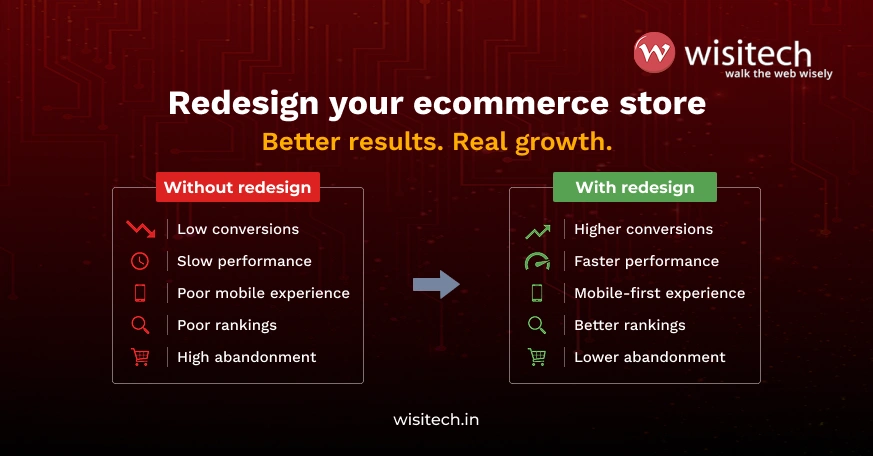
Wisitech delivers custom website redesign services for Indian D2C brands, funded startups, and established ecommerce businesses. Our redesign process starts with a UX and SEO audit before any design work begins. We diagnose before we design. Every redesign commitment includes a conversion rationale: we show you what is currently losing conversions and how the new design addresses it.
We build on Shopify, WooCommerce, CS-Cart, Laravel, and custom PHP. Our website speed optimization is built into every redesign, not charged separately. Core Web Vitals compliance is a delivery requirement, not an optional upgrade.
For businesses planning a platform migration alongside their redesign, our website replatforming services cover full URL mapping, 301 redirect implementation, product and customer data migration, and a 30-day post-launch SEO monitoring window. Your rankings do not need to drop during a well-executed migration.
If you are evaluating a professional website redesign for your ecommerce store, get in touch with us. We return a fixed-fee proposal within three working days of a discovery call.
27 years. 2,500+ projects. Fortune 500 experience. Creativity leads, AI amplifies.