

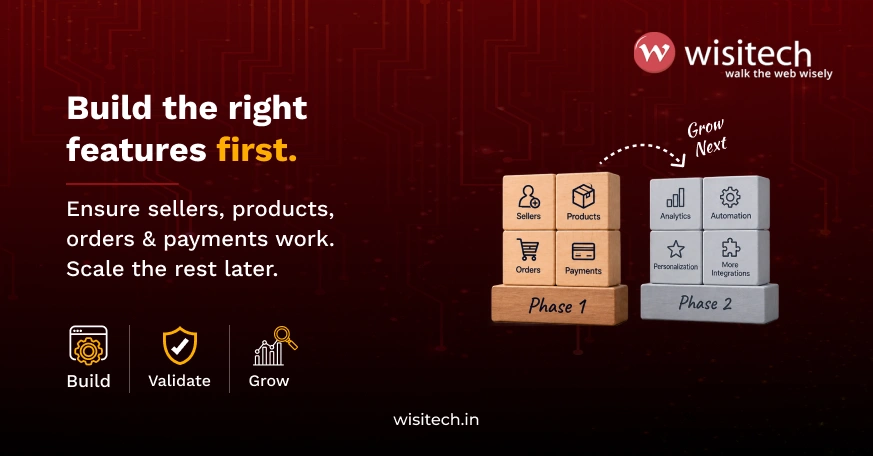
Your marketplace has 40 features on the roadmap, but your budget can realistically support 15.
That is where many marketplace projects go wrong.
Business owners often start by asking about the multi-vendor marketplace development cost in India, but the better first question is: What actually needs to be built for the marketplace to work?
A marketplace does not become viable because it has every feature competitors have. It becomes viable when sellers can join, list products, receive orders, get paid correctly, and customers can find and purchase what they need.
Everything else should earn its place on the roadmap.
This is especially important in India, where marketplace operations can involve multiple payment methods, GST considerations, seller verification, logistics integrations, commissions, returns, and different seller workflows. Building all of these at once can turn a manageable MVP into a long and expensive development project.
The practical approach is to separate the product into two phases: the capabilities required to prove the marketplace model and the capabilities that improve it after real users and sellers generate enough data.
Why feature prioritization matters more for marketplaces
A normal ecommerce store has one business operating the catalog, pricing, fulfillment, and customer experience.
A multi-vendor marketplace has several businesses operating through the same system.
That creates another layer of complexity.
A seller needs to create an account, submit products, manage inventory, process orders, and understand earnings. Customers need to search across sellers, compare products, complete checkout, and manage returns. The marketplace owner needs control over sellers, commissions, products, orders, payments, disputes, and reporting.
Every additional workflow creates development and testing requirements.
This is one reason the multi-vendor marketplace development cost in India can increase quickly when businesses treat every requested feature as a Phase One requirement.
The better approach is to identify the smallest system that can support the complete marketplace transaction.
If a feature does not help a seller get onboarded, help a customer purchase, help the marketplace process that transaction, or provide essential operational control, it should be questioned before it enters the first release.
What phase one actually needs to prove
Phase One should answer one business question:
Can the marketplace successfully connect sellers with customers and process transactions?
That sounds simple, but it gives you a strong filter for features.
1. Seller onboarding
Seller registration should be straightforward, but the marketplace owner still needs control.
The system may need seller profiles, business information, verification fields, approval workflows, and basic account management.
Do not build an elaborate seller reputation system on day one unless the business model depends on it.
The initial goal is to get legitimate sellers into the marketplace and make their next steps obvious.
2. Product listing and catalog management
Sellers need a reliable way to add products.
That includes product names, descriptions, pricing, images, inventory, categories, attributes, and relevant variations.
The important architectural decision is determining who owns the product information.
If every seller creates completely independent products, the catalog structure may work one way. If multiple sellers sell the same underlying product, product and seller relationships become more complex.
That decision can affect database structure, search, inventory, pricing, and the customer experience.
It should be resolved before development begins.
3. Customer accounts and marketplace search
Customers need to find products without fighting the interface.
Phase One should cover account creation, product discovery, category navigation, search, product details, cart management, and checkout.
Advanced personalization can wait.
A customer who cannot quickly find the right product will not care that the marketplace has an AI recommendation engine.
4. Checkout, payments, and order management
This is where marketplace development becomes fundamentally different from standard ecommerce.
The system needs to understand who receives the order, how the marketplace earns its commission, how seller earnings are calculated, and what happens when an order is cancelled or refunded.
Payment gateway integration also needs to be designed around the marketplace’s actual payout model.
For Indian businesses, this can involve INR payment processing, GST-related requirements, transaction records, and seller payout workflows.
This is an area where cutting corners during Phase One can create expensive redevelopment later.
5. Vendor dashboard
A seller dashboard does not need 50 reports.
Initially, sellers usually need to see and manage:
- Products
- Inventory
- Orders
- Order status
- Earnings
- Basic profile information
The dashboard should help sellers complete their daily work.
A sophisticated analytics suite can come later when there is enough marketplace activity to make those reports useful.
6. Marketplace administration
The marketplace owner needs more control than any individual seller.
The admin system should provide control over seller approvals, products, orders, commissions, customers, disputes, and marketplace settings.
This is one area where businesses sometimes underinvest.
A polished customer interface cannot compensate for a weak administration system when dozens or hundreds of sellers begin using the platform.
The features that should usually wait for phase two
Phase Two is where the marketplace starts optimizing rather than simply functioning.
The decision to delay these features does not mean they are unimportant. It means their value becomes clearer after the basic marketplace engine is working.
Advanced seller analytics
Once sellers have enough transactions, analytics become useful.
You can then introduce sales trends, conversion metrics, best-selling products, inventory insights, customer behavior, and other reporting features.
Building detailed dashboards before there is meaningful data often produces impressive screens with little business value.
Vendor marketing tools
Seller-specific coupons, promotional campaigns, sponsored placements, advanced merchandising, and vendor advertising can become powerful marketplace features.
But they should generally follow the core transaction workflow.
First make sure sellers can sell.
Then help them sell more.
Loyalty and rewards
Points, membership tiers, referrals, cashback, and loyalty programs can improve retention.
They also introduce additional business rules.
A loyalty system may affect order calculations, refunds, cancellations, promotions, and customer accounts.
If retention is not yet the primary problem, it may be better to postpone this complexity.
Personalized recommendations
Recommendations become more valuable when the marketplace has enough customer and product data.
Before that, a strong category structure and useful search experience will often deliver more immediate value.
Complex commission models
A basic commission model may be sufficient for launch.
Later, the marketplace might need different commission rates by seller, category, product, order value, promotional campaign, or seller tier.
These rules can become complicated quickly.
If the business model requires complex commissions from day one, they should obviously be part of Phase One. Otherwise, keep the initial logic as simple as the business model allows.
A better way to decide what gets built first
Feature prioritization should not happen through internal voting.
The loudest stakeholder should not automatically determine the roadmap.
A more useful method is to score every proposed feature against four questions:
Does it enable a transaction?
If removing the feature prevents the marketplace from completing its core transaction, it probably belongs in Phase One.
Does it reduce an important operational risk?
A feature that prevents incorrect payouts, duplicate orders, or seller approval problems may be more important than a visually impressive customer feature.
Does it support the business model?
If commissions are the primary revenue source, commission and payout functionality deserve more attention than secondary engagement features.
Can the feature be added safely later?
Some features are easy to introduce after launch. Others influence the underlying architecture.
Features that affect the data model, payment structure, product relationships, or order lifecycle deserve more architectural attention early.
This framework can reduce the multi-vendor marketplace development cost in India without reducing the marketplace to a basic website.
The objective is not to build less.
It is to build the right things first.
The architecture should be planned for phase two, even if the features are not
There is an important distinction between building a feature and planning for a feature.
A marketplace may not need advanced vendor analytics in Phase One.
But the underlying system should still collect the right information to support future reporting.
Similarly, you may not need a sophisticated loyalty engine at launch, but customer accounts, order records, and transaction data should be structured properly.
This is where experienced custom ecommerce development becomes valuable.
The goal is not to build every future feature immediately. It is to avoid making today’s MVP so rigid that tomorrow’s features require rebuilding the entire platform.
For example, if the marketplace might eventually support multiple commission structures, the data model should not hard-code one simplistic commission assumption into every order record.
If multiple sellers can eventually sell the same product, the catalog should be designed with that possibility in mind.
Good architecture creates room for growth without forcing the business to pay for unused functionality today.
What marketplace projects teach us about real-world complexity
Marketplace projects tend to reveal the same lesson: the visible website is only one part of the product.
In multi-seller work, the difficult problems often sit behind the storefront.
One marketplace project involved multiple sellers, product relationships, customer workflows, and administrative operations. The key challenge was not simply putting products on a website. The system had to define how sellers interacted with products, how transactions moved through the platform, and how administrators controlled the marketplace.
Another marketplace implementation involved a platform designed around multi-vendor operations. The lesson was similar: vendor management, product approval, commissions, orders, and administration have to work together as one operational system.
These experiences change how feature prioritization should be approached.
A marketplace should be designed around workflows, not a checklist of website features.
That distinction matters when evaluating an ecommerce development company in India.
Ask the development team to explain what happens when a seller joins, when two sellers sell related products, when an order contains products from different sellers, when a payment fails, when a seller is rejected, and when an order is refunded.
Those answers tell you more about marketplace expertise than a long list of technologies.
How feature decisions affect the budget
The multi-vendor marketplace development cost in India is influenced by far more than the number of pages.
Two marketplaces can have the same number of pages and completely different development requirements.
For example, a product page with basic information is relatively straightforward.
A product page that needs seller comparison, seller-specific inventory, different delivery rules, dynamic pricing, ratings, and seller availability introduces significantly more logic.
The same applies to checkout.
A standard ecommerce checkout and a marketplace checkout may look similar to the customer, but the backend requirements can be very different.
This is why a development estimate should be based on workflows and technical requirements rather than simply counting screens.
A credible provider of ecommerce development services in India should be able to explain what is included in the estimate, what assumptions have been made, which integrations are required, and which future features are deliberately excluded.
That makes the budget easier to understand and reduces unpleasant surprises later.
Platform choice should follow the feature strategy
Platform selection should come after the marketplace model is understood.
A hosted platform can make sense when the marketplace has relatively straightforward requirements and speed of launch is important.
WooCommerce can provide flexibility when the business already operates within the WordPress ecosystem and the marketplace requirements can be handled through the available architecture.
CS-Cart can be worth evaluating when vendor management is central to the business model and the platform’s multi-vendor capabilities align with the requirements.
A custom stack may make more sense when the marketplace has unusual workflows, complex integrations, specialized transaction rules, or requirements that do not fit comfortably into an existing platform.
The mistake is choosing a platform first and then changing the business model to fit it.
The technology should support the marketplace model, not dictate it.
What Indian marketplace owners should ask before development starts
Before approaching an ecommerce software development company, document the marketplace transaction from beginning to end.
Ask:
Who can become a seller?
Who approves sellers?
Can sellers create products independently?
Can multiple sellers sell the same product?
How are commissions calculated?
When are sellers paid?
Who handles refunds?
Who handles disputes?
How are shipping charges assigned?
What happens when one customer order contains products from multiple sellers?
Which actions require administrator approval?
What information needs to be available for GST and financial records?
These questions may seem operational rather than technical, but they directly influence the technical architecture.
They also make it much easier to compare proposals from different development teams.
If you are evaluating an ecommerce website development company in Delhi, for example, do not compare agencies only on quoted price or delivery promises. Ask each team to map your seller, customer, payment, and admin workflows before discussing the final scope.
For businesses searching for an ecommerce development company in Delhi, this approach also helps separate teams that understand marketplace systems from teams that primarily build conventional online stores.
How to keep phase one focused without limiting the business
A focused Phase One does not mean launching an incomplete marketplace.
It means launching a complete transaction loop.
A strong first release should allow:
Seller → onboarding → product listing → approval → customer discovery → cart → payment → order → seller fulfillment → commission calculation → administration
If that loop works reliably, you have something that can be tested with real users.
Once real data starts coming in, Phase Two decisions become easier.
You can see whether sellers need better analytics, whether customers need stronger discovery tools, whether loyalty would improve repeat purchases, whether vendor promotions are worth building, and where operational bottlenecks are developing.
That is a much better basis for product investment than copying a competitor’s feature list.
Building the right marketplace in two phases
The biggest mistake in marketplace development is treating launch as the finish line.
It is the first point where assumptions meet real behavior.
The multi-vendor marketplace development cost in India should therefore be viewed as an investment in an evolving system, not simply the price of creating the first version.
Phase One should establish the marketplace’s core economics and operational workflows.
Phase Two should improve efficiency, retention, seller performance, personalization, automation, and scale.
The two phases should be connected through a sensible technical foundation.
That is where an experienced custom ecommerce development company can add value. The right partner should challenge unnecessary features, identify architectural dependencies, and explain which decisions need to be made now versus later.
The best marketplace is rarely the one with the longest feature list.
It is the one where every important workflow works well enough for the business to learn, grow, and invest intelligently.
Build your marketplace around the business model, not a feature checklist
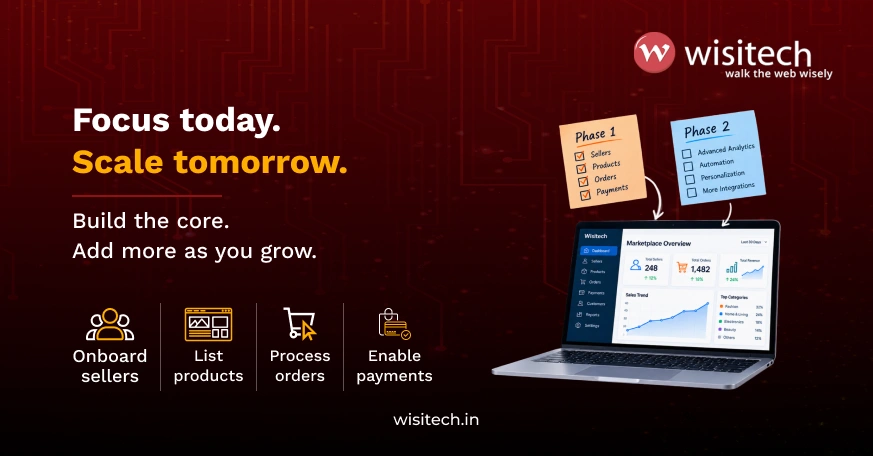
If your marketplace roadmap has become a long list of requested features, it may be time to separate essential workflows from future enhancements.
Wisitech works with businesses on ecommerce systems across Shopify, WooCommerce, CS-Cart, and custom implementations, with a focus on performance, integrations, operational workflows, and long-term scalability. The team brings 27 years of experience and more than 2,500 projects across 40+ countries.
For a marketplace project, that means starting with the business model, seller workflow, customer journey, payment logic, integrations, and administrative requirements before deciding what should be built.
If you are planning a marketplace and want to discuss the right Phase One scope, you can get a free consultation with Wisitech to review the requirements and determine what should be built now versus later.