

You are already selling. You have traffic, a product that works, and a team managing operations. But somewhere between ad spend and checkout, revenue is leaking. Conversion rates are flat. Cart abandonment is high. Personalization is nonexistent. And your current platform is held together with plugins and workarounds that your dev team spends more time maintaining than improving.
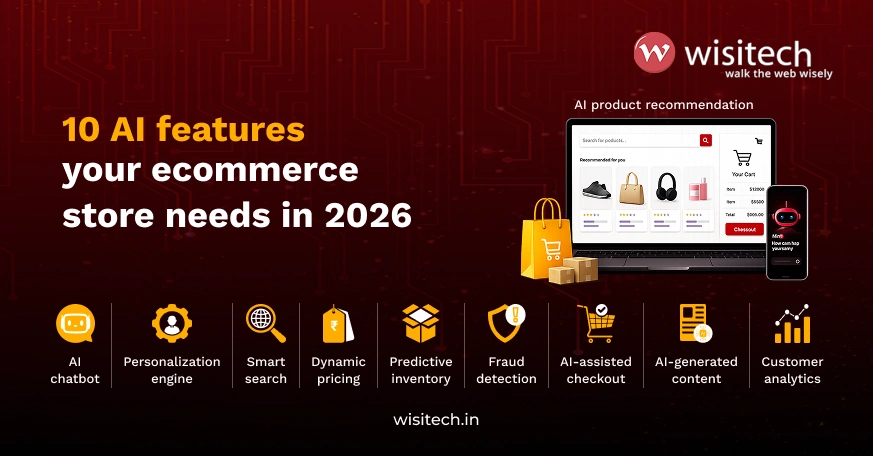
This is the exact problem that AI features every ecommerce website should have in 2026 are built to solve. Not as a novelty. Not as a competitive differentiator on paper. As functional infrastructure that reduces friction, increases order value, and gives your team back the time they are currently spending on manual processes.
If you are running a D2C brand or ecommerce-first SMB doing ₹1 crore to ₹30 crore annually, this guide is written for you. Not for someone building their first store. For someone whose current store is limiting what the business can actually do.
Why AI features every ecommerce website should have are no longer optional
The Indian ecommerce market is expected to reach USD 163 billion by 2026, growing at a CAGR of 27%, according to IBEF. That growth is not distributed evenly. It is concentrating in stores that have built smarter systems, not just bigger ad budgets.
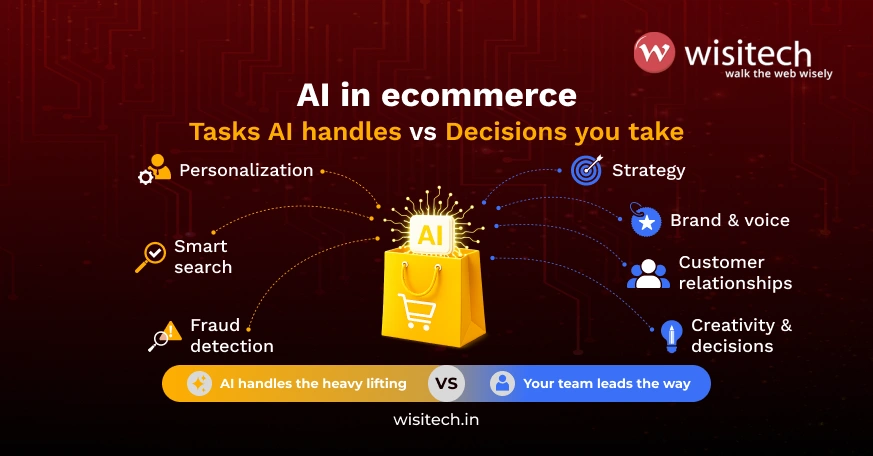
AI in ecommerce is not about replacing your team or automating your brand voice into something generic. The most effective implementations are AI-assisted: your team’s judgment and customer understanding remain central, while AI handles the pattern recognition, data processing, and personalization logic that no human team can execute at scale.
What this means practically is that a store running AI-assisted features operates with a structural advantage over one that does not. Smarter search results in fewer exits. Personalized recommendations increase average order value. Predictive inventory reduces stockouts and overstock simultaneously. None of these are cosmetic improvements. They are system-level upgrades with measurable impact on revenue.
The stores winning in India’s ecommerce market right now are not the ones with the biggest catalogs or the flashiest design. They are the ones where the infrastructure works harder than the marketing budget.
1. AI-powered product recommendations
Product recommendation engines are the highest-converting AI feature available to ecommerce stores today, and also one of the most widely misimplemented. A recommendation engine that simply surfaces bestsellers regardless of user context is not personalization. It is a bestseller list with a different label.
A properly implemented AI recommendation engine analyzes individual browsing behavior, purchase history, cart contents, and session patterns to surface products that are genuinely relevant to each user in real time. For Indian D2C brands with catalogs of 100 SKUs or more, this is where average order value moves. Studies consistently show that recommendation-driven purchases carry a 10 to 30 percent higher order value than organic browse-and-buy journeys.
The implementation question your ecommerce website development company should be able to answer is whether the recommendation logic is static (rule-based) or dynamic (ML-driven). Rule-based systems are cheaper to build but plateau quickly. ML-driven systems improve over time as they accumulate behavioral data. For stores doing meaningful volume, the difference in performance between the two compounds significantly over 12 months.
2. Smart site search with natural language processing
Search behavior on ecommerce sites is one of the clearest signals of purchase intent available, and most Indian ecommerce stores are wasting it entirely. A user who searches is three to five times more likely to convert than one who browses. Yet the majority of stores still run keyword-matching search that returns zero results for any query that does not match exact product copy.
AI-assisted search using natural language processing understands intent, not just syntax. A user searching “comfortable ethnic wear for summer wedding” should not get zero results because none of your product titles contain that exact phrase. An NLP-powered search engine maps that query to the relevant category, filters by season and occasion attributes, and returns results that match what the user actually meant.
For Indian ecommerce brands targeting regional audiences, NLP search with multilingual capability adds another layer of conversion advantage. An ecommerce development agency with experience in AI-assisted builds will configure search to handle transliterated queries, colloquial product names, and regional variations that standard search engines cannot process.
3. AI-assisted dynamic pricing
Dynamic pricing in ecommerce does not mean undercutting competitors in real time. For most Indian D2C brands, it means something more operationally useful: the ability to adjust pricing intelligently based on inventory levels, demand signals, margin thresholds, and competitive positioning, without requiring manual intervention for every SKU.
An AI-assisted dynamic pricing system monitors these variables continuously and applies pricing rules your team defines. If a product is moving fast and inventory is low, the system can hold price or apply a modest increase. If a slow-moving SKU is tying up warehouse space ahead of a new season, the system triggers a markdown automatically within the parameters you set.
For brands managing hundreds of SKUs across multiple categories, this eliminates a significant manual workload while improving both margin and sell-through rate. The key implementation requirement is clean, connected inventory data. Dynamic pricing is only as accurate as the data feeding it, which is why this feature is best planned at the architecture stage rather than bolted on post-launch. Engage ecommerce consulting services early if dynamic pricing is part of your growth roadmap.
4. Predictive inventory management
Stockouts and overstock are two of the most expensive operational problems in ecommerce, and both are largely predictable with the right data infrastructure. Predictive inventory management uses historical sales data, seasonal patterns, campaign calendars, and supplier lead times to forecast demand at the SKU level and trigger restocking actions before a problem occurs.
For Indian D2C brands that run sales events, festive campaigns, or influencer-driven traffic spikes, the value of this capability is especially high. A manually managed inventory system cannot process the combination of variables required to predict a Diwali demand spike accurately across 200 SKUs with different supplier lead times. An AI-assisted system can, and it does so continuously rather than on the quarterly review cycle most teams rely on.
The business outcome is straightforward: fewer lost sales from stockouts, less capital tied up in overstock, and a supply chain that responds to demand signals rather than lagging behind them. This is a feature that pays for itself within the first two to three inventory cycles for most mid-volume ecommerce operations.
5. Automated cart abandonment recovery
Cart abandonment rates in Indian ecommerce average between 70 and 80 percent, which means the majority of users who show purchase intent leave without completing a transaction. Manual follow-up on cart abandonment is not scalable. AI-assisted abandonment recovery is.
A properly built abandonment recovery system does more than send a generic “you left something behind” email. It analyzes why the abandonment likely occurred based on behavioral signals: did the user exit at the shipping cost reveal? Did they spend time on the return policy page before leaving? Did they add to cart multiple times across sessions without converting? Each of these signals maps to a different recovery message and timing logic.
For Indian brands, WhatsApp-based recovery sequences have significantly higher open and click rates than email, and AI-assisted tools can manage multi-channel recovery flows across WhatsApp, SMS, and email simultaneously. An experienced ecommerce website development company will integrate these flows directly into your checkout infrastructure rather than managing them through disconnected third-party apps.
6. AI-assisted visual search
Visual search is no longer a feature reserved for fashion giants. As Google Lens processes over 20 billion visual searches per month globally, the behavior of searching by image rather than keyword is becoming mainstream in Indian ecommerce as well. For categories where the user knows what they want but cannot describe it in text, visual search closes a conversion gap that standard search cannot address.
An AI-assisted visual search implementation allows users to upload a photo or screenshot and find matching or similar products in your catalog. For home decor, apparel, jewelry, and lifestyle categories especially, this removes the language barrier between intent and purchase. A user who has saved a photo of a sofa style can find your closest match in seconds rather than spending ten minutes trying to describe it in search terms.
The implementation complexity varies by catalog size and image tagging quality. For this feature to work accurately, your product images need to be consistently shot, and your catalog needs structured attribute tagging. If your current image library is inconsistent, plan for a catalog audit as part of the visual search implementation.
7. Personalized email and WhatsApp marketing automation
Generic broadcast marketing is losing effectiveness at a measurable rate. Open rates for non-personalized email campaigns in ecommerce have been declining steadily, while personalized campaigns indexed to individual behavior consistently outperform them. AI-assisted marketing automation makes genuine personalization possible at scale without requiring a dedicated CRM analyst for every campaign.
The distinction worth drawing here is between segmentation and personalization. Segmentation divides your audience into groups and sends each group a variation. Personalization generates communication that is specific to the individual user’s history, preferences, and current position in the purchase cycle. AI makes the latter achievable without manual effort per user.
For Indian ecommerce brands, WhatsApp automation is particularly high-value given India’s WhatsApp penetration. AI-assisted flows can manage post-purchase sequences, replenishment reminders, personalized product drops, and win-back campaigns across WhatsApp and email simultaneously, with send-time optimization and content variation handled automatically. An ecommerce development agency experienced in AI-assisted builds will configure these flows as part of your post-launch marketing infrastructure rather than treating them as an afterthought.
8. AI-assisted fraud detection and payment security
Payment fraud is an underreported but significant cost for Indian ecommerce businesses, particularly those running high-volume campaigns that attract fraudulent transactions at scale. Manual review of suspicious transactions is not viable at growth-stage volumes, and static rule-based fraud filters generate too many false positives that block legitimate orders.
AI-assisted fraud detection analyzes hundreds of behavioral and transactional signals in real time to assign a risk score to each transaction. Device fingerprinting, IP reputation, purchase velocity, billing and shipping address matching, and behavioral patterns during checkout are all factored into the assessment. Legitimate orders sail through. High-risk transactions are flagged for review or blocked automatically based on the thresholds your team configures.
For Indian D2C brands using Razorpay, PayU, or CCAvenue, most payment gateways offer some level of built-in fraud screening. The question your ecommerce consulting services provider should help you answer is whether the built-in screening is sufficient for your transaction volume and average order value, or whether a dedicated fraud intelligence layer is warranted.
9. AI-driven customer service and support automation
Customer service is one of the highest operational costs in ecommerce and one of the areas where AI assistance delivers the clearest ROI. The majority of inbound customer queries in Indian ecommerce fall into a small number of predictable categories: order status, return and exchange requests, product information, and payment issues. None of these require human judgment to resolve. All of them consume human time when managed manually.
AI-assisted customer service tools handle these query types through conversational interfaces on WhatsApp, website chat, and email, pulling real-time data from your order management system to give accurate, specific responses rather than generic holding messages. Your human support team is freed to handle the complex, high-stakes interactions where judgment, empathy, and relationship management actually matter.
The implementation threshold to watch for is integration depth. A customer service bot that cannot access live order data is more frustrating than no bot at all. Ensure any AI customer service tool you implement has a direct, real-time connection to your OMS, logistics API, and returns management system before going live.
10. Conversion rate optimization through AI-assisted A/B testing
Conversion rate optimization is one of the highest-leverage activities available to a growth-stage ecommerce brand, and also one of the most underinvested. Most Indian ecommerce brands run A/B tests sporadically, if at all, and rely on intuition more than data when making decisions about product page layout, CTA copy, pricing display, or checkout flow.
AI-assisted CRO tools change this by running continuous multivariate tests across your site and automatically routing more traffic to the better-performing variant as statistical significance is reached. Rather than waiting for a human analyst to review test results and implement changes, the system optimizes in near-real time. Over a 12-month period, this compounding effect on conversion rate is one of the strongest ROI arguments available to justify a platform investment.
For brands currently on template-based setups, this capability requires a platform architecture that supports dynamic content variation at the component level. This is one of the clearest technical reasons why growth-stage brands outgrow template stores and need a custom build from a qualified ecommerce website development company to unlock their full conversion potential.
How to evaluate whether your platform supports these features
Knowing which AI features matter is one half of the problem. The other half is understanding whether your current platform can support them, and if not, what it would take to get there.
The honest answer for most growth-stage brands in India is that template-based Shopify setups and out-of-the-box WooCommerce installations support some of these features through third-party apps, but not all of them, and not in an integrated way. App-based implementations create data silos. Behavioral data from your recommendation engine does not talk to your email automation. Your fraud detection does not connect to your inventory system. The result is a collection of tools that each do their job in isolation while the business operates without a unified view of the customer.
A properly architected ecommerce platform, built by an experienced ecommerce development agency, connects these features at the data layer so that every system is working from the same customer and operational data. This is the infrastructure difference between a store that grows and one that scales.
If you are evaluating your current platform against this list and finding gaps, the right next step is not to add more apps. It is to have an honest conversation about whether your current architecture can support where the business needs to go.
Why the AI features every ecommerce website should have in 2026 define your next growth phase
The AI features every ecommerce website should have in 2026 are not about keeping up with trends. They are about building a business system that works as hard as your team does. Every feature on this list has a measurable impact on conversion, order value, operational efficiency, or customer retention. None of them are decorative.
The brands that will capture the most from India’s ecommerce growth over the next three to five years are the ones building the right infrastructure now, not the ones optimizing a system that has already hit its ceiling.
At Wisitech, we function as an ecommerce consulting services and development partner for D2C brands, SMBs, and established businesses rebuilding for scale. Our approach is AI-assisted, not AI-dependent: every recommendation, architecture decision, and implementation is led by our team’s expertise and shaped around your specific business requirements, brand positioning, and growth objectives.
Tell us your current platform, your monthly revenue, and the two or three biggest conversion or operational problems you are hitting. We will tell you exactly which of these features your business needs first and what it would take to build them properly.
Disclaimer: Feature capability benchmarks, conversion rate statistics, and market figures cited in this article are based on published industry data and development agency benchmarks available as of May 2026. Actual outcomes vary by platform, catalog size, traffic volume, and implementation quality. This article is intended for general guidance only and does not constitute a formal project proposal or technical specification. Contact Wisitech directly for a project-specific assessment.