

Most Indian small businesses decide their digital marketing budget the same way: they pick a number that feels safe, hand most of it to Google Ads because it delivers the fastest visible result, and treat everything else as whatever is left over. SEO gets a token amount. The website itself gets nothing until it visibly breaks. Content happens only when someone remembers to write a post. The budget was never actually split. It was just spent on whatever felt most urgent that month.
A smarter starting point is to treat the digital marketing budget as one system with four connected parts, not four separate expenses competing for the same rupee. Website development services should provide the foundation the other three depend on, rather than being treated as a one-time purchase. Working with a provider that understands this connection usually makes the budget easier to get right from the start.
Why most Indian small businesses get their digital marketing budget split wrong
The most common mistake is treating ads and SEO as competitors for the same budget, when they actually solve different problems on different timelines. Ads can bring visitors and leads as soon as campaigns go live, while SEO takes months to build up but can keep bringing visitors long after the budget for a specific piece of content has been spent. Businesses that pour everything into ads and starve SEO end up paying for the same traffic every single month, with nothing compounding in the background.
The second mistake is bigger and quieter: treating the website itself as a sunk cost instead of an ongoing budget line. A business will happily pay for ads and SEO to send more visitors to a website that loads slowly, confuses people on mobile, or has not been touched since it was built three years ago. Sending more traffic to a broken funnel does not fix the funnel. It just makes the leak more expensive.
A third mistake shows up less often but costs more when it happens: changing the entire budget allocation every few months based on whichever channel had a good or bad quarter. Digital marketing, especially SEO, rewards consistency. A business that funds SEO generously for two months, cuts it entirely for the next two, then restarts from scratch loses most of the compounding benefit that made SEO worth funding in the first place.
What percentage of revenue should actually go into the digital marketing budget
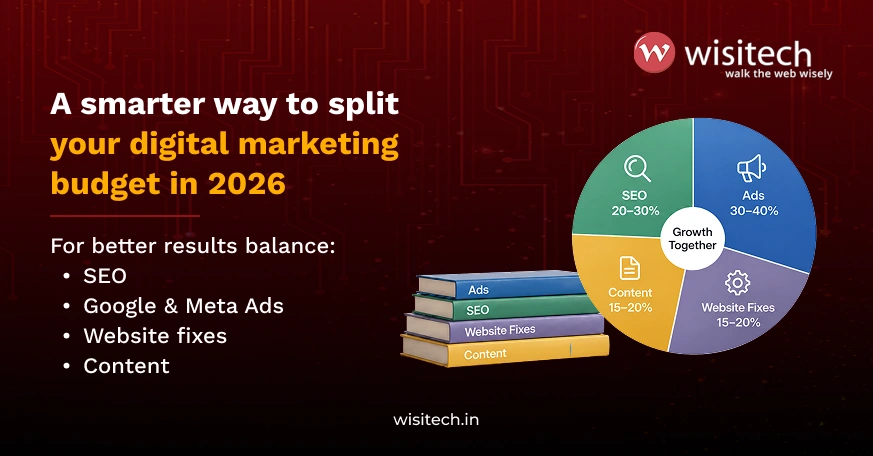
For most Indian small businesses, a digital marketing budget of 5 to 12 percent of annual revenue is a reasonable range, with the higher end suited to businesses in competitive categories or metro markets where costs run higher. Within that number, a workable starting split looks like this:
- Ads: 30 to 40 percent, covering paid search and paid social campaigns to generate leads, sales, and targeted traffic while other channels build up
- SEO: 20 to 30 percent, since it is the channel that keeps working after the ad spend stops
- Website fixes and maintenance: 15 to 20 percent, treated as a permanent line item, not a one-time project
- Content: 15 to 20 percent, since it supports SEO, landing pages, ad campaigns, and conversion over time
These are starting points for splitting the digital marketing budget, not fixed rules. A business with an outdated, slow website should temporarily shift more toward fixing the website before spending heavily on ads that send visitors to it. A business with a strong website and weak visibility should lean harder into SEO and content instead.
SEO budget: what it should actually cover
A meaningful share of the digital marketing budget going toward SEO services should cover more than the occasional blog post. It should include technical work (site speed, mobile usability, structured data), on-page work (page titles, content depth, internal linking), and off-page work (backlinks and authority building) running consistently, not in bursts. SEO takes three to six months to show real movement, which is exactly why businesses that switch SEO company every few months rarely see results: the new team spends the first few months just relearning the account.
Businesses comparing a SEO company against handling SEO in-house or through a freelancer should weigh consistency as much as cost. A single freelancer juggling multiple clients often cannot maintain the steady monthly output SEO actually needs to compound. Reviewing rankings and organic traffic every quarter, rather than only when a lead slowdown forces the question, is what keeps this part of the budget from quietly drifting off track.
Ads budget: how much is enough to actually learn something
Many Indian small businesses set their Google Ads or Meta Ads budget at a random number like ten thousand or twenty thousand rupees a month, without connecting it to an actual goal. A more useful approach starts from the goal itself: figure out how many leads or sales the business needs, what a lead or customer is worth, and work backward to a realistic daily budget, rather than picking a number and hoping.
In practice, the right budget depends on the platform, audience, competition, and campaign objective. Google Ads can capture people who are actively searching for a product or service, while Meta Ads can help businesses reach targeted audiences, build demand, and bring previous visitors back through remarketing. Directing paid traffic to a generic homepage instead of a dedicated landing page is one of the most common ways this budget gets wasted, regardless of which platform the campaign runs on. A landing page built around the specific offer in the ad, rather than a general company overview, gives both Google Ads and Meta Ads campaigns a stronger chance of converting at the same spend level.
Website fixes: the budget line most Indian small businesses skip entirely
Most Indian small businesses will pay for a rebuild only after something breaks in an obvious way. A slow, outdated website usually keeps losing leads quietly for months before anyone treats it as a budget priority, since nothing about a slow page screams for attention the way a stopped ad campaign does.
This is where a fixed, ongoing budget for website redesign services or targeted fixes, rather than a single occasional rebuild, pays for itself. Site speed, mobile usability, and a checkout or enquiry form that actually works are not one-time projects. They need periodic attention as plugins update, traffic grows, and customer expectations shift. Businesses evaluating custom website development against a template-based fix should judge it by one question: does the current site’s structure actually support the business today, or was it built for a version of the business that no longer exists?
Content: the line that makes the other channels work harder
Content is usually the first budget line an Indian small business cuts when money gets tight, and it is often the wrong one to cut. Good content is what SEO needs to rank for anything beyond the business’s own name, and it also gives paid campaigns stronger landing pages, ad messaging, creative ideas, and supporting information once someone clicks through.
A realistic content marketing services budget does not need to be large to be effective. It needs to be consistent enough that a website is not still running on the same five pages it launched with two years ago. Businesses that treat content marketing agency support as an occasional add-on, rather than a standing part of the budget, tend to see SEO and paid campaigns underperform relative to what they are actually capable of.
A real example: what happens when the split gets fixed
A premium LED lighting manufacturer based in New Delhi, needed a stronger digital presence to reach dealers and generate real leads, not just visibility. Building a proper online presence, backed by lead-focused marketing rather than a single channel working alone, changed what the website could actually deliver for the business, moving it from a static brochure to a working part of how the company reaches dealers. The lesson generalizes well beyond LED lighting: a strong website and a lead-generation strategy working together outperform either one running in isolation. Businesses that split their digital marketing budget the same way, treating the website as part of the growth engine rather than a separate line item, tend to see steadier results across every other channel too.
A simple way to check your own split
Before finalizing next year’s digital marketing budget, a few honest questions help more than another spreadsheet:
- Is more than half the budget going to ads while SEO gets whatever is left over?
- Has the website itself gone untouched for more than a year, regardless of how much is being spent to send traffic to it?
- Is content something that happens only when someone remembers, rather than on a fixed schedule?
- Would the business survive a month with zero ad spend, or does every lead disappear the moment the campaigns pause?
Two or more honest “yes” answers usually mean the budget is unbalanced in a specific, fixable way, not that the total amount is wrong.
Grow with Wisitech

Wisitech has spent 27 years helping Indian businesses get this balance right, across 2,500+ projects and 40+ countries, as a certified Google Partner. SEO, ads, website development, and content are handled as one connected system by one team, rather than separate activities managed in isolation. This makes it easier to align campaigns, landing pages, organic visibility, and content around the same business goals.
If your budget already feels stretched across too many directions with too little to show for it, a free consultation is the fastest way to see where it is actually leaking. Talk to Wisitech and get a clear, honest read on your current split, no bloated agency pitch included.