

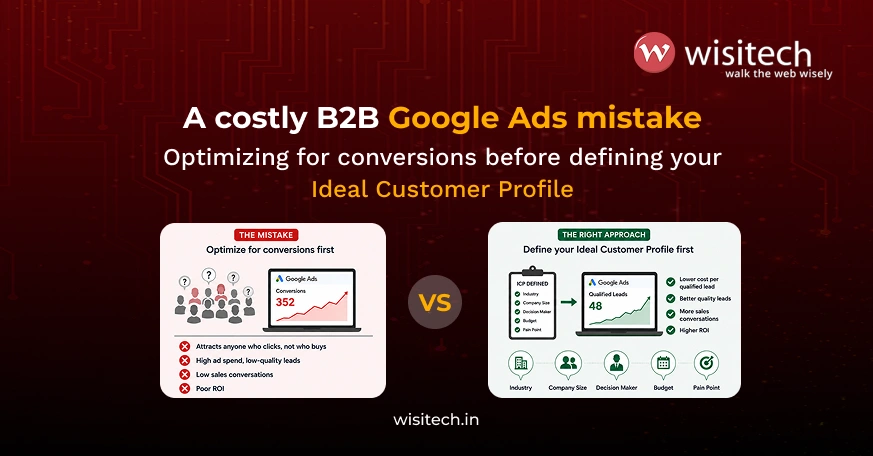
Most Indian B2B companies running Google Ads share the same frustration. The dashboard looks productive. Clicks are coming in. The spend is tracking. And then the sales team opens the lead sheet and finds job applicants, students, and people looking for free resources, not a single conversation worth having. The clicks were real. The problem is that Google Ads for B2B companies requires a fundamentally different setup than B2C advertising, and most campaigns are built the wrong way from the start.
This guide covers the specific structural reasons B2B Google Ads in India produces unqualified traffic, what a properly built campaign looks like, and how to measure the right outcomes. Whether you are managing campaigns in-house or evaluating professional Google Ads management, the structural issues are the same and the fixes are the same.
What is a qualified lead in B2B Google Ads?
A qualified lead in B2B Google Ads is a prospect who matches your Ideal Customer Profile, has decision-making authority or meaningful influence, has a real budget allocated for what you sell, and is actively evaluating solutions right now. This is distinct from a form fill, an inquiry, or a contact request.
Most B2B campaigns in India optimize for form fills. The problem is that form fills are not qualified leads. They are expressions of interest from a population that includes the right buyers, the wrong buyers, curious visitors, students, competitors, and people who misunderstood the ad. Optimizing for form fills without qualifying what those forms contain is the root cause of the qualified lead problem.
When Wisitech audits B2B Google Ads accounts that have been running for six months or more, the most common finding is that 60 to 75% of the form fills in the account were never sales-qualified. The campaigns are generating activity. The leads are going into a CRM. The monthly report shows a cost per lead that looks reasonable. And the sales team has quietly stopped working Google Ads leads because they have learned they are mostly noise. The disconnect between marketing metrics and sales reality is exactly what this guide addresses.
| Qualified lead | Unqualified lead |
|---|---|
| Decision-maker or strong influencer at the target company | Student, job seeker, or researcher |
| Budget allocated and purchase timeline under 90 days | Interested but no budget or timeline defined |
| Company size and vertical match your ICP | Individual or company outside your addressable market |
| Specific inquiry about your product or service | Generic inquiry or price check with no context |
| Responds to follow-up within 48 hours | Ghosts after initial form submission |
The difference between a lead worth calling and one that wastes your sales team’s time
Why Google Ads for B2B companies in India requires a different approach
Running Google Ads for B2B companies in India means operating in a market with three structural characteristics that make it unlike B2C advertising and unlike equivalent B2B campaigns in Western markets.
Long sales cycles
The average B2B sales cycle in India runs 45 to 90 days. Most Google Ads campaigns are built to optimize for day-zero conversion. They have no mechanism for staying visible during the 60 days when the prospect is evaluating, comparing, and building internal consensus. The result: your competitor who runs a ₹5,000 per month Display remarketing campaign stays in front of the decision-maker the entire time. You paid for the click that started their research, and someone else closed the deal. B2B Google Ads that does not include a remarketing layer is paying for the first impression and giving away every impression after that.
Multiple decision-makers
Most Indian B2B purchases involve two to four stakeholders. The person who clicks your ad is typically not the person who signs the contract. They are the researcher: a mid-level manager, a junior analyst, or a technical lead. What this means practically for your Google Ads account is that your landing page needs to be built for someone who needs to go back and present your solution internally. A pricing page that says ‘Contact us for a quote’ gives them nothing to share. A landing page that includes a one-page PDF download, a case study from a comparable company, or a ROI calculator gives them everything they need to become an internal advocate. Wisitech consistently sees landing pages with a downloadable leave-behind convert at 35 to 50% higher rates for B2B than those without.
India’s B2B CPC landscape
B2B keywords in India cost significantly less than equivalent terms in the US or UK, typically 70 to 85% lower per click. This sounds like an advantage, and it is, but it also means that the same budget that would produce a narrow, qualified campaign in the US will produce a broad, high-volume campaign in India. More clicks, more impressions, and more form fills, but without tight structural controls, more irrelevant traffic too. The lower B2B Google Ads CPC environment rewards precise targeting because the click volume at broad match settings is genuinely dangerous for lead quality.
B2B Google Ads CPC benchmarks by industry in India (2026)
Google Ads cost per click for B2B India varies significantly by vertical. Use this as a reference when setting budget expectations.
| B2B vertical | Avg. CPC (INR) | Min. monthly spend | Notes |
|---|---|---|---|
| IT services and software | 80 – 250 | 60,000 – 1,00,000 | High search volume, competitive keywords |
| SaaS and B2B platforms | 100 – 350 | 60,000 – 1,50,000 | Low volume, high intent |
| Manufacturing and industrial | 30 – 120 | 30,000 – 80,000 | Lower competition, niche terms |
| Professional services (legal, CA, consulting) | 100 – 400 | 80,000 – 2,00,000 | High CPC, high deal value |
| Logistics and supply chain | 40 – 150 | 40,000 – 1,00,000 | Moderate competition |
| Healthcare B2B (equipment, pharma) | 60 – 200 | 50,000 – 1,20,000 | Regulated category, specific terms |
| HR and recruitment tech | 50 – 180 | 40,000 – 1,00,000 | Job-seeker noise requires strong negatives |
| Fintech and BFSI B2B | 100 – 350 | 80,000 – 2,00,000 | Highly regulated, compliance keywords |
What Google Ads for B2B companies actually costs in India across industries, use this before entering any agency or budget conversation
CPC figures are indicative averages as of June 2026 based on Google Keyword Planner benchmarks. Actual CPC varies by Quality Score, keyword match type, location targeting, and bid competition. All budget figures exclude 18% GST on management fees.
One pattern Wisitech has observed managing IT services and B2B data accounts is that the gap between click volume and qualified lead volume is widest in verticals where the product name doubles as a job category. An IT outsourcing company running ‘IT services company India’ on phrase match will generate clicks from engineering students, job-seekers researching potential employers, and individuals looking for freelance IT help. The same keyword that reaches a procurement manager at a 200-person manufacturing company also reaches a student writing a college report on the Indian IT industry. The fix is not a bigger budget. It is exact match on commercial-intent terms, phrase match on specific service queries, and landing pages that open with a qualifier: ‘For companies looking to outsource their development team.’
How to build a Google Ads campaign that generates qualified B2B leads in India
The gap between a B2B campaign that produces irrelevant clicks and one that produces sales-ready inquiries is structural, not budgetary. Here is what the right structure looks like.
Step 1: Define your ICP before touching Google Ads
Your Ideal Customer Profile is the most important document in your Google Ads account, and it should be written before you create a single campaign. Define the company size (revenue range, headcount), vertical, geography (metro, pan-India, specific states), buyer role (who initiates, who evaluates, who signs), and the specific trigger that causes them to search. The trigger is the part most businesses skip. A manufacturing company searching ‘inventory management software’ might be triggered by an audit failure, a warehouse expansion, or an investor requirement to modernize operations before a funding round. Each trigger produces different search behavior and warrants a different ad message and landing page. If you are unsure how to map these, a good Google Ads company that specializes in B2B will work through trigger identification with you before a single campaign goes live. Getting this wrong at the start is the most expensive mistake in B2B paid search.
Step 2: Build your keyword list on exact and phrase match
B2B Google Ads keyword strategy India should start with exact and phrase match only. Never launch a B2B campaign on broad match. In India’s market, broad match on a keyword like ‘IT services company’ triggers ads for ‘IT services jobs’, ‘IT services salary’, and ‘IT services degree’ before it finds a qualified buyer. Google search ads management for B2B requires a tight list of 15 to 30 exact and phrase match keywords organized by intent stage, expanded deliberately from search term data after 4 to 6 weeks.
Step 3: Build a negative keyword master list for Indian B2B
This is the single most underused tool in Indian B2B Google Ads, and the one that produces the most immediate improvement in lead quality. Add these negative keywords before launch:
- Job-related: jobs, vacancy, career, salary, fresher, hiring, apply, interview, resume, walk-in
- Education and research: course, certification, training, tutorial, free, how to, learn, guide, definition, meaning, example
- Competitor names: add specific competitor brand names to prevent wasted impressions
- Consumer intent: personal, individual, home, house, for me, myself, student
- Hindi language irrelevant queries: kya hai, kaise kare, kya hota hai — these appear in broad match and are almost always non-buyer intent
- Vendor-seeking signals that attract the wrong tier: cheap, affordable, lowest price, free trial if you are not offering one
In our experience managing B2B accounts across IT, SaaS, and professional services, the most damaging search terms are not the obvious ones. They are the mid-funnel informational queries that look relevant at a glance but have no conversion intent: ‘how does IT outsourcing work’, ‘what is SaaS’, ‘ERP system features comparison’. These trigger on phrase match and look like good traffic in click data. They almost never convert. Review your search terms weekly for the first three months, and add new negatives continuously. An account maintained this way consistently outperforms an equivalent account left to run.
Step 4: Structure ad groups by buyer intent, not by product
Most Indian B2B agencies structure ad groups by product category. The right approach is to structure by buyer intent. An IT services company should not have one ad group called ‘IT Services’. It should have separate ad groups for ‘custom software development for enterprises’, ‘IT outsourcing for startups’, ‘dedicated development teams’, and ‘legacy system migration’. Each maps to a different buyer intent and requires a different landing page and a different offer.
Step 5: Create B2B-specific landing pages, not product pages
A B2B PPC landing page India should not look like a product page. It should address the specific pain point that triggered the search, show relevant social proof from similar companies, and make the next step extremely low friction: a 30-minute discovery call, a free audit, a specific deliverable. Google Ads landing page optimization for B2B also means qualifying visitors before they submit: a visible question like ‘Are you a decision-maker at a company with 50+ employees?’ on the form filters out students and job-seekers before they enter your CRM.
Step 6: Set up conversion tracking that connects to actual revenue
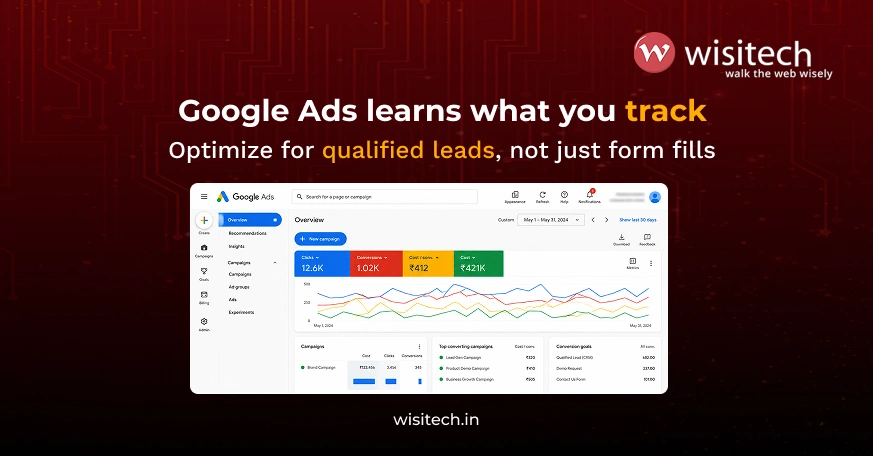
Form fill tracking is the floor, not the ceiling. B2B Google Ads conversion tracking India at a serious level means connecting Google Ads to your CRM so that qualified lead status, SQL conversion, and closed-won deals are imported back into Google Ads as offline conversions. Accounts that use offline conversion import see approximately 31% lower cost-per-lead because Smart Bidding learns to optimize toward deals, not just form fills. If you use Zoho CRM or Freshsales, both support offline conversion import via the Google Ads API or through Zapier.
Step 7: Add remarketing campaigns for the 45 to 90 day sales cycle
A B2B prospect who clicks your search ad and does not convert on the first visit is not a lost lead. They are a warm prospect in the awareness stage of a long decision cycle. Remarketing campaigns that keep your brand visible while they evaluate alternatives are not just a nice-to-have. They are structurally necessary given the average Indian B2B sales cycle length. Set up remarketing audiences by page visited, time spent on site, and form-started-but-not-submitted. Serve different messages to each segment.
Should B2B companies in India use Performance Max campaigns?
Take a clear stance: for lead generation, Performance Max for B2B India should be used with caution and only after your search campaigns are producing clean, qualified lead data. Performance Max gives Google’s AI full control over where your ads appear across Search, Display, YouTube, Gmail, and Maps. In B2B, this almost always produces a mix of high-intent and low-intent traffic that dilutes lead quality. The AI optimizes toward conversions, and if your conversion events are form fills, it will find form fills from whoever is most likely to submit a form, which often includes students and job-seekers.
Use Performance Max for B2B brand awareness and remarketing, not as your primary lead generation vehicle. Reserve your primary Search campaigns for exact and phrase match lead gen. If you have inherited an account where PMax is already running as lead gen, a Google Ads audit services review should be the first step before making structural changes, to understand what the existing campaigns are actually optimizing toward.
What a properly structured B2B Google Ads account looks like
Google Ads account structure for B2B India should be organized around funnel stage, not campaign type. Here is the recommended architecture:
| Campaign layer | Campaign type | Goal | Bid strategy |
|---|---|---|---|
| Core lead gen | Search – exact/phrase match | Qualified form submissions | Target CPA or Max Conversions |
| Brand protection | Search – brand terms | Capture branded searches | Target Impression Share |
| Competitor conquest | Search – competitor terms | Intercept competitor research | Manual CPC initially |
| Awareness | Display or YouTube | Reach ICP accounts | Target CPM |
| Remarketing | Display or Search | Re-engage warm prospects | Target CPA |
| ABM targeting | Display or PMax (controlled) | Target specific company lists | Target CPM |
The account architecture Wisitech uses for Google Ads for B2B companies – organized around funnel stage, not campaign type
Measuring what actually matters in B2B Google Ads
The metrics most Indian B2B campaigns report on are the wrong ones. Here is what to track and what to ignore.
Track these
- Cost per qualified lead (CPQL). Total spend divided by the number of leads your sales team rated as qualified. Not total form fills. Qualified leads only.
- SQL conversion rate. The percentage of leads that become Sales Qualified Leads after your team’s first contact. This tells you whether your targeting is producing the right audience.
- Pipeline sourced from Google Ads. Total deal value in your CRM that originated from Google Ads, regardless of where in the cycle the deal currently sits.
- Closed-won ROAS. Revenue from closed deals attributable to Google Ads divided by total ad spend. This requires offline conversion import and typically takes 90 to 180 days to calculate accurately.
- Search term report quality. Review weekly. The ratio of relevant to irrelevant search terms your ads triggered is a direct indicator of campaign health.
Ignore these
- Click-through rate as a primary KPI – a high CTR on a broadly matched keyword means your ad is attracting everyone, not just qualified buyers.
- Total impressions – irrelevant in B2B unless you are running specific brand-building campaigns.
- Total lead volume without qualification data – 100 leads with 3 SQLs is worse than 20 leads with 8 SQLs.
- Quality Score as a standalone metric – optimize for it as a supporting signal, not as a campaign goal.
When to schedule B2B Google Ads in India
B2B searches in India peak between 11am and 2pm on weekdays. Decision-makers and procurement teams are at their desks, evaluating vendors, running searches. The same ad running at 8pm on Saturday is reaching a completely different audience. Scheduling your ads to run during peak B2B hours, typically Monday to Friday, 9am to 6pm, with higher bids during the 11am to 2pm window, can reduce wasted spend by 15 to 25% while improving lead quality.
Indian B2B search volume also has seasonal patterns. Q4 of the Indian financial year (January to March) sees significantly higher B2B search activity as procurement budgets are being finalized and spent. Q1 (April to June) is often slower as new budgets are approved. Factor this into your bidding and budget allocation strategy.
Connecting Google Ads to Zoho CRM and Freshsales for offline conversion tracking
This is the technical step most Indian B2B companies skip, and it is the one that changes campaign performance most dramatically. Offline conversion tracking Google Ads in India means importing your CRM’s lead qualification and deal-closure data back into Google Ads so the algorithm learns what a real buyer looks like, not just what a form submitter looks like.
For Zoho CRM: use the Zoho Google Ads integration available in Zoho’s marketplace. It maps Zoho lead stages (Lead, Qualified, Proposal, Closed Won) to Google Ads conversion events. Set Qualified Lead and Closed Won as your primary conversion events. Set initial form fill as a secondary conversion. This tells Smart Bidding to optimize toward deals, not just inquiries.
For Freshsales: use the Google Ads integration in Freshsales Marketplace. The setup is comparable. Import GCLID with every lead, then fire conversion events when lead status changes to Sales Qualified Lead and again on deal closure.
Accounts that implement B2B Google Ads conversion tracking India with CRM-level offline data consistently see cost-per-qualified-lead fall by 25 to 40% within three to four months as Smart Bidding builds an accurate audience model.
What active B2B Google Ads management looks like week by week
B2B Google Ads management India is not a monthly check-in. It is a weekly discipline. What separates Google Ads optimization services that actually reduce CPL from those that maintain the status quo is this cadence:
- Weekly: Search term report review and negative keyword additions. Bid adjustments by keyword, device, location, and time of day. Ad copy performance review and rotation.
- Bi-weekly: Audience signal review. Remarketing list additions. Landing page conversion rate check against industry benchmarks.
- Monthly: Budget pacing and allocation review across campaigns. Quality Score analysis by ad group. CRM lead quality review with sales team, are the leads improving or degrading?
- Quarterly: ICP validation, are the companies converting actually matching your ideal profile? Keyword expansion based on accumulated search term data. Campaign architecture review. Offline conversion data import refresh.
Wisitech’s Google Ads management for B2B companies in India
Wisitech manages Google Ads for B2B companies across IT services, SaaS, manufacturing, professional services, logistics, and healthcare. We are a certified Google Partner. Our B2B campaigns are built around qualified lead generation, not form fill volume.
Our Google Ads management services for B2B start with ICP definition and account architecture, not keyword selection. We set up conversion tracking with CRM integration from day one, so Smart Bidding has real signal. We review search term reports weekly, maintain active negative keyword lists, and connect campaign performance to your sales pipeline, not just your Google Ads dashboard. Our custom Google Ads management for B2B includes offline conversion import, account restructuring for legacy accounts, and reporting that maps ad spend to pipeline and closed-won revenue.
If your B2B campaigns are producing clicks but not qualified leads, request a Google Ads audit. We will tell you exactly what is producing the wrong traffic and what needs to change.
27 years. 2,500+ projects. Fortune 500 experience. Creativity leads, AI amplifies.