

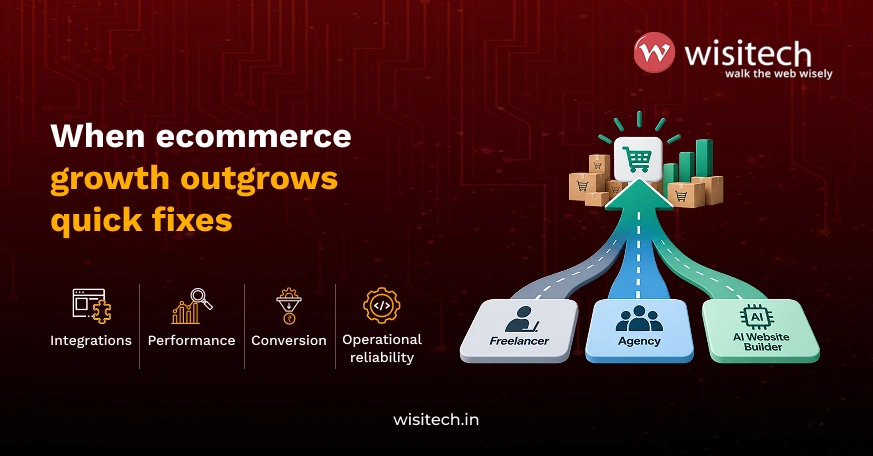
Your store has reached a stage where technical decisions affect revenue. The catalogue is larger, paid traffic costs more, and your team spends time working around the website. This is where the freelancer vs agency vs AI website builder decision deserves a practical assessment.
Start with the problem, not the provider
A freelancer may be enough for theme changes, landing pages, or a contained WooCommerce fix. The choice changes when requirements involve ERP, CRM, logistics, payments, inventory, custom pricing, or several teams.
For a brand doing ₹1 crore to ₹30 crore annually, downtime or a poorly planned checkout change can cost more than a cheaper build.
When a freelancer still makes sense
Freelancers work well when scope is narrow, and ownership is clear. They can handle Shopify customisations, WooCommerce fixes, or migration tasks efficiently.
The risk starts when one person becomes responsible for development, QA, integrations, deployment, and support. If that person becomes unavailable during a launch, the business carries the disruption.
Ask: if the work stopped tomorrow, how much of the operation would stop with it? That often clarifies the freelancer vs agency vs AI website builder decision faster than comparing quotations.
When an AI builder has reached its limit
AI website builders can reduce the effort required to create a basic store. They suit validation or temporary sites.
Growth-stage ecommerce has harder problems underneath the interface: product data, integrations, permissions, checkout, analytics, performance, SEO, and workflows. AI can assist, but someone still has to make architectural decisions, test the result, and own the consequences.
That makes the freelancer vs agency vs AI website builder comparison less about technology and more about accountability.
When an agency becomes the safer choice
An agency earns its place when your ecommerce website behaves like a business system. An ecommerce website development company should coordinate UX, development, QA, integrations, and post-launch support.
Consider a Delhi D2C brand spending ₹8 lakh a month on performance marketing. If mobile pages are slow, tracking is unreliable, and checkout errors appear, increasing ad spend will not repair the system. The losses show up as weaker conversion, wasted media spend, and abandoned carts.
A capable ecommerce web development company can investigate those problems together, identifying whether the underlying issue lies in the storefront, integrations, data flow, checkout process, or the way different systems interact with each other.
For complex operations, an experienced development partner may be appropriate when the business needs dealer portals, custom order logic, ERP workflows, or role-based access. A specialist ecommerce software development company can be particularly valuable when these requirements need to work as one connected system.
This is where the decision usually tilts toward an agency.
A practical test before you decide
Ask five questions:
- Is the work a defined task or a business-critical system?
- Does the store depend on several external platforms?
- Will the work affect checkout, payments, inventory, SEO, or analytics?
- Who owns QA, deployment, security, and post-launch issues?
- What happens if the primary person becomes unavailable?
If most answers point to interconnected risk, agency delivery deserves serious consideration. An experienced agency can work across Shopify, WooCommerce, CS-Cart, and custom ecommerce systems, bringing development, conversion, SEO, performance, and growth expertise together. Exploring ecommerce growth services or Shopify development can help determine which approach fits your next stage of growth.
Choose for the business you are becoming
A cheap option can become expensive when it creates rework. An experienced ecommerce web development company can help you plan for the next 12 to 18 months, taking into account traffic, new SKUs, integrations, performance, and long-term ownership.
For a growth-stage brand, an agency is justified when reliability, coordination, and continuity matter as much as speed.
Choose for the growth ahead
The freelancer vs agency vs AI website builder decision becomes more important as your ecommerce operation grows more complex. Consider the cost of downtime, integration failures, poor conversion, and repeated development before choosing the cheapest route.
For a growth-stage Indian brand, an agency can bring the development, testing, integrations, performance, and ongoing support needed to keep the ecommerce system dependable as the business expands.
If your store is becoming harder to manage, bring us the problem you are trying to solve, and let’s figure out the right technology path before you invest further.