

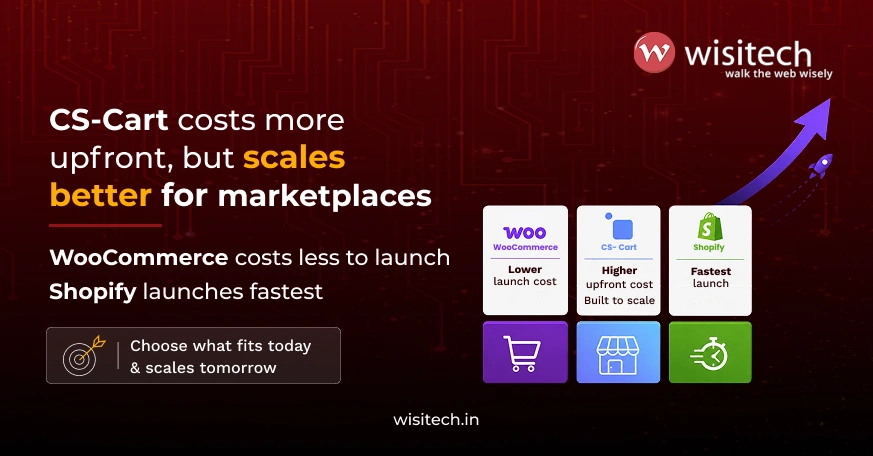
Building a multi-vendor marketplace is not the same as building an ecommerce store. The platform decision affects vendor onboarding, commission logic, payout management, compliance requirements, and long-term maintenance cost in ways that most buyers do not discover until after the build has started. The multi-vendor marketplace development cost in India ranges from 3 lakh to 45 lakh depending on which platform you choose, how much customization your business model requires, and whether the agency you hire has actually built marketplaces before or is learning on your project.
This guide gives you real 2026 INR cost figures for all three platforms, a direct comparison across the dimensions that matter, and a decision framework so you choose the right platform before committing to a build.
Multi-vendor marketplace development cost in India: 2026 snapshot
The table below answers the primary question directly. Detailed breakdowns for each platform follow. The multi-vendor marketplace development cost figures below cover development only and exclude platform licensing, annual maintenance, and payment gateway fees.
| Platform | License Cost | Development Cost (INR) | Timeline | Best For |
|---|---|---|---|---|
| CS-Cart Multi-Vendor | $3,590 one-time or $60/month | 6,00,000 – 25,00,000 | 12 to 20 weeks | Complex, scalable marketplaces |
| WooCommerce + Dokan | $149/year (Dokan Pro) | 3,00,000 – 12,00,000 | 8 to 16 weeks | Content-commerce hybrids, flexible builds |
| Shopify + Webkul/Shipturtle | Shopify plan + app fees | 4,00,000 – 15,00,000 | 8 to 14 weeks | Fast launch, hosted infrastructure |
Multi-vendor marketplace development cost in India across CS-Cart, WooCommerce and Shopify at a glance: platform, license, development cost, timeline, and best use case.
Development cost figures are indicative market benchmarks as of June 2026. Actual costs vary by feature complexity, integration requirements, and agency tier. All INR figures exclude 18% GST. Platform license costs are sourced from official vendor pricing pages and are subject to change.
What is a multi-vendor marketplace and why does platform choice matter?
A multi-vendor marketplace is an ecommerce platform where multiple independent sellers list and sell products or services, the platform operator manages the infrastructure, and buyers transact with sellers through the platform. The operator typically earns a commission on each transaction. Think Amazon, Etsy, or Flipkart at the enterprise level, or any number of vertical marketplaces in fashion, electronics, or B2B supply.
Platform choice in multi-vendor marketplace development determines how vendors onboard, how commissions are configured, how payouts are managed, how disputes are handled, and what the technical ceiling is for the marketplace as it scales. Choosing the wrong platform because it looked cheaper at the build stage is the most common reason Indian marketplace projects require full rebuilds within 18 to 24 months.
CS-Cart multi-vendor: the purpose-built marketplace platform
CS-Cart Multi-Vendor is the only platform in this comparison that was designed specifically for multi-vendor marketplace operation. CS-Cart multi-vendor development starts with a foundation that natively handles vendor storefronts, commission structures, payout management, separate vendor dashboards, product approval workflows, and shipping carrier integration per vendor. These are not plugins or add-ons. They are core features of the platform.
CS-Cart licensing in 2026
CS-Cart offers two licensing options as of June 2026:
| License Type | Cost | What Is Included | Best For |
|---|---|---|---|
| One-time License | $3,590 (3,00,000 INR) | Lifetime license, 1 year of upgrades | Businesses wanting cost certainty |
| Monthly Subscription | From $60/month (5,000 INR/month) | Hosting, upgrades, support included | Startups, lower upfront commitment |
| CS-Cart Multi-Vendor Plus | $7,490 one-time | Advanced vendor features, extended storefronts | Enterprise marketplaces |
CS-Cart licensing options that affect your total multi-vendor marketplace development cost: one-time license, monthly subscription, and Multi-Vendor Plus tier compared.
Prices sourced from cs-cart.com as of June 2026. License costs are in USD and will vary in INR based on exchange rates. Verify current pricing at cs-cart.com before committing.
CS-Cart development cost breakdown in India
| Marketplace Type | Development Cost (INR) | Timeline | Notes |
|---|---|---|---|
| Standard Marketplace (50-200 Vendors) | 6,00,000 – 10,00,000 | 12 to 14 weeks | Core features, standard theme |
| Custom Marketplace (Complex Logic) | 10,00,000 – 18,00,000 | 14 to 18 weeks | Custom vendor tiers, pricing rules |
| Enterprise Marketplace (200+ Vendors) | 18,00,000 – 25,00,000+ | 18 to 24 weeks | Multi-storefront, custom integrations |
Multi-vendor marketplace development cost on CS-Cart by complexity: standard, custom, and enterprise builds with INR ranges and timelines.
Development cost estimates are based on Indian agency market rates of $20 to $40 per hour as of June 2026. Actual quotes vary by scope, team structure, and agency tier. All figures exclude license cost and 18% GST.
What CS-Cart multi-vendor does natively that others cannot match
- Vendor-level storefronts. Each vendor gets their own branded storefront within the marketplace. Not a product listing page. A full vendor store with its own SEO slug, categories, and design.
- Commission rules per vendor tier. Set different commission rates by vendor category, product type, or sales volume. Rule-based commission logic is baked in, not built as a workaround.
- Vendor payout management. Automated vendor payout scheduling with Stripe, PayPal, or manual bank transfers. No third-party plugin required.
- Product approval workflows. Operator reviews and approves vendor product listings before they go live. Essential for any curated marketplace.
- Return and refund management per vendor. Each vendor can have separate return policies. The platform handles dispute routing without custom code.
- Multi-currency and multi-language out of the box. Cross-border marketplace builds on CS-Cart do not require separate localization plugins.
Wisitech has delivered marketplace builds on CS-Cart across B2B wholesale, vertical product platforms, and service booking. Our CS-Cart development services cover the full scope: architecture, vendor configuration, commission logic, payment integration, and post-launch AMC. The consistent observation from these projects: when CS-Cart is scoped correctly from the start, it rarely requires major rework at month 12, because the platform’s native vendor management features handle the edge cases that kill Dokan and Shopify app-based marketplaces as they scale.
CS-Cart’s honest limitations
- Steeper learning curve for both developers and marketplace operators than WooCommerce.
- Smaller global developer community means finding experienced CS-Cart developers outside India or dedicated CS-Cart agencies is harder.
- The admin interface, while powerful, is less intuitive than Shopify for operators who have not run a marketplace before.
- Add-on ecosystem is smaller than WooCommerce plugins. Custom functionality often requires bespoke add-on development.
WooCommerce multi-vendor marketplace: flexibility at a lower entry cost
WooCommerce development for multi-vendor marketplaces relies on the Dokan plugin to add marketplace functionality on top of WordPress’s native ecommerce layer. This architecture gives WooCommerce marketplaces two significant advantages: the development community for WordPress is enormous, keeping build costs lower, and the content management capabilities of WordPress are unmatched for marketplace operators who need strong SEO, editorial content, and blog infrastructure alongside their product catalog.
WooCommerce multi-vendor plugin options: which one fits your marketplace?
Dokan is the most widely used option but not the only one. The right plugin depends on your marketplace model, vendor complexity, and budget. Here is how the four main options compare.
Dokan: the market standard for most marketplace builds
Dokan is the default recommendation for most WooCommerce marketplace builds. It moves vendors out of the WordPress admin entirely, giving them a clean frontend dashboard that reduces onboarding friction and support tickets. It has strong built-in modules for split payments via Stripe Connect and PayPal Marketplace, seller verification, and live chat. For most D2C and retail marketplace models, custom WooCommerce development on top of Dokan Pro covers the majority of requirements without heavy bespoke work. The caveat: licensing costs scale up quickly if you need multiple premium add-ons, and database optimization becomes critical beyond a few thousand concurrent vendor queries.
WCFM marketplace: the power-user option for complex logic
WCFM (WooCommerce Multivendor Marketplace) is the right choice when the marketplace model requires highly complex custom logic: booking systems, rentals, digital asset marketplaces, or intricate commission structures. It offers the most feature-rich free tier of any WooCommerce multi-vendor plugin and gives both the admin and vendor granular control over shipping zones, product attributes, and coupon parameters. The trade-off: the backend configuration is dense, and the vendor learning curve is steeper than Dokan’s. Wisitech often writes custom CSS or overrides templates on WCFM builds to simplify the vendor interface for non-technical sellers.
WC Vendors: stable, high-performance, minimal footprint
WC Vendors is one of the oldest and most architecturally stable multi-vendor plugins in the WooCommerce ecosystem. Unlike plugins that inject heavy custom database tables, it relies on native WooCommerce data structures, making it highly compatible with advanced caching and premium hosting environments. Its commission engine supports percentage, fixed, tiered, and fee-based splits out of the box. The limitation: it is more minimalist visually than Dokan and requires solid theme integration or custom frontend work to look polished. For WooCommerce development projects that prioritize performance, clean code, and predictable behavior over feature breadth, WC Vendors is often the better architecture choice.
MarketKing: built for B2B and wholesale marketplace models
MarketKing is the right plugin when the marketplace model is B2B, wholesale, or hybrid B2B/B2C. It has native tools for wholesale pricing, minimum order quantities, tax exemptions, and sub-vendor staff management, features that require custom development on Dokan or WCFM. For RFQ (Request for Quote) architectures, corporate vendor networks, and dealer portals, MarketKing covers functionality that the other plugins cannot match without significant additional build cost.
WooCommerce multi-vendor plugin pricing comparison (2026)
| Plugin | Starting Price | Free Tier | Source |
|---|---|---|---|
| Dokan | $149/year | Yes (Dokan Lite) | dokan-pro.com |
| WCFM Marketplace | Free core | Yes, full features | wordpress.org |
| WC Vendors | $99.50/year | Yes (limited) | wcvendors.com |
| MarketKing | Verify at kingsplugins.com | No | kingsplugins.com |
Plugin pricing sourced from official vendor websites as of June 2026. All prices are in USD and subject to change. MarketKing uses introductory pricing with full-price renewals. Verify current pricing before committing.
WooCommerce marketplace development cost in India
| Marketplace Type | Development Cost (INR) | Timeline | Notes |
|---|---|---|---|
| Standard WooCommerce Marketplace | 3,00,000 – 5,00,000 | 8 to 10 weeks | Dokan Pro, standard theme |
| Custom WooCommerce Marketplace | 5,00,000 – 9,00,000 | 10 to 14 weeks | Custom theme, vendor features |
| Complex WooCommerce Marketplace | 9,00,000 – 12,00,000 | 14 to 18 weeks | Custom vendor logic, integrations |
Multi-vendor marketplace development cost on WooCommerce by build type: standard, custom, and complex marketplace projects with INR benchmarks.
Figures are indicative market benchmarks as of June 2026. All figures exclude GST, hosting, and plugin license costs.
Where WooCommerce marketplace builds break down
The most consistent custom WooCommerce development challenge in marketplace builds is plugin dependency. A WooCommerce marketplace with Dokan is only as stable as the combination of plugins running simultaneously. Dokan, WooCommerce, a payment plugin, a shipping plugin, a review plugin, an SEO plugin, and a caching layer need to be tested together after every update. Wisitech’s maintenance logs for WooCommerce marketplace clients show that plugin conflict is the leading cause of post-launch issues, accounting for roughly 60% of support tickets in the first 12 months.
The answer to this is not avoiding WooCommerce. It is choosing an experienced WooCommerce development agency that builds with a minimal plugin philosophy, writes custom functionality rather than stacking plugins, and manages updates systematically. The difference between a well-built WooCommerce marketplace and a poorly built one is not the platform. It is the engineering discipline behind it.
Shopify multi-vendor marketplace: the fastest launch, the most constraints
Shopify does not have native multi-vendor functionality. Building a marketplace on Shopify requires third-party apps such as Webkul Multi Vendor Marketplace, Shipturtle, or Multi Vendor Marketplace by Appkodes. These apps add vendor management on top of Shopify’s hosted infrastructure, which means Shopify development for a marketplace comes with both the platform’s advantages (managed hosting, fast checkout, strong payments ecosystem) and its constraints (customization ceiling, transaction fees, app dependency for core marketplace features).
Shopify marketplace app costs in 2026
| App | Monthly Cost | What It Adds | Limitations |
|---|---|---|---|
| Webkul Multi Vendor | From ₹1,500/month | Vendor accounts, product management | Limited payout automation |
| Shipturtle | From ₹4,100/month | Multi-vendor + multi-location shipping | Best for product marketplaces |
| Multi Vendor Marketplace | From ₹1,700/month | Basic vendor dashboard, commission | Limited vendor storefront |
App pricing sourced from the Shopify App Store as of June 2026. USD figures converted to INR at approximately ₹83 per USD. Actual INR cost will vary with exchange rate fluctuations. All figures exclude Shopify plan subscription fees and transaction fees.
Shopify marketplace development cost in India
| Marketplace Type | Development Cost (INR) | Timeline | Notes |
|---|---|---|---|
| Standard Shopify Marketplace | 4,00,000 – 6,00,000 | 8 to 10 weeks | Third-party app, standard theme |
| Custom Shopify Marketplace | 6,00,000 – 10,00,000 | 10 to 14 weeks | Custom theme, app customization |
| Shopify Plus Marketplace | 10,00,000 – 15,00,000 | 12 to 16 weeks | Checkout extensions, custom logic |
Multi-vendor marketplace development cost on Shopify by build type: standard, custom, and Shopify Plus marketplace projects with INR benchmarks.
Figures are indicative benchmarks as of June 2026. Shopify Plus licensing starts at approximately $2,300/month and is priced separately.
The honest limitation of Shopify marketplace development: the platform’s closed architecture means that custom vendor commission logic, complex payout rules, and vendor-level storefront customization all require workarounds rather than native implementation. Marketplaces that start on Shopify frequently hit this ceiling at 50 to 100 active vendors when operational complexity outgrows what the app ecosystem can handle without heavy custom code.
CS-Cart vs WooCommerce vs Shopify: full marketplace feature comparison
This is the multi-vendor marketplace development cost and feature comparison that most buyers need before making a platform decision.
| Feature | CS-Cart Multi-Vendor | WooCommerce + Dokan | Shopify + App |
|---|---|---|---|
| Native Vendor Dashboard | Yes | Yes (Dokan) | Via third-party app |
| Commission Engine | Native, rule-based | Dokan Pro required | App-dependent |
| Vendor Payout Automation | Native | Dokan Business+ | Limited, app-dependent |
| Vendor Storefronts | Full storefronts | Basic vendor pages | Not available natively |
| Product Approval Workflow | Native | Dokan Pro | Manual or app-based |
| Multi-currency Support | Native | Plugin required | Shopify Markets (Plus) |
| India Payment Gateway | Razorpay, PayU, CCAvenue | Razorpay, PayU, Cashfree | Razorpay, PayU |
| SEO Capability | Strong | Strongest (WordPress) | Good but limited |
| Hosting | Self-hosted | Self-hosted | Managed (Shopify) |
| Customization Ceiling | Very high | Very high | Medium |
| Platform Transaction Fee | None | None | 0.5% to 2% (unless Shopify Payments) |
| Development Cost (INR) | 6L to 25L+ | 3L to 12L | 4L to 15L |
| Best For | Scalable, complex marketplaces | Content-driven, flexible builds | Fast launch, managed infrastructure |
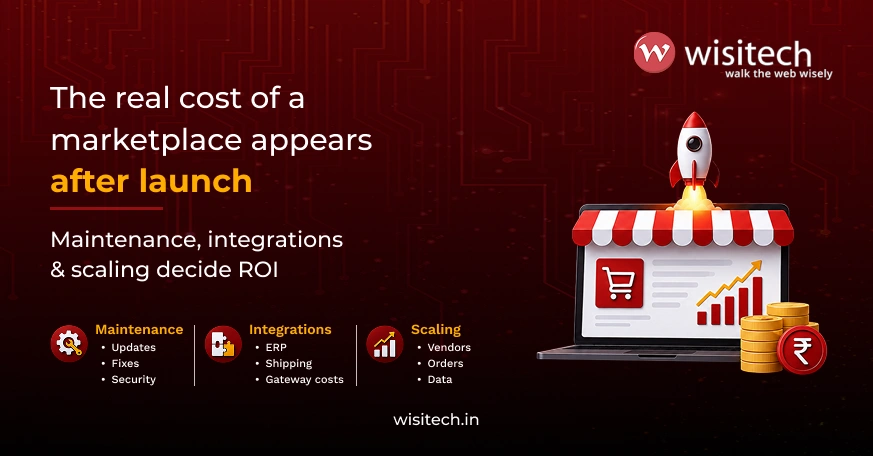
Hidden costs of multi-vendor marketplace development in India
The development cost is only part of the multi-vendor marketplace development cost picture. These are the costs most buyers discover after go-live.
Annual maintenance and support
Marketplace platforms require active maintenance: plugin and platform updates, security patches, performance monitoring, and feature additions as the business grows. Budget 15 to 25% of the initial development cost annually for maintenance. A 10 lakh marketplace build should have a maintenance budget of 1.5 to 2.5 lakh per year. Wisitech structures marketplace AMCs (Annual Maintenance Contracts) around response SLAs, update cycles, and a defined scope of monthly maintenance tasks so clients know exactly what they are paying for.
Payment gateway integration and transaction fees
Razorpay charges approximately 2% per transaction for most Indian merchants. PayU and Cashfree have similar rate structures. On a marketplace processing 1 crore per month, gateway fees alone are 2 lakh per month. Factor this into unit economics before platform selection. Shopify adds its own platform transaction fee on top of gateway fees unless you use Shopify Payments, which is not available in India.
Vendor onboarding and documentation
Building vendor onboarding flows, vendor agreements, GST compliance tooling for vendor payouts, and TDS deduction logic for Indian marketplaces typically adds 1 to 3 lakh to the development scope. This is frequently missed in the initial quote and surfaces as a change order after the build has started.
Hosting and infrastructure scaling
Self-hosted platforms (CS-Cart and WooCommerce) require hosting that scales with traffic. A marketplace serving 100 to 500 concurrent users needs managed cloud hosting at 3,000 to 8,000 per month, a CDN, Redis caching, and a dedicated database layer. Hosting costs are often underestimated in initial build quotes because they are treated as a post-launch consideration rather than an architecture decision.
How to choose the right platform for your marketplace
The right multi-vendor marketplace development platform depends on three factors: your marketplace’s operational complexity, your technical team’s capacity for ongoing management, and your growth timeline.
| Your Situation | Platform | Why | INR Budget |
|---|---|---|---|
| Complex commission logic, 100+ vendors from day one | CS-Cart | Native vendor management, purpose-built | 8L to 25L |
| Content-heavy marketplace, strong SEO priority | WooCommerce | WordPress SEO + Dokan vendor layer | 4L to 12L |
| Fast launch needed, team can manage Shopify | Shopify | Managed hosting, fastest time to market | 4L to 10L |
| B2B wholesale marketplace, dealer portal | CS-Cart B2B Edition | Role-based pricing, bulk orders native | 10L to 25L |
| Budget limited, willing to accept plugin constraints | WooCommerce | Lowest total cost of ownership | 3L to 6L |
| Existing Shopify store adding vendor functionality | Shopify | Least disruption, existing ecosystem | 3L to 8L |
Match your situation to the right platform with this multi-vendor marketplace development cost and decision framework by marketplace type and INR budget.
Wisitech builds multi-vendor marketplaces on CS-Cart, WooCommerce and Shopify
Wisitech has delivered CS-Cart development services and WooCommerce development services for marketplace clients across B2B wholesale, product verticals, service marketplaces, and ecommerce platforms for 27+ years. 2,500+ projects delivered. We are not a generalist web agency that builds marketplaces occasionally. Marketplace architecture, vendor management configuration, payment gateway integration, and post-launch AMC are a core part of our practice.
Our CS-Cart marketplace development engagements start with a platform fit assessment before any code is written. If CS-Cart is the right platform, we scope the build around your vendor management requirements, commission logic, and payout structure before estimating. If WooCommerce with Dokan fits your model better, we say so. We do not recommend the platform that is easier to sell. We recommend the one your marketplace will still be running on at vendor 500.
Every Wisitech marketplace build comes with written contracts, milestone-based payments, source code ownership on final payment, and a structured post-launch AMC. We use AI to accelerate research, technical documentation, and content structuring, with human engineering judgment driving every architecture decision.
If you are evaluating multi-vendor marketplace development cost and want a direct conversation about platform fit, development scope, and realistic timeline for your specific marketplace model, get in touch with us.
27+ years. 2,500+ projects. Fortune 500 experience. Creativity leads, AI amplifies.