

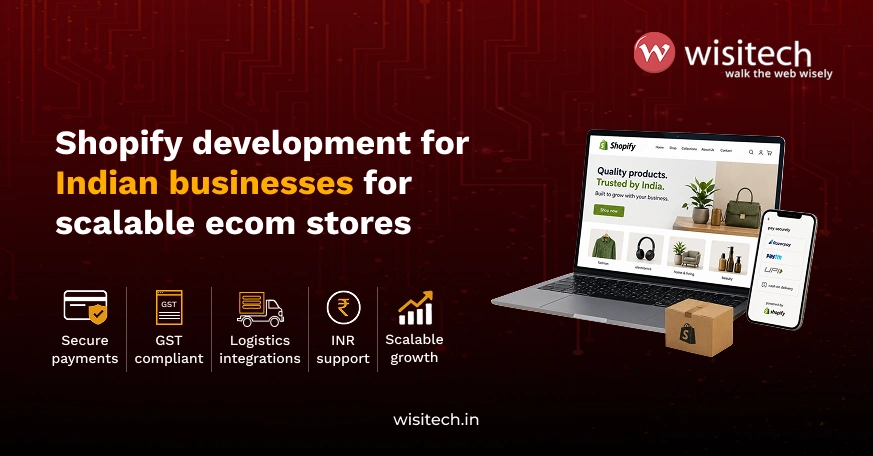
India’s ecommerce market is growing rapidly, and businesses across fashion, electronics, healthcare, beauty, manufacturing, and D2C sectors are searching for scalable ways to sell online. This is where Shopify development for Indian businesses becomes important. It refers to the process of building, customizing, optimizing, and integrating Shopify stores to match specific business requirements.
For Indian businesses, Shopify offers a practical ecommerce foundation with support for INR pricing, GST-ready configurations, payment gateway integrations, and mobile-friendly storefronts. However, while Shopify’s no-code tools are enough for some stores, others eventually require professional development support to scale efficiently.
This guide explains what Indian businesses can build on Shopify without technical expertise, and when hiring a Shopify development company becomes the smarter business decision.
What is Shopify development for Indian businesses, exactly?
Shopify development involves creating and customizing ecommerce stores using Shopify’s platform capabilities. This includes store setup, theme customization, payment integrations, speed optimization, app integrations, and advanced functionality development tailored to business goals.
For Indian businesses, Shopify development often includes region-specific requirements such as GST setup, COD configuration, Razorpay integration, multi-language support, and logistics connectivity with providers like Shiprocket or Delhivery.
What can you build on Shopify without a developer?
Many businesses in India can launch a functional online store using Shopify’s built-in tools and app ecosystem without writing code.
Launch a basic ecommerce store
Shopify provides ready-made themes and drag-and-drop editing tools that allow businesses to launch stores quickly. You can:
- Add products and collections
- Upload banners and images
- Create category pages
- Configure navigation menus
- Set up product variants
- Enable mobile responsiveness
This works especially well for startups, local retailers, boutique brands, and businesses validating ecommerce demand before investing heavily in custom development.
Configure Indian payment gateways
Shopify supports multiple Indian payment providers through apps and integrations. Businesses can connect:
- Razorpay
- PayU
- CCAvenue
- Instamojo
- Paytm Payment Gateway
Most integrations can be completed without coding using setup documentation and dashboard configurations.
Set up GST and tax rules
Indian ecommerce sellers can configure GST rates directly inside Shopify settings. Businesses can:
- Apply product-wise GST rates
- Generate GST-ready invoices using apps
- Configure tax-inclusive pricing
- Maintain region-specific tax rules
This makes Shopify suitable for many small and mid-sized Indian ecommerce businesses.
Add Cash on Delivery (COD)
Since COD remains important for Indian ecommerce, Shopify allows merchants to activate COD payment methods without custom development. Businesses can also use apps for:
- COD verification
- OTP confirmation
- RTO reduction workflows
- COD fee customization
Extend features through apps
The Shopify App Store includes thousands of extensions for marketing, inventory, shipping, customer engagement, analytics, and automation.
Businesses can add:
- Email marketing tools
- WhatsApp integrations
- Loyalty programs
- Subscription billing
- Abandoned cart recovery
- SEO optimization tools
For many growing brands, these apps provide enough functionality during the early growth phase.
The 5 situations when you need a Shopify developer
While Shopify’s no-code ecosystem is powerful, there are situations where professional development becomes necessary.
1. Custom theme development beyond templates
Businesses that want a unique brand identity often outgrow pre-built templates. This is where Shopify theme development becomes essential.
A developer can help with:
- Fully customized storefronts
- Advanced UI/UX improvements
- Conversion-focused layouts
- Interactive product pages
- Custom checkout experiences
- Mobile performance enhancements
This is particularly important for premium D2C brands competing in crowded Indian markets.
2. Complex third-party integrations
Many Indian businesses use ERP systems, CRM platforms, warehouse software, or accounting tools that require API connectivity.
A developer may be required for:
- SAP integration
- Zoho CRM connectivity
- Tally synchronization
- Shiprocket API integrations
- Delhivery automation
- Inventory synchronization across marketplaces
These integrations usually require technical expertise beyond app installation.
3. Advanced Shopify store development
As businesses scale, they often require features unavailable through standard apps.
Examples include:
- Multi-vendor marketplaces
- B2B wholesale portals
- Custom product configurators
- Subscription commerce systems
- Multi-location inventory logic
- Regional pricing systems
This is where Shopify store development becomes more strategic than simple store setup.
4. Performance optimization at scale
High-traffic ecommerce stores often experience slower loading times due to excessive apps, large media files, or poorly optimized themes.
Professional developers offering Shopify speed optimization services can help improve:
- Core Web Vitals
- Mobile performance
- Page load speed
- Script optimization
- Image compression
- Checkout responsiveness
Better speed directly improves user experience and conversion rates.
5. Headless commerce or enterprise-level requirements
Large businesses may require advanced architecture, such as headless commerce or enterprise integrations.
This may include:
- Shopify Hydrogen implementations
- Custom frontend frameworks
- Enterprise security controls
- Advanced API orchestration
- Omnichannel commerce systems
In these situations, custom Shopify development becomes necessary for long-term scalability.
India-specific Shopify considerations
Indian ecommerce businesses operate differently from many global markets, so localization matters.
Payment gateway preferences
Indian consumers use a mix of UPI, wallets, COD, and cards. Businesses should ensure Shopify supports their preferred payment methods while minimizing checkout friction.
GST compliance
Tax compliance is critical for ecommerce sellers in India. Businesses should ensure:
- Correct GST slabs
- HSN/SAC configurations
- Automated invoice generation
- State-specific tax handling
Logistics integrations
Shipping efficiency significantly impacts customer satisfaction. Shopify integrations with Indian logistics providers help automate fulfillment and tracking.
Popular integrations include:
- Shiprocket
- Delhivery
- Blue Dart
- Ecom Express
Regional language support
Businesses targeting Tier-2 and Tier-3 cities increasingly require multilingual storefronts. Shopify supports multi-language capabilities that can help businesses expand regional reach.
What actually drives Shopify development cost in India
The cost of Shopify development depends on store complexity, customization requirements, integrations, and business scale, not on a fixed price list. A store that only needs a theme, a payment gateway, and GST configuration sits at one end of that range. A store that needs custom theme development, multiple ERP or logistics integrations, and ongoing performance work sits at the other, and most Shopify development projects fall somewhere between the two depending on how much of the above your business actually needs.
Rather than anchoring to a generic budget bracket, it is worth scoping the actual requirement first: which of the five developer-trigger situations above applies, how many integrations are involved, and whether the work is a one-time build or an ongoing partnership. Businesses should focus less on the cheapest option and more on scalability, support quality, and technical reliability. Book a free consultation to get a project-specific estimate based on your actual scope rather than a generic range.
Choosing the right partner for Shopify development for Indian businesses
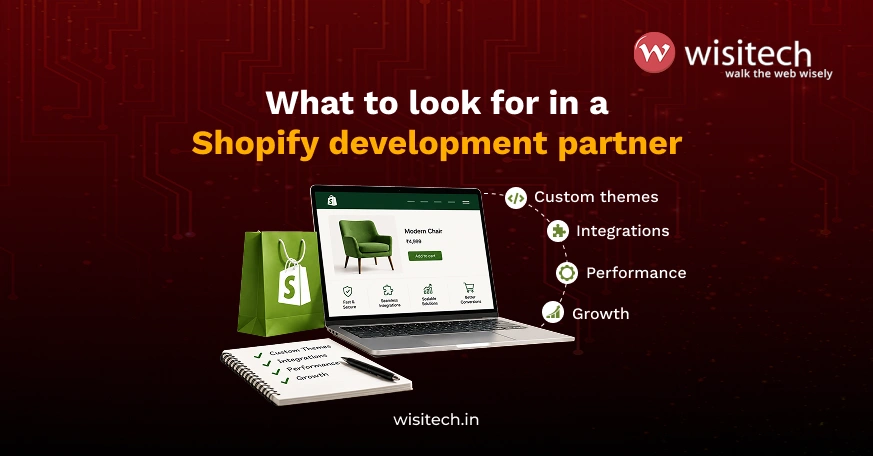
Hiring the right development partner can prevent long-term operational problems.
Here are important evaluation points:
Check ecommerce experience
Choose a partner with experience across ecommerce workflows, payment systems, logistics integrations, and conversion optimization, not just theme installation. Wisitech’s Shopify work draws on 27 years of ecommerce and digital experience across Indian and international brands.
Review technical capabilities
A reliable Shopify ecommerce development company should cover more than store setup. Wisitech’s Shopify development services span four areas: Shopify migration from WooCommerce, Magento, Wix, or a custom platform, custom Shopify development, Shopify redesign and CRO, and ongoing Shopify integrations and support, so the technical need is covered from launch through scale rather than handled by a single generalist.
Ask about Indian market expertise
Your developer should understand GST workflows, COD requirements, Indian payment systems, logistics integrations, and mobile-first buying behavior. Wisitech’s Shopify team works out of Delhi NCR and serves ecommerce brands across India, so this is applied directly to projects rather than treated as an afterthought.
Evaluate scalability support
As your business grows, your store requirements will evolve. Wisitech treats this as a long-term technical partnership rather than a one-time handoff, with structured execution, defined milestones, and ongoing support built into the engagement from the start rather than added on later.
Review communication and process structure
A defined process reduces delays and misunderstandings during development projects. Look for a partner that separates discovery, UX and architecture planning, development, and launch and optimization into distinct stages with clear milestones, rather than treating the whole build as one open-ended task. Most Shopify development projects take roughly 4 to 10 weeks depending on complexity, custom functionality, integrations, migration requirements, and content readiness, so a partner should be able to place your project on that timeline early, not midway through.
As a Shopify development agency, Wisitech focuses on practical ecommerce solutions tailored to business goals instead of generic template-based implementation, working from a structured discovery-to-launch process and a custom-first approach rather than bloated, app-heavy themes.
What the right approach actually depends on
Shopify gives Indian businesses a flexible way to launch and scale ecommerce operations. Many startups and small brands can begin using Shopify without technical expertise through templates, apps, and built-in features.
However, once businesses require custom experiences, advanced integrations, performance optimization, or enterprise scalability, professional Shopify development for Indian businesses becomes essential.
The right development strategy depends on your business stage, operational complexity, and growth goals. Investing in experienced developers at the right time can improve customer experience, operational efficiency, and long-term ecommerce performance.
Businesses looking for scalable ecommerce solutions should work with an experienced ecommerce website development company offering professional Shopify development services, custom integrations, and Indian ecommerce workflows.
Not sure which side of that line your store falls on? Book a free consultation and get a clear scope and timeline before you commit to a build.