

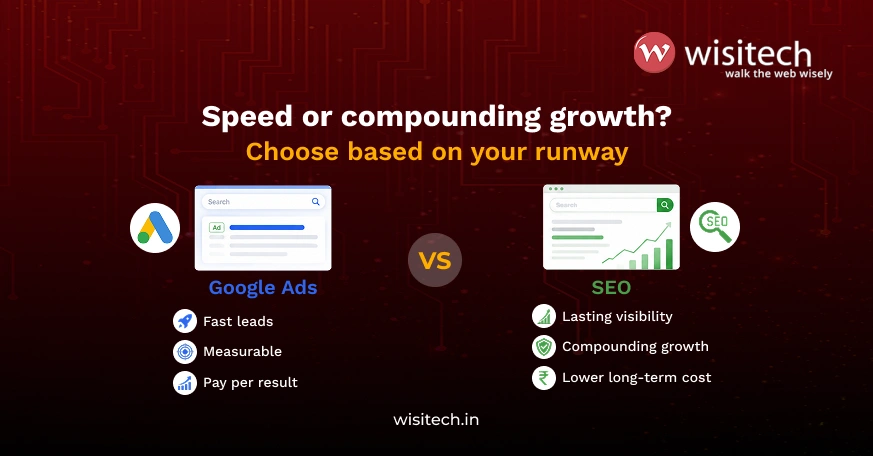
You have a marketing budget. It is not unlimited. Someone told you to invest in SEO. Someone else told you Google Ads will give you results faster. Both of them are right, which is exactly what makes the SEO vs Google Ads in India decision so frustrating.
The honest answer is that the question is not which channel is better. It is which one to fund first, given where your business is right now, what your revenue timeline looks like, and whether you can afford to wait six months for organic results or need leads by next Tuesday.
This guide gives you that answer with real INR cost benchmarks, a head-to-head comparison across the parameters that actually matter, and a decision framework by business type. No dollar-converted figures. No generic advice that applies equally to a Mumbai D2C brand and a Jaipur law firm.
What is SEO and how does it work in India?
SEO is the discipline of making your website appear when the right people are searching for what you sell, without paying for every click. SEO services cover the full stack: technical foundations (site speed, crawlability, Core Web Vitals), on-page content strategy, link acquisition, and structured data. The work compounds in a way that paid channels cannot: rankings built this month continue delivering traffic next year at zero incremental cost. In India, Google holds over 98% of the search market. 800 million internet users. 60%+ on mobile. SEO benefits for Indian businesses are amplified by that scale in a way that is genuinely difficult to replicate through paid channels over a 24-month horizon. A page-one ranking for a commercial keyword is not just visibility. It is a permanent asset that your competitors have to work to displace.
How long does SEO take to show results in India?
SEO in India typically shows measurable organic traffic growth in months 3 to 6 for moderate-competition keywords. Competitive commercial terms in real estate, legal services, or B2B software can take 9 to 12 months to show significant ranking movement. Technical fixes and on-page improvements often show faster gains. Month 1 is audit and foundation. Month 2 to 3 is on-page implementation, technical remediation, and content. Month 4 to 6 is when link acquisition and content depth start producing measurable traffic movement. Month 6 onwards is compounding. The reason this timeline feels slow is that SEO is building an asset, not running a tap. Once the rankings are there, they continue delivering without incremental spend per click.
What are Google Ads and how do they work?
Google Ads puts your business at the top of search results today, not in six months. You bid on keywords, pay when someone clicks, and the traffic starts immediately. Google Ads cost in India has two components that buyers frequently conflate: ad spend (what Google charges per click) and the management fee (what an agency charges to build and optimize the campaigns). Get either wrong and the economics fall apart. The trade-off is blunt: the moment you stop paying, the traffic stops. There is no compounding, no residual asset, no rankings that outlast the budget. For a business that needs customers this month, that immediacy is exactly the point. For a business thinking about where it wants to be in two years, the economics look very different.
Average Google Ads CPC by industry in India (2026)
| Industry | Avg. CPC (INR) | Min. monthly spend | Notes |
|---|---|---|---|
| D2C ecommerce | 10 – 40 | 30,000 – 60,000 | Shopping + search |
| B2B services | 80 – 300 | 60,000 – 1,00,000 | High CPC, high value |
| Real estate | 150 – 500 | 1,00,000 – 3,00,000 | Most competitive |
| Education and edtech | 40 – 150 | 50,000 – 1,50,000 | Seasonal demand |
| Healthcare | 60 – 200 | 40,000 – 80,000 | Regulated categories |
| Local services | 20 – 80 | 15,000 – 40,000 | Call extensions key |
| SaaS and B2B software | 100 – 350 | 60,000 – 1,50,000 | Low volume, high intent |
CPC figures are indicative averages as of May 2026. Actual CPC varies by Quality Score, keyword match type, location, and competition. All budget figures exclude 18% GST. The minimum daily budget on Google Ads has no technical floor. The Google Ads minimum budget in India that produces meaningful optimization data is 1,000 to 2,000 per day in ad spend, or 30,000 to 60,000 per month. Below this, campaigns cannot accumulate sufficient conversion data for automated bidding to function effectively.
SEO vs Google Ads in India: Head-to-head comparison
Put both channels on the same table and the picture becomes clear. SEO vs PPC in India looks different depending on your time horizon, risk tolerance, and revenue model. Here is the honest comparison across every parameter that actually matters:
| Parameter | SEO | Google Ads |
|---|---|---|
| Time to first results | 3 to 6 months for most keywords | Days to weeks from launch |
| Cost structure | Fixed monthly retainer, no per-click cost | Ad spend + management fee per month |
| Traffic durability | Continues after you stop investing | Stops immediately when budget stops |
| Long-term ROI | 5x to 15x over 24 to 36 months | 2x to 6x ROAS at campaign maturity |
| Click cost | Zero per click (covered by retainer) | INR 10 to 500 depending on industry |
| Control over visibility | Built through effort; algorithm-dependent | Immediate; fully controllable by budget |
| Brand trust signal | High — organic results seen as earned | Lower — users know it is an ad |
| Keyword targeting | Broad and long-tail organic reach | Exact, phrase, and broad match control |
| Best for | Long-term growth, B2B, content-driven businesses | Immediate leads, product launches, seasonal campaigns |
Cost analysis: what each channel costs Indian businesses in 2026
This is where most comparisons fall short. They show CPC ranges without showing the full cost of building organic visibility or the compounding economics of SEO over time. Here is an honest cost picture for both.
Understanding SEO vs Google Ads in India requires comparing both the upfront investment and the long-term return each channel can deliver.
What SEO actually costs at different stages
| Business type | Monthly SEO retainer (INR) | Expected outcome at 12 months | Notes |
|---|---|---|---|
| Early-stage SMB | 15,000 – 40,000 | Local visibility, initial traffic | Package model often sufficient |
| D2C ecommerce brand | 60,000 – 1,50,000 | Category page rankings, organic revenue | Custom strategy essential |
| B2B lead generation | 60,000 – 1,50,000 | Commercial keyword rankings, organic leads | Long cycle, high value |
| Mid-market, competitive niche | 1,50,000 – 3,00,000 | Top-3 rankings for priority terms | Full-stack SEO required |
| Enterprise | 3,00,000 – 6,00,000+ | Multi-region authority, organic growth | Dedicated team model |
Figures are indicative benchmarks as of May 2026. All figures exclude 18% GST.
The compounding economics of SEO vs paid ads
Here is the scenario most Indian business owners never actually model. Two businesses each spend 80,000 per month on digital marketing. Business A spends it on Google Ads. Business B spends it on SEO. After 24 months, both have invested 19.2 lakh. Business A has received traffic for exactly 24 months. In month 25, the traffic stops. Business B has organic rankings producing 500 qualified sessions per month at zero per click. That traffic continues in month 25, 26, 27, and beyond. No additional investment required. Run that math against any paid channel and the answer is the same. SEO is the only marketing investment that keeps working after you stop paying for it. That is not an argument against Google Ads. It is the reason SEO-first thinking makes sense for any Indian business with a planning horizon longer than six months.
When to choose SEO first
SEO benefits for Indian businesses compound most powerfully when the business has the runway to let organic authority build. These are the situations where SEO should be your primary investment:
- Your product or service has consistent search demand throughout the year, not just seasonal spikes.
- Your sales cycle is longer than 2 weeks and buyers research before contacting you.
- You are building a B2B brand or a content-heavy ecommerce store where trust and authority drive conversions.
- You have a 6 to 12-month runway before the organic investment needs to pay back.
- Your competitors are ranking organically for terms your buyers are searching, which means the traffic exists and you are not capturing it.
- You need a channel that works while you sleep and does not require continuous ad spend to maintain.
Industries where SEO delivers the highest long-term ROI in India
B2B services and SaaS are the strongest case for SEO vs PPC prioritization. Decision-making cycles are long, buyers research extensively before making contact, and a site that ranks for commercial-intent queries receives qualified, high-intent visitors at zero per-click cost. Ecommerce brands with large catalogs benefit enormously from category and product page SEO because the volume of rankable pages creates traffic scale that paid ads cannot match efficiently. Education and professional services in India also see compounding returns from content-led SEO because authority builds over time in ways that advertising spend cannot replicate.
When to choose Google Ads first
Google Ads vs organic traffic tips firmly toward paid when speed is the constraint. Choose Google Ads as your primary channel when:
- You need leads or sales within 30 to 60 days and cannot wait 6 months for organic results.
- You are launching a new product or entering a new market and need immediate visibility.
- Your business is seasonal and the revenue window is too short for SEO to compound.
- You are testing demand for a new offer before committing to a content program.
- Your average deal value is high enough to justify CPCs of 100 to 500 per click.
- You are running a time-sensitive campaign: a festive season sale, a product launch, or an event registration.
Industries where Google Ads delivers the best ROI in India
Real estate, local services, and high-ticket B2B services are the strongest cases for Google Ads as a primary channel. Real estate buyers in India are actively searching with high intent and a short decision window. Local service businesses, plumbers, dentists, event planners, caterers, need to appear immediately when someone searches ‘near me’. High-ticket B2B services where a single closed deal covers months of ad spend justify the CPCs that Google demands in competitive categories.
SEO vs Google Ads for ecommerce in India: What the data shows
Most articles on this topic are written for Delhi and Mumbai. The reality is that the majority of Indian businesses operate outside the four metros, and the channel economics are genuinely different there.
In Jaipur, Indore, Lucknow, Coimbatore, and Kochi, Google Ads CPCs are significantly lower than in metro markets for most categories. Less competition means your budget goes further on paid. And on the organic side, the SEO competition is thinner too, which means SEO benefits for Indian businesses in Tier 2 cities can compound faster than in Delhi or Mumbai. Fewer competitors have invested in technical SEO and content depth, so the barrier to ranking is lower.
For a Tier 2 business with a 6-month runway, the hybrid model is often the clearest answer: run Google Ads immediately for leads while building local SEO, Google Business Profile optimization, and content targeting city-specific commercial terms. Both channels are more efficient here than in metro markets. Use that advantage.
The hybrid strategy: running SEO and Google Ads together
The best answer to SEO vs Google Ads in India is not choosing one channel over the other. It is sequencing both strategically. It is a sequence. Run Google Ads for immediate lead flow in months one through six while SEO builds foundations. As organic rankings establish themselves in months six through twelve, reduce paid dependence on those terms. Reallocate the freed budget either into deeper SEO investment or into paid campaigns for keyword clusters where organic is not yet competitive.
This is not compromise. It is using each channel for what it does well. Google Ads for speed. SEO for permanence. Businesses that run both with a clear switching strategy consistently outperform those that commit to one and ignore the other, not because they spend more, but because they never have a dead month where one channel is between phases.
How SEO data improves Google Ads performance
One under-appreciated benefit of running both simultaneously: SEO keyword research tells you which organic queries produce the most qualified traffic. That intelligence directly improves paid campaign structure. Conversely, Google Ads conversion data tells you which queries convert fastest, which informs which SEO keywords to prioritize for content investment. The two channels feed each other when managed together.
Decision framework: which channel to invest in first
Use this framework to match your business situation to the right starting channel.
| Your situation | Start with | Reason | Add second channel |
|---|---|---|---|
| New business, need leads in 30 days | Google Ads | Only channel that delivers immediate visibility | SEO in month 2 |
| D2C ecommerce brand, 6-month runway | Both simultaneously | Google Shopping for immediate sales, SEO for category pages | Running from day one |
| B2B service company, long sales cycle | SEO first | Buyers research before contacting; organic trust matters | Google Ads for high-intent terms |
| Local service business, city-specific | Google Ads + Local SEO | Immediate visibility plus GBP optimization | Content SEO in month 3 |
| Seasonal business with revenue window | Google Ads | SEO cannot compound in time for seasonal peaks | SEO in off-season |
| Funded startup with 12-month runway | SEO first, Ads second | Build organic foundation while testing paid for rapid learning | Google Ads from month 2 |
| Enterprise, competitive national keyword landscape | Both, with SEO as primary | SEO builds defensible organic moat; Ads fill gaps | Full integration from launch |
SEO vs Google Ads for ecommerce in India: what the data shows
Of all the business types in India, ecommerce has the clearest answer of any business type. Not because one channel is better, but because both are essential at different stages of the funnel. Google Shopping Ads capture buyers who are searching with intent right now. Professional SEO services build category and product page authority that delivers organic traffic at zero per-click cost over 12 to 24 months. Here is what the pattern looks like for Indian ecommerce brands that get this right: Google Shopping and search campaigns launch on day one for immediate revenue. Technical SEO, product page optimization, and category content run in parallel from month one. By month 12, organic traffic covers a meaningful share of orders. By month 18 to 24, organic produces 30 to 50% of revenue with no incremental ad spend attached to it. The brands that delay SEO investment end up permanently dependent on paid traffic as CPCs rise every year. The ones that start early build a channel that gets cheaper over time.
Which channel should your business invest in first? Wisitech can help you decide.
Wisitech has been running custom SEO services and Google Ads management for Indian businesses for over 27 years. 2,500+ projects. Clients across ecommerce, B2B, education, and enterprise verticals. We are a certified Google Partner. Our search engine optimization services start from 80,000 per month and are built around full-stack execution: technical SEO, content strategy, white-hat link acquisition, and reporting against commercial KPIs, not just keyword rankings. Our Google Ads programs are managed around ROAS and pipeline, not impressions. We own the development stack, so technical fixes on either channel ship without waiting for a separate team. If you are making the SEO vs Google Ads decision for your business and want a direct recommendation based on your category, budget, and timeline, get in touch with us. We will tell you which channel makes sense at your current stage and what a realistic program looks like for your specific situation. 27 years. 2,500+ projects. Fortune 500 experience. Creativity leads, AI amplifies.