

Hiring a digital marketing agency is exciting. It often comes after months of frustration with stagnant traffic, inconsistent lead generation, underperforming campaigns, or a marketing strategy that never seems to move beyond ideas.
Yet one of the biggest challenges businesses face after signing with an agency is expectation management.
Many founders expect immediate rankings from SEO, instant leads from content, or dramatic revenue growth within a few weeks. The reality is more nuanced. Different marketing channels operate on different timelines, and the first 90 days are typically focused on building a foundation that can generate sustainable results over time.
For growth-focused businesses, especially those investing in SEO services, paid advertising, content marketing, or Local SEO, understanding what should happen during those first three months helps create healthier agency relationships and more realistic performance expectations.
What should happen in the first 90 days with a digital marketing agency in India?
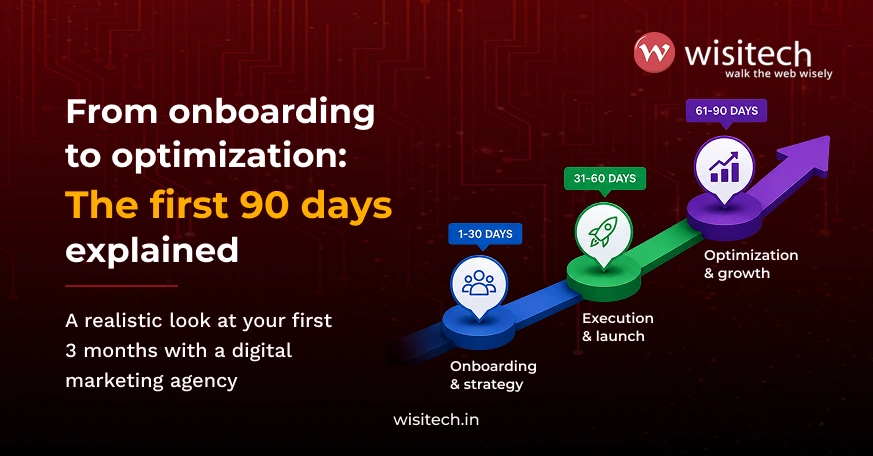
The first 90 days with a digital marketing agency should focus on three stages:
- Discovery and strategy
- Execution and launch
- Optimization and performance analysis
The goal is not immediate transformation. The goal is building the systems, campaigns, content, and data foundation needed for long-term growth.
Days 1-30: Discovery, audits, and strategy development
The first month is often the least exciting from a visible-results perspective, but it is usually the most important.
A good agency will spend this period understanding your business before making recommendations.
What your agency should be doing (H3)
During this phase, the agency typically:
- Reviews your website
- Analyzes competitors
- Audits current marketing channels
- Evaluates SEO performance
- Reviews historical campaign data
- Identifies technical issues
- Defines KPIs and reporting metrics
- Builds a 90-day action plan
If you’re investing in SEO services for small business, keyword research and content planning should begin during this stage.
For businesses working with a Google Ads management company, account audits, audience analysis, conversion tracking setup, and campaign planning are usually completed during this period.
What you should be doing (H3)
The first month requires active participation from the client.
You should be prepared to provide:
- Access to analytics platforms
- CRM access
- Historical marketing data
- Customer insights
- Sales process information
- Competitor information
Many marketing projects slow down because agencies spend weeks waiting for approvals and access.
Days 31-60: Campaign execution begins (H2)
This is where businesses start seeing visible activity.
The strategy phase transitions into implementation.
SEO and content marketing activities (H3)
For businesses investing in SEO services, agencies typically begin:
- Technical SEO fixes
- Content planning
- On-page optimization
- Internal linking improvements
- Local SEO enhancements
- Content creation
Businesses using content marketing agency services often see the first wave of blog content, landing pages, thought leadership articles, and website copy updates during this phase.
For B2B companies, this stage is particularly important because quality content supports SEO, credibility, and lead nurturing simultaneously.
Unlike low-cost content providers, experienced agencies focus on creating content aligned with business objectives rather than publishing articles simply to meet quotas.
Google Ads launch and optimization
Businesses working with a Google Ads management company or investing in pay per click management services will typically see campaigns go live during this period.
However, this is still a learning phase.
Campaigns require:
- Audience testing
- Keyword refinement
- Ad copy testing
- Conversion tracking validation
- Budget allocation adjustments
Initial performance data often reveals opportunities that were not visible during planning.
Local SEO and GBP optimization
Businesses targeting local customers should see activity around:
- Google Business Profile optimization
- Citation cleanup
- Review generation strategies
- Local keyword targeting
- Local landing page improvements
For many service-based businesses, Local SEO often produces some of the earliest visibility improvements.
Days 61-90: Optimization and performance evaluation
The third month is where meaningful insights begin to emerge.
This is the point where enough data exists to make informed decisions.
What agencies should be analyzing
Your agency should now be reviewing:
- Traffic trends
- Lead quality
- Conversion rates
- Keyword movement
- Campaign performance
- Content engagement
- Cost per lead
- Return on ad spend
This is also where strategy refinement becomes important.
Good agencies do not simply launch campaigns and walk away. They continuously optimize based on performance data.
Channel-by-channel timeline expectations
One of the biggest mistakes businesses make is expecting every marketing channel to produce results at the same speed.
| Marketing Channel | Time to First Signals | Time to Meaningful Results |
|---|---|---|
| Google Ads | 2-4 weeks | 60-90 days |
| Local SEO & GBP | 4-8 weeks | 3-5 months |
| SEO Services | 3-4 months | 6-12 months |
| Content Marketing | 2-3 months | 4-6 months |
| Email Marketing | Immediate | 1-3 months |
This timeline shows how different services offered by a digital marketing agency produce results at different speeds, helping businesses set realistic expectations for growth.
Businesses should understand that SEO and content are long-term assets, while paid advertising typically generates faster feedback.
What should a digital marketing agency deliver by day 90?
By the end of the first 90 days, you may not have achieved peak ROI yet.
However, you should have:
- A documented marketing strategy
- Clearly defined KPIs
- Active campaigns
- Published content
- Keyword tracking systems
- Reporting dashboards
- Performance data
- An optimization roadmap
For businesses investing in content writing services, there should also be a clear content pipeline aligned with search intent, audience needs, and business objectives.
Questions to ask your agency at 30, 60, and 90 days
At 30 days:
- What did the audits reveal?
- What opportunities were identified?
- What priorities are being addressed first?
At 60 days:
- Which campaigns are live?
- What early patterns are emerging?
- What adjustments are being made?
At 90 days:
- What is performing best?
- What needs improvement?
- What should the next quarter focus on?
These conversations help keep both sides aligned around outcomes rather than assumptions.
What businesses often misunderstand about agency results
Many businesses evaluate agencies too early.
A company may spend years building marketing problems but expect solutions within a few weeks.
The strongest agency relationships are built around transparency, communication, and realistic timelines.
The first 90 days should be viewed as the foundation-building phase. The systems established during this period often determine whether marketing becomes a predictable growth engine or remains a series of disconnected tactics.
What businesses often misunderstand about agency results
The first 90 days with a digital marketing agency are not about overnight success. They are about creating the strategy, infrastructure, campaigns, and optimization processes needed for sustainable growth.
Whether you’re investing in SEO services for small business, pay per click management services, content marketing agency services, Local SEO, or broader digital marketing initiatives, understanding the timeline helps you evaluate progress more accurately.
Not sure what results you should realistically expect in your first 90 days? Get your 90-day growth outlook, and we’ll outline which channels are likely to produce the earliest signals and which ones require a longer investment timeline.
Disclaimer: The timelines, deliverables, and performance expectations discussed in this article are general guidelines intended for informational purposes only. Actual results may vary based on industry competitiveness, website condition, budget, target audience, campaign scope, market conditions, and business objectives. SEO, content marketing, paid advertising, and Local SEO all operate on different timelines, and no reputable agency can guarantee specific rankings, traffic levels, or revenue outcomes within a fixed period.