

Your store is live. Traffic is coming in. Ads are running. And still, conversions are underwhelming, checkout is leaking, and your team is spending more time managing platform workarounds than actually growing the business.
If that sounds familiar, the problem is rarely the product. More often, it is the ecommerce infrastructure underneath it.
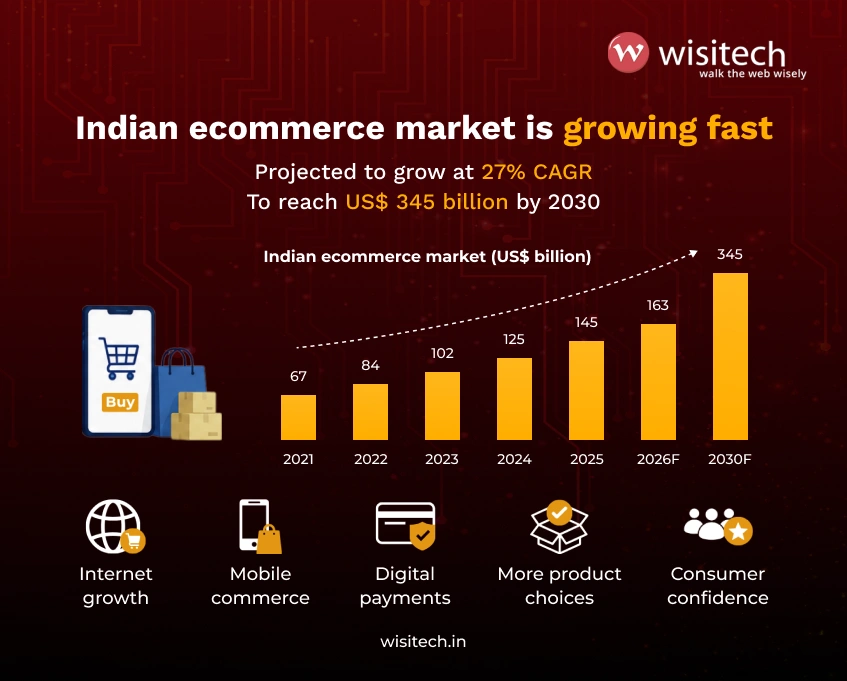
Ecommerce website development cost is no longer a one-time setup number. It is an ongoing business decision, and in a market growing as fast as India’s, getting it wrong is an expensive mistake. According to the Indian Brand Equity Foundation (IBEF), Indian ecommerce is expected to grow at a CAGR of 27% to reach USD 163 billion by 2026. The opportunity is real. But the investment needs to be matched to the stage you are actually at, not the stage you were at when you launched your first store.
This guide gives you verified pricing, platform comparisons, and the questions to ask before you spend a rupee.
What does ecommerce website development cost in India in 2026?
The honest answer is that the range is wide because the scope is wide.
An ecommerce website in India in 2026 typically costs anywhere between ₹4,90,000 and ₹25,00,000 or more, depending on the platform chosen, level of customization, and business complexity.
Here is how that range breaks down by business type:
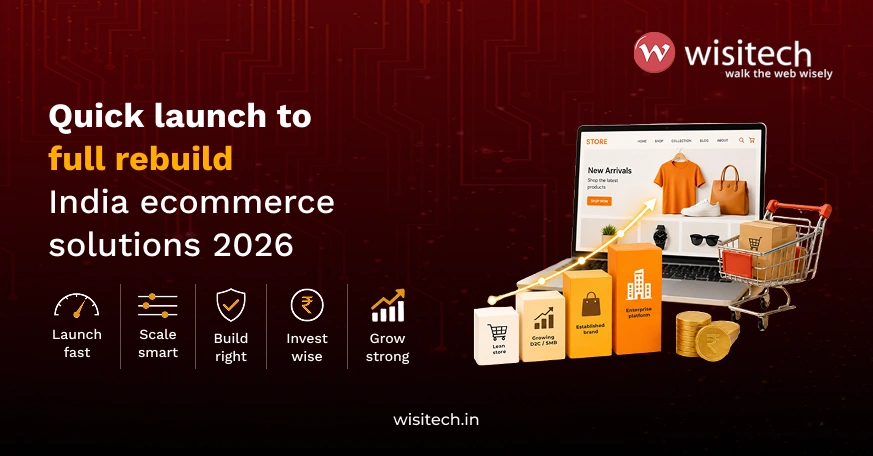
| Business Stage | Typical Cost Range | Platform Fit |
|---|---|---|
| Early-stage/Lean Store | ₹4,90,000 – ₹5,10,000 | Shopify Basic, WooCommerce template |
| Growing D2C/SMB | ₹24,90,000 – ₹25,10,000 | Shopify Plus, custom WooCommerce |
| Established Brand/Multi-category | ₹24,90,000 – ₹25,10,000 | Custom WooCommerce, Magento |
| Enterprise/B2B/Marketplace | ₹24,90,000 – ₹25,10,000 | Custom stack, headless commerce |
Estimated ecommerce website development costs in India by business stage, helping businesses choose the right platform and investment level for their growth goals.
Ecommerce website development cost in India by business stage, from lean store to enterprise platform (2026 benchmarks)
The problem most growth-stage operators run into is not the build cost. It is building for the wrong tier. A brand doing ₹5 crore annually on a ₹50,000 Shopify template is not saving money. It is leaving conversion on the table and creating technical debt that costs more to fix than it would have cost to build correctly the first time.
Platform-by-platform cost breakdown
Shopify
Shopify is the fastest path to launch for D2C brands and SMBs that want a managed environment. The real cost is not the development. It is the accumulation of app subscriptions: reviews, loyalty programs, advanced filtering, upsell tools, and email automation. Shopify works well as long as your business model fits within its framework. When it does not, you hit walls: limited checkout customization, weak B2B logic, restricted backend integrations. That is when businesses outgrow it. For Indian brands scaling past ₹2 crore in annual revenue, the subscription costs and app dependencies on Shopify often make a custom WooCommerce build more cost-efficient over a 24-month horizon. Working with an experienced ecommerce website development company at this stage ensures you are building for where the business is going, not where it is today.
WooCommerce
WooCommerce is the preferred platform for brands that want cost-controlled growth with strong SEO capability and full flexibility.
The trade-off is technical overhead. WooCommerce requires active hosting management, plugin maintenance, and performance optimization. A poorly configured WooCommerce store can be slower and more prone to downtime than a comparably scoped Shopify store. The platform rewards businesses that have a technically capable partner managing it.
For Indian SMBs already running WordPress for content marketing, WooCommerce eliminates the need for a separate CMS, keeping your SEO authority and your product catalog on one domain. However, if your store will carry more than 1,000 SKUs at launch, invest in a staging environment and proper caching setup from day one. The performance gap between a well-configured and a poorly-configured WooCommerce store is significant, and it compounds at scale.
Magento
Magento is built for large catalogs, complex business logic, and enterprise operations. For most Indian SMBs and D2C brands currently operating in the ₹1 crore to ₹30 crore revenue range, Magento is usually more platform than required. It is the right choice when you are managing thousands of SKUs, multiple warehouses, or complex B2B pricing tiers.
Magento’s strength is its ability to handle catalog complexity and multi-store configurations that would require extensive plugin workarounds on Shopify or WooCommerce. The trade-off is a higher implementation cost and a steeper learning curve for your internal team. Before committing to Magento, engage in ecommerce consulting services to assess whether your catalog and operational complexity genuinely requires it, or whether a well-architected custom WooCommerce build would serve you better at a lower total cost of ownership.
Custom development
Enterprise-grade custom ecommerce platforms and SaaS commerce systems built on custom stacks in India typically cost ₹5,00,000 to ₹25,00,000 or more, and are best suited for businesses with unique workflows that standard platforms cannot support.
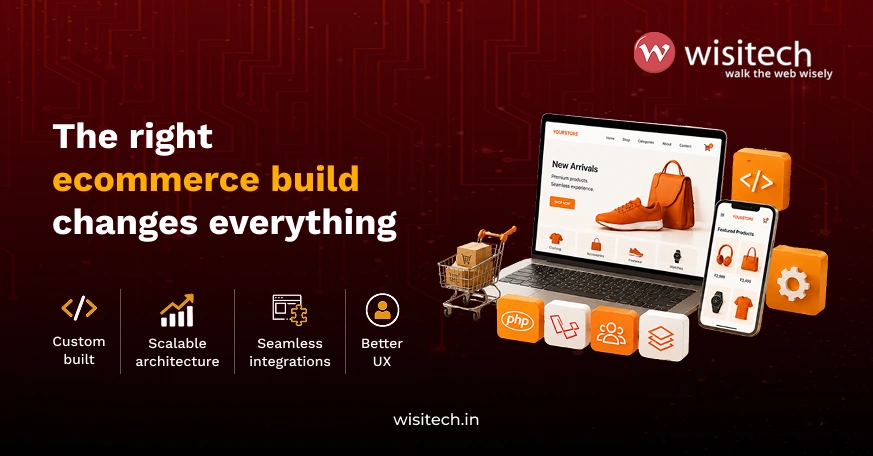
As a full-service ecommerce development company, Wisitech builds custom platforms on PHP, Laravel, and React for businesses that need logic-heavy, integration-driven commerce systems. This includes multi-vendor marketplaces, B2B dealer portals, and headless commerce architectures. If you are evaluating whether your business needs a custom build or a well-configured platform, speak to our team here.
Mobile performance is not optional
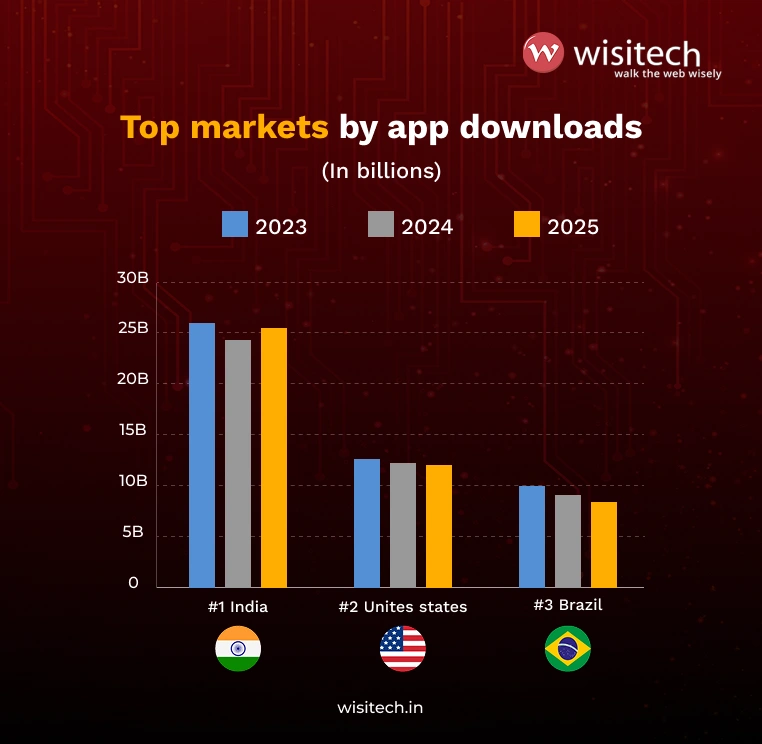
Flipkart and Amazon India have both reported that majority of their total platform traffic comes from mobile apps. Shopping app downloads in India hit 25.5 billion in 2025.
This matters for your development brief. A store that loads in 4 seconds on desktop but takes 7 seconds on a mid-range Android device is not a mobile-optimized store. It is a desktop-first store with a responsive skin. The difference in conversion rates between a genuinely mobile-optimized checkout and a responsive template is measurable, and it is significant.
Any ecommerce web development company you evaluate should be able to show you Lighthouse scores and Core Web Vitals benchmarks for live stores they have built, not just design mockups.
The B2B ecommerce case
B2B ecommerce in India is underbuilt relative to the opportunity. Most industrial, distribution, and wholesale businesses are still running dealer orders over WhatsApp. According to IBEF, India’s B2B online marketplace represents a USD 200 billion opportunity by 2030.
A properly built B2B portal requires role-based access, custom pricing logic, bulk order workflows, credit management, and ERP integration. This is not a WooCommerce template project. Our web portal development services cover this scope end-to-end, from architecture to deployment, for manufacturers, distributors, and service businesses moving their dealer networks online.
For businesses in this category, custom ecommerce development is not a premium. It is the only path to a system that actually mirrors how B2B transactions work.
Hidden costs most buyers discover post-launch
Ongoing monthly ecommerce website costs in India typically cover hosting, security updates, content management, and monitoring, excluding marketing spend.
Beyond monthly maintenance, budget separately for:
- Annual hosting renewal and scaling costs
- Platform subscription increases (Shopify raises plan prices periodically)
- SSL and security compliance
- Post-launch bug fixes outside the warranty window
- GST at 18% on development invoices
Ask any vendor to give you a 12-month total cost of ownership estimate, not just the development quote. The two numbers are rarely the same.
Freelancer vs agency: The practical decision
For stores doing meaningful revenue, a freelancer arrangement for a rebuild creates the same structural risks as the original cheap build. Code ownership ambiguity, no QA process, no post-launch accountability, and no capacity to scale the engagement as the project grows.
The right question is not “freelancer or agency?” The right question is: “Do I need a vendor or a development partner?” The answer to that determines which type of engagement actually fits your business.
Wisitech operates as an ecommerce development agency for D2C brands, funded startups, and established businesses that are rebuilding for growth, not just replacing what is broken. Our engagements cover platform selection, UX architecture, development, integration, QA, and post-launch support. Contact us to discuss your ecommerce build or rebuild.
Why your ecommerce website development cost decision matters more than the number itself
Getting your ecommerce website development cost right from the start is the difference between a store that scales and one that creates debt. Whether you are launching lean on WooCommerce, growing on Shopify, or rebuilding for enterprise on a custom stack, the platform decision, feature budget, and development partner you choose will shape your business outcomes for the next three to five years. Do not let a low initial quote mask a high total cost of ownership.
Wisitech offers ecommerce consulting services to help Indian businesses at every stage make that decision with full information. Tell us your current platform, monthly revenue, and the three biggest operational bottlenecks you are hitting, and we will tell you exactly what kind of build you need.
Disclaimer: Prices stated in this article are indicative benchmarks, sourced from published Indian development agency benchmarks and market data. Actual development costs vary based on scope, feature complexity, platform choice, agency tier, and geographic location within India. Costs for third-party tools, app subscriptions, payment gateway setup, and ongoing maintenance are separate from the development quotes cited. This blog is intended for general guidance only and does not constitute a formal project estimate or commercial proposal.